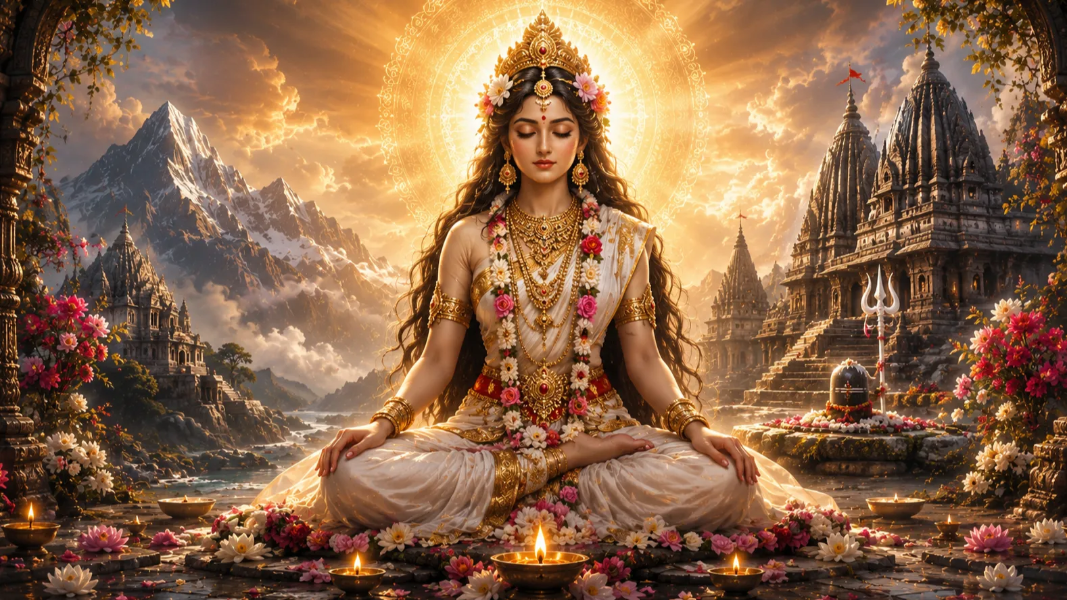
In Indian culture and आध्यात्मिकता, Shaktipeeths hold a unique and immensely sacred place. These are the divine sites where the various body parts of Adi Shakti Goddess Sati fell when Lord Shiva was carrying her on his shoulders, performing the fierce Tandava dance. These 51 Shaktipeeths are spread not only in India but also in neighboring countries, and each Shaktipeeth is a center of deep faith, devotion, and spiritual energy for devotees.
Visiting, having darshan (sacred viewing), and performing spiritual practices at these holy places allows devotees to experience the immense grace and power of the Goddess. Let us embark on this spiritual journey and delve into the origin, mythological story, significance, and all the sacred places where Goddess Sati's body parts fell, regarding these divine 51 Shaktipeeths.
Mythological Story: Daksha Yajna and Goddess Sati's Self-Immolation
The secret of the origin of Shaktipeeths is hidden in a heartbreaking mythological story, which is the tale of the deep love between Lord Shiva and Goddess Sati, the ego of Prajapati Daksha, and ultimately, the Goddess's self-immolation.
Prajapati Daksha's Ego
According to mythology, Prajapati Daksha was the son of Brahma and an extremely powerful and arrogant king. His daughter, Sati, married Lord Shiva of her own will, which Daksha never approved of. Daksha did not consider Shiva to be his equal, seeing him as a dweller of cremation grounds and lord of ghosts and spirits. For this reason, he always harbored feelings of malice and disdain towards Shiva.
Organization of a Grand Yajna
Once, Prajapati Daksha organized a grand yajna named 'Brihaspatisava'. He invited Brahma, Vishnu, Indra, and all the deities, sages, and hermits, but deliberately did not send an invitation to his daughter Sati and son-in-law Lord Shiva. His intention was to insult Shiva.
Sati's Anxiety and Shiva's Warning
When Goddess Sati saw that all the deities and her relatives were going to her father's yajna, she also expressed a desire to go there. Lord Shiva explained to her that it is not proper to go to someone's house without an invitation, especially to the house of someone who holds animosity towards us. He also told Sati about Daksha's ego and his contempt for Shiva. But Sati was extremely eager to go to her father's house, as she wished to meet her sisters, sisters-in-law, and relatives. Shiva finally granted her permission to go, but with a heavy heart.
Insult at the Yajna and Self-Immolation
When Sati reached Daksha's yajna site, no one greeted her properly. Daksha openly insulted Shiva in front of everyone and spoke ill of him. Hearing the insult to her husband, Sati was deeply pained. She was extremely hurt and enraged by her father's behavior. She felt that there was no place for Shiva in her father's yajna, and it was better to give up her body than to be called the daughter of such a father.
As this thought arose, Goddess Sati immersed herself in the fire of that very yajna and gave up her life. She used her yogic power to incinerate her body, so that her father's yajna would not be defiled by her impure body.
Shiva's Fierce Form and Tandava
When the news of Sati's self-immolation reached Lord Shiva, he was consumed by rage. His fury shook the entire universe. From his matted hair, he created Virabhadra and Mahakali, who devastated Daksha's yajna and severed Daksha's head from his body.
After this, Lord Shiva lifted Sati's burnt body onto his shoulders and began performing the 'Tandava' dance throughout the universe. His anger was so intense that if he had continued to dance in this manner, the destruction of creation was certain. The gods prayed to Lord Vishnu to calm Shiva.
Vishnu's Sudarshan Chakra and the Origin of Shaktipeeths
Lord Vishnu used his Sudarshan Chakra to break Shiva's delusion and save creation. He cut Sati's body into 51 pieces. The places where these pieces fell came to be known as Shaktipeeths. At each of these places, a part or ornament of Goddess Sati fell, and along with Shakti, Bhairava (a form of Lord Shiva) also became enshrined. Thus, these 51 Shaktipeeths were established in various corners of creation, which today remain supreme holy pilgrimage sites for devotees.
Significance of Shaktipeeths: Why are These Sacred Places So Special?
The significance of Shaktipeeths is not limited to mythological stories, but they are also extremely important from a spiritual, cultural, and historical perspective.
- Center of Divine Feminine Power: These places are dedicated to Adi Shakti, the various forms of Goddess Durga. Here, devotees experience different aspects of feminine power – creation, sustenance, and destruction. By visiting these Peeths, devotees feel connected to the Goddess's power, which gives them inner strength and energy.
- Fulfillment of Desires and Moksha: It is believed that worship and spiritual practices performed with true devotion and faith at these sacred sites fulfill all the desires of devotees. Many devotees undertake pilgrimages to these Peeths for the attainment of liberation (moksha) and spiritual advancement.
- Freedom from Sins: Bathing and having darshan at Shaktipeeths help devotees to be freed from all their known and unknown sins, inspiring them to live a pure life.
- Sadhana and Siddhi: These places are also considered extremely important for Tantric and Yogic practices. Many accomplished practitioners and yogis attain Siddhis (spiritual powers) by meditating at these Peeths.
- Cultural and Historical Heritage: Shaktipeeths are centuries-old temples that present wonderful examples of Indian architecture, sculpture, and art. These places are living proofs of Indian culture and traditions, where customs and festivals of various regions are celebrated.
- Presence of Bhairava: At each Shaktipeeth, along with Shakti, her protector Bhairava is also present, who provides security to devotees and makes their journey successful.
Detailed List of 51 Shaktipeeths: Where Goddess Sati's Body Parts Fell and Current Location
Here is a detailed list of the 51 Shaktipeeths, mentioning the body part of Goddess Sati that fell at each place and its current location:
- Hinglaj Shaktipeeth:
- Fallen body part: Brahmarandhra (upper part of the head)
- Current location: On the banks of Hingol River, Balochistan, Pakistan.
- Name of Shakti: Kottari / Kottavi. Bhairava: Bhimlochan.
- Sharkarre Shaktipeeth:
- Fallen body part: Eyes
- Current location: Near Karachi, Sukkur, Pakistan.
- Name of Shakti: Mahishasuramardini. Bhairava: Krodhesh.
- Sugandha Shaktipeeth:
- Fallen body part: Nose
- Current location: Shikarpur, Barisal, Bangladesh.
- Name of Shakti: Sunanda. Bhairava: Tryambak.
- Kashmir Shaktipeeth (Amarnath):
- Fallen body part: Throat (neck)
- Current location: Amarnath Cave, Jammu and Kashmir, India.
- Name of Shakti: Mahamaya. Bhairava: Trisandhyeshwar.
- Jwalaji Shaktipeeth:
- Fallen body part: Tongue
- Current location: Kangra, Himachal Pradesh, India.
- Name of Shakti: Siddhida (Ambika). Bhairava: Unmatta.
- Tripurmalini Shaktipeeth:
- Fallen body part: Left breast
- Current location: Jalandhar Cantonment, Punjab, India.
- Name of Shakti: Tripurmalini. Bhairava: Bhishan.
- Ambika Shaktipeeth:
- Fallen body part: Left breast
- Current location: Bharatpur, Rajasthan, India. (This Shaktipeeth is not listed separately in some lists, but falls under others.)
- Name of Shakti: Ambika. Bhairava: Amritesh.
- Bhramari Shaktipeeth:
- Fallen body part: Left bangle
- Current location: Bilaspur, Himachal Pradesh, India. (Also known as Naina Devi Temple)
- Name of Shakti: Mahishamardini (Naina Devi). Bhairava: Kapalbairav.
- Virata Shaktipeeth:
- Fallen body part: Right foot thumb (big toe of the right foot)
- Current location: Virat, Rajasthan, India.
- Name of Shakti: Ambika. Bhairava: Amrit.
- Kali Shaktipeeth (Kalighat):
- Fallen body part: Right foot thumb (big toe of the right foot)
- Current location: Kalighat, Kolkata, West Bengal, India.
- Name of Shakti: Kalika. Bhairava: Nakulish.
- Yugadya Shaktipeeth:
- Fallen body part: Right foot thumb (big toe of the right foot)
- Current location: Khirgram, Purba Bardhaman, West Bengal, India.
- Name of Shakti: Bhuteshwari. Bhairava: Khirakantak.
- Bahula Shaktipeeth:
- Fallen body part: Left arm (left hand)
- Current location: Bardhaman, Purba Bardhaman, West Bengal, India.
- Name of Shakti: Bahula. Bhairava: Bhiruk.
- Ugratara Shaktipeeth:
- Fallen body part: Right foot thumb (big toe of the right foot)
- Current location: Tarapith, Birbhum, West Bengal, India.
- Name of Shakti: Ugratara. Bhairava: Batuk.
- Chhinnamastika Shaktipeeth:
- Fallen body part: Skeleton
- Current location: Rajrappa, Ramgarh, Jharkhand, India.
- Name of Shakti: Chhinnamastika. Bhairava: Shiva.
- Rajrappa Shaktipeeth:
- Fallen body part: Bangle
- Current location: Rajrappa, Ramgarh, Jharkhand, India. (Near Chhinnamastika)
- Name of Shakti: Chhinnamastika. Bhairava: Shiva.
- Kamakhya Shaktipeeth:
- Fallen body part: Yoni
- Current location: Nilachal Hill, Guwahati, Assam, India.
- Name of Shakti: Kamakhya. Bhairava: Umanand.
- Prayag Shaktipeeth:
- Fallen body part: Finger of the hand
- Current location: Allahabad (Prayagraj), Uttar Pradesh, India.
- Name of Shakti: Lalita. Bhairava: Bhava.
- Vindhyavasini Shaktipeeth:
- Fallen body part: Left thumb (big toe of the left foot)
- Current location: Mirzapur, Uttar Pradesh, India.
- Name of Shakti: Vindhyavasini. Bhairava: Bhairava.
- Manas Shaktipeeth:
- Fallen body part: Right hand
- Current location: Near Mansarovar Lake, Tibet, China.
- Name of Shakti: Dakshayani. Bhairava: Amar.
- Lanka Shaktipeeth:
- Fallen body part: Anklet
- Current location: Trincomalee, Sri Lanka.
- Name of Shakti: Indrakshi. Bhairava: Rakshaseshwar.
- Ratnavali Shaktipeeth:
- Fallen body part: Right shoulder
- Current location: Hooghly, West Bengal, India.
- Name of Shakti: Kumari. Bhairava: Shiva.
- Mithila Shaktipeeth:
- Fallen body part: Left shoulder
- Current location: Janakpur, Nepal / Border of Madhubani, Bihar.
- Name of Shakti: Uma/Mahadevi. Bhairava: Mahodar.
- Kartoyatat Shaktipeeth:
- Fallen body part: Left foot
- Current location: Bhabanipur, Bogra, Bangladesh.
- Name of Shakti: Arpana. Bhairava: Vaman.
- Shrishail Shaktipeeth:
- Fallen body part: Neck
- Current location: Sylhet, Bangladesh.
- Name of Shakti: Mahalakshmi. Bhairava: Sambaranand.
- Devgarbha Shaktipeeth:
- Fallen body part: Left shoulder
- Current location: On the banks of Kopai River, Bolpur, West Bengal, India.
- Name of Shakti: Devgarbha. Bhairava: Rakta.
- Kalamadhava Shaktipeeth:
- Fallen body part: Left buttock (left hip)
- Current location: Amarkantak, Madhya Pradesh, India.
- Name of Shakti: Kali. Bhairava: Asitang.
- Shonadesh Shaktipeeth:
- Fallen body part: Right buttock (right hip)
- Current location: Amarkantak, Madhya Pradesh, India.
- Name of Shakti: Narmada. Bhairava: Bhadrasen.
- Ramgiri Shaktipeeth:
- Fallen body part: Chest
- Current location: Chitrakoot, Madhya Pradesh, India.
- Name of Shakti: Shivani. Bhairava: Chand.
- Ujjaini Shaktipeeth:
- Fallen body part: Upper lip
- Current location: Ujjain, Madhya Pradesh, India.
- Name of Shakti: Mahakali. Bhairava: Lambkarna.
- Dandeswari Shaktipeeth:
- Fallen body part: Right arm (right hand)
- Current location: Panchavati, Nashik, Maharashtra, India.
- Name of Shakti: Bhramari. Bhairava: Vikrant.
- Kolhapur Shaktipeeth:
- Fallen body part: Three eyes
- Current location: Kolhapur, Maharashtra, India.
- Name of Shakti: Mahalakshmi. Bhairava: Krodhish.
- Mahishasuramardini Shaktipeeth:
- Fallen body part: Shoulder
- Current location: Chitradurga, Karnataka, India.
- Name of Shakti: Mahishasuramardini. Bhairava: Vakratunda.
- Gokarna Shaktipeeth:
- Fallen body part: Right ear
- Current location: Gokarna, Uttara Kannada, Karnataka, India.
- Name of Shakti: Jayadurga. Bhairava: Bhairava.
- Sarvashail Shaktipeeth:
- Fallen body part: Right cheek
- Current location: On the banks of Godavari River, Rajamahendravaram, Andhra Pradesh, India.
- Name of Shakti: Rakini/Vishweswari. Bhairava: Vatsanabh.
- Nayanayogini Shaktipeeth:
- Fallen body part: Right eye
- Current location: Srikalahasti, Chittoor, Andhra Pradesh, India.
- Name of Shakti: Mahotsaha. Bhairava: Bhairava.
- Srihat Shaktipeeth:
- Fallen body part: Right ear
- Current location: North Sylhet, Bangladesh.
- Name of Shakti: Mahalakshmi. Bhairava: Kapilambar.
- Vibhuti Shaktipeeth:
- Fallen body part: Right foot
- Current location: Jalpaiguri, West Bengal, India.
- Name of Shakti: Bhramari. Bhairava: Sarvanand.
- Kanyashram Shaktipeeth:
- Fallen body part: Back
- Current location: Kanyakumari, Tamil Nadu, India.
- Name of Shakti: Sarvani. Bhairava: Nimish.
- Panchsagar Shaktipeeth:
- Fallen body part: Lower teeth
- Current location: Varanasi (Kashi), Uttar Pradesh, India.
- Name of Shakti: Varahi. Bhairava: Maheshwar.
- Ambika Shaktipeeth:
- Fallen body part: Toes of the left foot
- Current location: Palanpur, Gujarat, India.
- Name of Shakti: Ambika. Bhairava: Amritesh.
- Kamari Shaktipeeth:
- Fallen body part: Right foot
- Current location: Mathura, Uttar Pradesh, India.
- Name of Shakti: Uma. Bhairava: Bhutesh.
- Attahas Shaktipeeth:
- Fallen body part: Lower lip
- Current location: Labhpur, Birbhum, West Bengal, India.
- Name of Shakti: Phullara. Bhairava: Vishwesh.
- Vakreshwar Shaktipeeth:
- Fallen body part: Mind
- Current location: Vakreshwar, Birbhum, West Bengal, India.
- Name of Shakti: Mahishasuramardini. Bhairava: Vakranath.
- Jalpaiguri Shaktipeeth:
- Fallen body part: Right foot
- Current location: Jalpaiguri, West Bengal, India. (Here, the Goddess is worshipped in her Tridha form)
- Name of Shakti: Bhramari. Bhairava: Sarvanand.
- Khirgram Shaktipeeth:
- Fallen body part: Big toe of the right foot
- Current location: Khirgram, Purba Bardhaman, West Bengal, India.
- Name of Shakti: Yugadya. Bhairava: Khirakantak.
- Kirit Shaktipeeth:
- Fallen body part: Crown
- Current location: Kiritkona, Murshidabad, West Bengal, India.
- Name of Shakti: Vimala. Bhairava: Samvart.
- Nalhati Shaktipeeth:
- Fallen body part: Nose
- Current location: Nalhati, Birbhum, West Bengal, India.
- Name of Shakti: Kalika. Bhairava: Yogesh.
- Vajreshwari Shaktipeeth:
- Fallen body part: Right foot
- Current location: Pune, Maharashtra, India.
- Name of Shakti: Vajreshwari. Bhairava: Kapal.
- Prabhas Shaktipeeth:
- Fallen body part: Stomach
- Current location: Prabhas Patan, Junagadh, Gujarat, India.
- Name of Shakti: Chandrabhaga. Bhairava: Vakratunda.
- Janakpur Shaktipeeth:
- Fallen body part: Left wrist
- Current location: Janakpur, Nepal.
- Name of Shakti: Uma/Mahadevi. Bhairava: Mahodar.
- Patan Shaktipeeth:
- Fallen body part: Left arm (left hand)
- Current location: Patan, Gujarat, India.
- Name of Shakti: Bhagwati. Bhairava: Siddhnath.
The Glory of Some Prominent Shaktipeeths
Although all Shaktipeeths are equally important and revered, some have particularly widespread fame and influence.
1. Kamakhya Shaktipeeth, Assam
Located on Nilachal Hill in Guwahati, Assam, Kamakhya Shaktipeeth is one of the most important and famous Shaktipeeths. Here, Goddess Sati's yoni fell. This is the only temple where there is no idol of the Goddess, but a naturally formed yoni-shaped stone from which water flows continuously. This place is considered the largest center for Tantric practices. Every year, the Ambubachi Mela is held here, when it is believed that the Goddess undergoes menstruation, and the temple remains closed during this period. The form of Shakti here is 'Kamakhya' and Bhairava is 'Umanand'.
2. Kalighat Shaktipeeth, Kolkata
Kalighat, located in Kolkata, West Bengal, is the sacred place where the big toe of Goddess Sati's right foot fell. This temple is dedicated to the fierce and powerful form of Goddess Kali. The presiding deity here is 'Kalika' and Bhairava is 'Nakulish'. This temple is known for its exquisite architecture and deep spiritual energy. Millions of devotees come here to seek the Goddess's darshan and blessings.
3. Jwalaji Shaktipeeth, Himachal Pradesh
Located in the Kangra district of Himachal Pradesh, Jwalaji Shaktipeeth is a unique and miraculous place. Here, Goddess Sati's tongue fell. There is no idol in this temple, but rather nine flames that naturally ignite from the earth and have been burning for centuries. These nine flames represent the nine forms of the Goddess. The Shakti here is 'Siddhida' or 'Ambika' and Bhairava is 'Unmatta'. This place provides an amazing and miraculous experience for devotees.
4. Vaishno Devi Shaktipeeth, Jammu and Kashmir (Amarnath)
This does not directly appear in the traditional list of 51 Shaktipeeths, but its glory and significance are no less than that of any Shaktipeeth. However, the Amarnath Shaktipeeth, where Sati's throat fell, is in this region. Located on Trikuta Mountain in Katra, Jammu and Kashmir, the Shri Mata Vaishno Devi temple is a center of faith for millions of devotees. Here, the three forms of Maa Durga – Mahakali, Mahalakshmi, and Mahasaraswati – are enshrined as Pindis. Although it is not considered a Shaktipeeth, its power and spiritual significance are no less than any Shaktipeeth, and it is considered a major power center of North India.
Spiritual Significance of Visiting Shaktipeeths
A pilgrimage to the 51 Shaktipeeths is not merely a tourist trip but a profound spiritual experience. This journey offers devotees an opportunity for self-purification, peace of mind, and the attainment of the Goddess's grace.
- Inner Purification and Transformation: A pilgrimage to these holy sites purifies the mind and soul. The divine energy here frees devotees from negative thoughts and actions, leading to positive transformation within them.
- Spiritual Connection: By visiting these places, devotees connect directly with Adi Shakti. This connection provides them with strength and courage to face life's challenges.
- Purification of Karma: It is believed that spiritual practices and worship performed in Shaktipeeths destroy the karmas of past lives and pave the way for new, positive karmas.
- Awakening of Consciousness: The energy of these places helps in awakening the Kundalini Shakti, opening new doors to spiritual advancement.
- Peace and Bliss: In the calm and divine atmosphere of the Shaktipeeths, devotees experience immense peace and bliss, which frees them from worldly sorrows.
- Cultural Unity: These Peeths, spread across every corner of India, weave together diverse cultures and traditions, thereby promoting national unity and harmony.
Conclusion
The 51 Shaktipeeths are not just temples made of bricks and stones; rather, they are living symbols of Goddess Sati's love, sacrifice, and the infinite forms of Adi Shakti. These places are deeply embedded in the heart of Indian आध्यात्मिकता and have provided inspiration and solace to millions of devotees for centuries. Visiting these holy places connects us to our roots, reminds us of our mythological heritage, and allows us to experience the divine power that is the foundation of this entire creation. By visiting these Shaktipeeths, devotees not only advance on the path to salvation but also attain happiness, prosperity, and peace in every aspect of life.
Jai Mata Di!
अक्सर पूछे जाने वाले प्रश्न (FAQ)
Q: What are Shaktipeeths?
Shaktipeeths are divine sites where the various body parts of Adi Shakti Goddess Sati fell when Lord Shiva was performing the fierce Tandava dance with her body on his shoulders.
Q: How many Shaktipeeths are mentioned in total?
According to this article, a total of 51 Shaktipeeths are mentioned.
Q: Where are the Shaktipeeths spread?
These 51 Shaktipeeths are spread not only in India but also in neighboring countries.
Q: What is the significance of visiting and having darshan at Shaktipeeths?
Visiting, having darshan, and performing spiritual practices at these holy places allows devotees to experience the immense grace and power of the Goddess.
Q: Which mythological story is associated with the origin of Shaktipeeths?
The secret of the origin of Shaktipeeths is hidden in a heartbreaking mythological story of Prajapati Daksha's yajna and Goddess Sati's self-immolation.
Q: Who was Prajapati Daksha?
Prajapati Daksha was the son of Brahma and an extremely powerful and arrogant king.
Q: Why did Prajapati Daksha dislike Lord Shiva?
Daksha did not consider Shiva to be his equal, calling him a dweller of cremation grounds and lord of ghosts and spirits, which led to a constant feeling of malice and disdain towards Shiva in his heart.
Q: Which yajna did Prajapati Daksha organize?
Prajapati Daksha organized a grand yajna named 'Brihaspatisava'.
Q: Who was not invited to Daksha's yajna?
Daksha deliberately did not invite his daughter Sati and son-in-law Lord Shiva.
Q: Why did Goddess Sati want to go to the yajna even without an invitation?
Sati was extremely eager to go to her father's house because she wanted to meet her sisters, sisters-in-law, and relatives.
Q: What warning did Shiva give Sati before she went to the yajna?
Lord Shiva explained to Sati that it is not proper to go to someone's house uninvited, especially to the house of someone who harbors animosity towards us.
Q: What happened to Goddess Sati at the yajna site?
At the yajna site, no one gave Sati a proper welcome. Daksha severely insulted Shiva in front of everyone and spoke ill of him.
Q: Why did Goddess Sati self-immolate?
Distraught by the insult to her husband, Sati felt immense pain and realized that it was better to give up her body than to be called the daughter of such a father.
Q: How did Goddess Sati give up her body?
Goddess Sati, using her yogic power, immolated herself in the sacrificial fire of the yajna and gave up her life.
Q: What was Lord Shiva's reaction upon hearing the news of Sati's self-immolation?
When the news of Sati's self-immolation reached Lord Shiva, he became enraged, and his fury shook the entire universe.

Author
Praarthana Editorial Team
The Praarthana Editorial Team shares daily spiritual guidance, authentic rituals, and deep insights from ancient Sanatan scriptures to support your spiritual journey.
ऐप डाउनलोड करें
पंचांग तिथि, त्यौहार, व्रत, उत्सव, एकादशी, आरती संग्रह, मंत्र, व्रत कथा



एक टिप्पणी छोड़ें