Bhakti aur Kathae
Vaman Jayanti 2026: Complete Story and Worship Rituals of Lord Vaman Who Measured the Universe in Three Steps
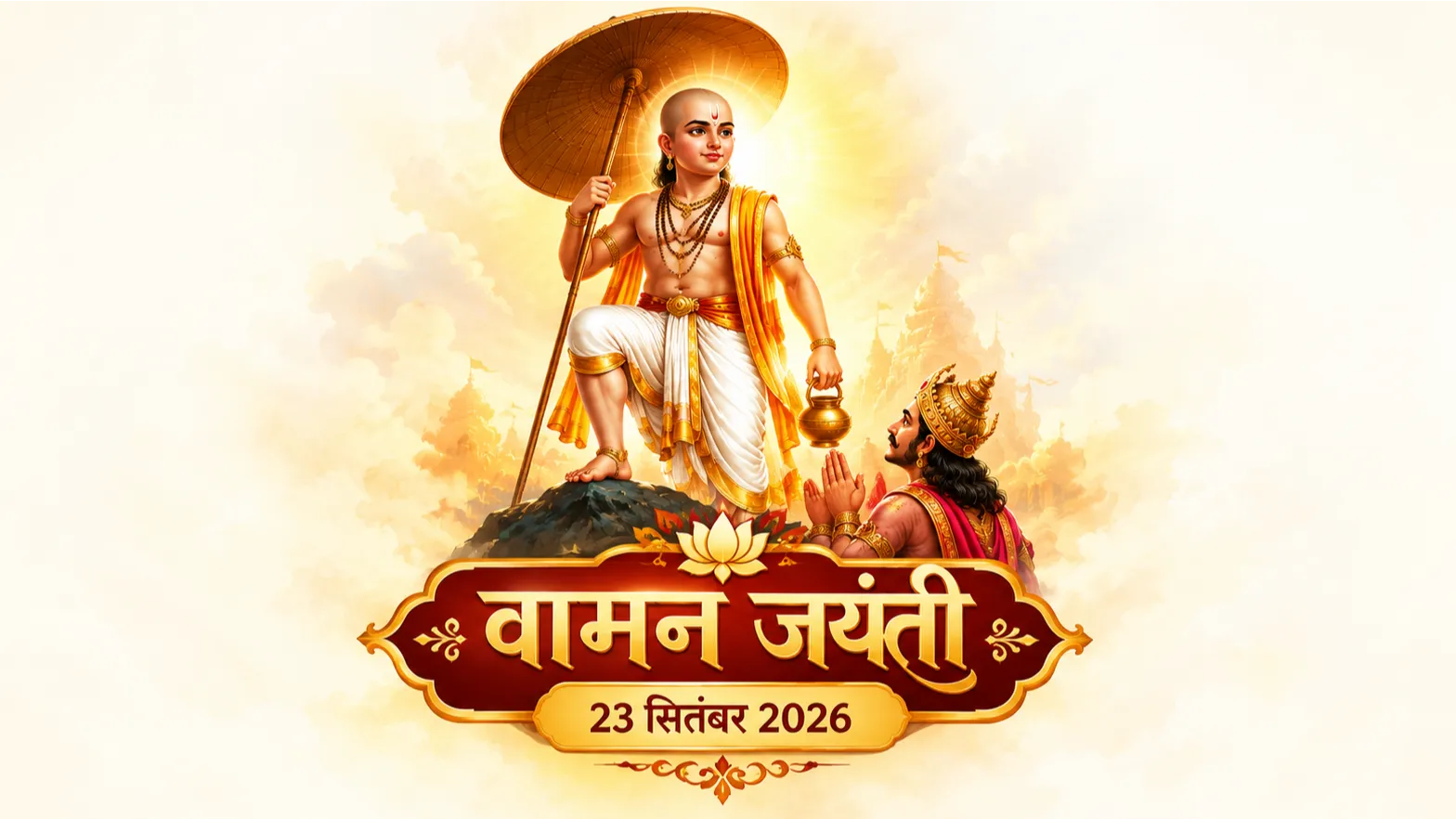
In Sanatan Dharma, the ten incarnations (Dashavatara) of Lord Vishnu hold special significance. Each of these ten incarnations took birth on Earth to establish righteousness and destroy unrighteousness. One of them is Lord Vaman, who is the fifth incarnation of Lord Vishnu. The auspicious festival of Vaman Jayanti is celebrated every year on the Dwadashi tithi of the Shukla Paksha in the month of Bhadrapada. This day symbolizes the descent of Lord Vaman to Earth, who shattered the ego of King Bali and established balance in the universe. In the year 2026, this auspicious date will be celebrated with devotion and faith. This article will apprise you of the significance of Vaman Jayanti 2026, the complete story of Lord Vaman, and the detailed worship rituals for this day.
Significance of Vaman Incarnation
The Vaman incarnation of Lord Vishnu is not just a story, but is replete with profound philosophical and spiritual teachings. This incarnation teaches us the lessons of humility, sacrifice, commitment, and the omnipresence of God.
- Destruction of Ego and Establishment of Humility: This incarnation conveys the message of making the arrogant humble and honoring the humble. Lord Vaman effortlessly removed the subtle ego hidden behind King Bali's philanthropy. It teaches that charity and benevolence bear fruit only when they are entirely free from ego.
- Restoration of Dharma: When King Bali conquered the three worlds and deprived the gods of their rightful places, the balance of Dharma was disturbed. Lord Vaman restored Dharma by returning their rights to the gods.
- Omnipresence of God: In the Vaman incarnation, the Lord assumed a cosmic form (Virat Swaroop) and measured the three worlds with His two steps, proving that God permeates every particle and His power is limitless. He can manifest in any form to protect His devotees and establish righteousness.
- Rescuer from Crises: This incarnation demonstrates that whenever there is a crisis on Dharma and devotees call out, the Lord manifests in any form to protect them. At the prayer of Devmata Aditi, Lord Vishnu assumed this form.
- Significance of Charity: This story also highlights the importance of charity, while teaching that charity should be done thoughtfully and by recognizing eligibility. King Bali took a vow to give charity, and the Lord tested him.
This incarnation also teaches us that the divine play (Lila) of God is beyond comprehension and He can do anything at His will. Coming in the form of a small Vaman, He measured the entire universe, showing that external appearance does not matter, but inner strength and resolve do.
The Complete Story of King Bali and Lord Vaman
The story of Lord Vaman is described in detail in the Srimad Bhagavata Purana and other Hindu scriptures. This story is a wonderful blend of charity, commitment, and divine power.
Background: The Rise of King Bali
King Bali, the great-grandson of Hiranyakashipu and grandson of devotee Prahlad, was an extremely valorous and righteous king. Like his grandfather Prahlad, he was a devotee of Lord Vishnu, but he had also become somewhat proud of his power and philanthropy. Under the guidance of Shukracharya, he had greatly increased his power and influence by performing many sacrifices, including the Ashwamedha Yajna. On the strength of his penance and power, he had also conquered Indraloka, which made all the deities fearful and powerless.
Aditi, the mother of the gods, was deeply grieved by the plight of her sons. On the advice of Maharishi Kashyap, she performed a difficult penance called Payovrata to please Lord Vishnu. Pleased with her penance, Lord Vishnu gave her darshan and assured her that He would take birth as her son, restore the kingdom to the gods, and subdue Bali's ego.
The Advent of Vaman
When the time came, on the Dwadashi tithi of the Shukla Paksha in the month of Bhadrapada, Lord Vishnu was born from the womb of Mother Aditi as an extremely radiant, short-statured Brahmin boy. At the time of His birth, joy filled all the realms. Maharishi Kashyap performed His Upanayana (sacred thread) ceremony, during which deities presented Him with various items – Suryadeva gave the Gayatri mantra, Brihaspati gave the sacred thread (Yajnopavita), Kashyap gave the girdle (Mekhala), Earth gave the black antelope skin, Chandra gave the staff (Danda), Mother Aditi gave the loincloth (Kaupina), Devmata Indrani gave the umbrella, Lord Brahma gave the Kamandalu, and the Saptarishis gave Kusha grass. Thus, Vaman stood ready as a fully celibate boy in the guise of a Brahmin.
Meanwhile, King Bali was performing his final and greatest Ashwamedha Yajna on the banks of the Narmada River at a place called 'Bhrgukachchha', which was being organized by Maharishi Shukracharya. Upon the completion of this Yajna, Bali would become the master of the three worlds and no one would be able to defeat him.
The Plea for Charity from Bali
With His divine aura and brahmachari form, Lord Vaman arrived at the Yajna pavilion. The entire Yajna arena was illuminated by His radiance. King Bali saw Him from a distance, and being impressed by His supernatural form, stepped forward to welcome Him. He bowed to Vaman, offered Him a seat, washed His feet, and sprinkled that water upon his own head.
King Bali asked Vaman, "O Brahmin boy! Your arrival is a matter of great fortune for me. You may ask of me whatever you desire. I am ready to give you wealth, gems, elephants, horses, villages, gold, or any other object."
Lord Vaman smiled and said, "O King! I am a simple celibate student. I do not have need for these vast riches. I only require three paces of land, which I can measure with my own steps. This will suffice to build my hermitage where I will reside."
Shukracharya's Obstruction and Bali's Firm Resolve
King Bali was surprised to hear that a small Brahmin boy was asking for such a small thing, when he could offer him the sovereignty of all three worlds as well. He thought that this boy perhaps did not realize the significance of his request. Bali urged Vaman to ask for more, but Vaman remained steadfast in his vow of three paces of land.
Seeing all this, King Bali's guru, Shukracharya, who recognized the true identity of Lord Vaman through his divine vision, warned Bali. Shukracharya said, "O King! This is not an ordinary boy; He is Lord Vishnu Himself who has come in the guise of Vaman through deception. Under the pretext of charity, He will take away everything you possess. Do not give Him any charity."
However, King Bali was true to his word. He ignored his guru's warning and said, "Gurudev! If Lord Vishnu Himself has come to ask something of me, it is my ultimate good fortune. I will not hesitate to offer Him everything I own. Even if He takes away everything from me, I cannot deceive Him, because giving a word and then backing out of it is a sin."
King Bali took water in his hand and resolved to donate three paces of land. Shukracharya still tried to stop Bali. When Bali was releasing the vow-water from his Kamandalu, Shukracharya transformed into a small insect and entered the spout of the Kamandalu so that the water could not flow out and the charity could not be completed. Understanding this, Lord Vaman inserted a blade of Kusha grass into the spout of the Kamandalu, which pierced one of Shukracharya's eyes and forced him out.
Trivikram Form and Measuring the Universe
As soon as King Bali released the vow-water into Vaman's hand, Lord Vaman instantly assumed His cosmic form (Virat Swaroop). He became so gigantic that His first foot spanned the Earth and His second foot pierced through and crossed the heavenly realm. Seeing His gigantic form, all the gods, sages, Yakshas, Gandharvas, and Kinnaras became terrified and began to sing His praises.
The Lord measured the entire Earth, Patala Loka, and the nether worlds with His first step. His second step surpassed Swarga Loka and all the higher realms. Now there was no space left in the universe where He could place His third step.
Vaman asked King Bali, "O King! I have measured the Earth and heaven with my two steps. Now tell me, where should I place my third step? You had promised to donate three paces of land."
Bali's Surrender and Patala Loka
King Bali, who understood his defeat yet remained steadfast to his word, bowed his head at the feet of the Lord with utmost humility and devotion. He said, "O Lord! You have taken everything from me, but my vow is still incomplete. I now have only my body remaining. Please place your third step upon my head."
Lord Vaman was extremely pleased with this dedication and devotion of King Bali. He placed His third step on Bali's head and sent him to Patala Loka (Sutala Loka). However, the Lord did not curse Bali; instead, He made him the ruler of Sutala Loka and granted him the boon that He Himself would stand as a gatekeeper at his door to protect him. Thus, Lord Vaman returned the kingdom to the gods and, while breaking King Bali's pride, bestowed upon him immortality and the gift of devotion.
This story teaches that the Lord destroys ego, but never abandons a true devotee. By sending Bali to Sutala Loka, the Lord gave him an honorable place where he could live with even greater comfort and peace than the gods.
Vaman Jayanti 2026: Date and Significance
Vaman Jayanti 2026 will be celebrated on the Dwadashi tithi of the Shukla Paksha in the month of Bhadrapada. This date is the celebration of the birth of Lord Vishnu's Vaman incarnation.
- This day provides an important opportunity for devotees to express their devotion towards Lord Vishnu.
- Worshiping Lord Vaman on this day endows a person with the virtues of humility, sacrifice, and integrity.
- It is believed that keeping a fast and performing worship on this day destroys all sins of a person and grants them liberation (Moksha).
- Happiness, prosperity, and peace remain in the home.
- Victory over enemies is attained and all wishes are fulfilled.
Worship Rituals for Vaman Jayanti 2026
The Vaman worship rituals are extremely simple and fruitful. On this day, devotees worship Lord Vaman with faith. Here is the step-by-step worship method and required materials:
Required Materials:
- Idol or picture of Lord Vaman
- Yellow garments (to offer to the Lord)
- Panchamrita (mixture of milk, curd, ghee, honey, and Gangajal)
- Pure water (for bathing and Achamana)
- Sandalwood, Roli, Kumkum, Akshat (rice)
- Incense sticks, lamp (Diya), agarbatti
- Fresh flowers (especially yellow or lotus flowers), Tulsi leaves
- Fruits, sweets, Naivedya (Kheer, Besan Ladoos, or any yellow sweet)
- Betel leaf, betel nut, cloves, cardamom
- Yajnopavita (sacred thread)
- Chhatra (small umbrella), Danda (wooden stick) as symbols in worship
- Grains, clothes, or money for charity
- Camphor for Aarti
Auspicious Timing for Worship:
The festival of Vaman Jayanti is primarily celebrated during the daytime, as Lord Vaman was born during the midday hour (Madhyahna Kala). Devotees observe fasting and worship throughout the day after bathing in the morning.
Step-by-Step Worship Method:
- Morning Bath and Resolution (Sankalpa): Wake up early in the morning on Vaman Jayanti, take a bath, and wear clean clothes. Clean the worship area. After this, taking water and Akshat in your hand, take a vow (Sankalpa) to observe the fast and worship Lord Vaman with devotion.
- Installation of Vaman Idol/Picture: Spread a yellow cloth on a clean wooden platform (Chowki) and install the idol or picture of Lord Vaman. If an idol of Vaman Ji is not available, you can also keep a picture of Lord Vishnu's child form or four-armed form.
- Water and Achamana: Bathe the Lord with pure water (if an idol) or sprinkle water. Afterward, offer water for Achamana.
- Panchamrita Bath: Bathe the Lord with Panchamrita and then with pure water, and wipe Him clean with a clean cloth.
- Garments and Yajnopavita: Offer new yellow garments to the Lord (if possible) and adorn Him with the sacred thread (Yajnopavita).
- Tilak and Flower Offering: Apply a tilak of sandalwood, roli, and kumkum to the Lord. Offer Akshat (rice). Thereafter, offer yellow flowers, lotus flowers, and Tulsi leaves.
- Lighting Incense and Lamp: Light incense, a lamp, and agarbatti.
- Naivedya and Fruits: Offer Naivedya (Kheer, sweets) and various types of fruits to the Lord. Make sure to include Tulsi leaves in the Naivedya. Also offer betel leaf, betel nut, cloves, and cardamom.
- Umbrella and Staff: Symbolically keep a small umbrella and staff (wooden stick) near the Lord. This is the recognition of the Vaman form.
- Mantra Chanting: Now, with a concentrated mind, chant the mantras of Lord Vaman.
- Main Mantra: "Om Namo Bhagavate Vamanaya"
- You can also recite other mantras of Lord Vishnu such as "Om Namo Bhagavate Vasudevaya" or Vishnu Sahasranama.
- Reading/Listening to Vaman Katha: Recite or listen to the story of Lord Vaman. This is considered very auspicious.
- Aarti: Perform Aarti of Lord Vaman using camphor or a ghee lamp.
- Apology Prayer: Seek forgiveness from the Lord for any mistakes made during the worship.
- Distribution of Prasadam: After the worship, distribute Prasadam among all present devotees and family members.
- Charity and Philanthropy: Charity holds special significance on this day. Feed Brahmins, give them Dakshina, and donate food, clothes, or money to the poor and needy. Donating yellow items is considered extremely auspicious.
Spiritual Benefits of Observing Vaman Jayanti
The festival of Vaman Jayanti is not just a religious ritual, but also a medium for spiritual upliftment. Observing this day brings numerous spiritual benefits:
- Subdual of Ego: This festival inspires us to recognize the ego within ourselves and abandon it. The story of Lord Vaman serves as an example of humbling the arrogant King Bali, giving us the strength to overcome our pride.
- Development of Humility and Sacrifice: The Vaman incarnation is a symbol of humility and sacrifice. Worshiping and listening to the story on this day fosters these virtues in a person, advancing their spiritual life.
- Importance of Commitment: The story of King Bali teaches us to remain steadfast to our word, no matter how great a sacrifice is required. This enhances spiritual firmness.
- Attainment of Divine Blessings: Worshipping the Vaman form of Lord Vishnu brings special blessings of the Lord, leading to happiness, peace, and prosperity in life.
- Liberation from Sins: By performing worship and fasting with a sincere heart on this day, a person gets liberated from sins committed knowingly or unknowingly.
- Increase in Knowledge and Wisdom: Understanding the Vaman incarnation story and its underlying message increases a person's knowledge and wisdom, helping them walk on the righteous path of life.
- Enhancement of Devotion and Faith: Remembering the divine plays of the Lord on this auspicious occasion deepens one's devotion and faith towards God.
- Radiance of Positive Energy: A religious atmosphere and worship at home radiate positive energy, bringing peace to the mind and soul.
Conclusion
Vaman Jayanti 2026 reminds us of the wonderful Vaman incarnation of Lord Vishnu, who measured the entire universe with His small form and established righteousness and justice. This festival imparts a profound message of humility, sacrifice, commitment, and the omnipresence of God. Worshiping Lord Vaman with devotion, listening to His story, and performing charity on this day not only brings material happiness and prosperity, but also paves the way for spiritual advancement. On this Vaman Jayanti, let us all abandon our inner ego and worship the Lord with humility and a spirit of service to become worthy of His divine blessings.
अक्सर पूछे जाने वाले प्रश्न (FAQ)
Q: What is Vaman Jayanti?
Vaman Jayanti is an auspicious festival in Sanatan Dharma that symbolizes the descent of Lord Vaman, the fifth incarnation of Lord Vishnu, to Earth.
Q: Where does Lord Vaman rank among the Dashavatara of Vishnu?
Lord Vaman is the fifth incarnation among the ten incarnations (Dashavatara) of Lord Vishnu.
Q: On which date is Vaman Jayanti celebrated?
The auspicious festival of Vaman Jayanti is celebrated every year on the Dwadashi tithi of the Shukla Paksha in the month of Bhadrapada.
Q: What was the main purpose of the Vaman incarnation?
The main purpose of the Vaman incarnation was to shatter the ego of King Bali, restore balance in the universe, and re-establish Dharma.
Q: What spiritual teachings do we get from the Vaman incarnation?
The Vaman incarnation teaches us lessons of humility, sacrifice, commitment, the omnipresence of God, and the destruction of ego.
Q: In His cosmic form, how many steps did Lord Vaman use to measure the three worlds?
Lord Vaman assumed a cosmic form and measured the three worlds with His two steps.
Q: How does the Vaman incarnation convey the message of destroying ego and establishing humility?
This incarnation conveys the message of removing the subtle ego of the arrogant King Bali and establishing humility, teaching that charity is fruitful only when free from ego.
Q: How did Lord Vaman restore Dharma?
When King Bali conquered the three worlds and deprived the gods of their rightful places, Lord Vaman restored Dharma by returning their rights to the gods.
Q: How is the omnipresence of God proven by the Vaman incarnation?
In the Vaman incarnation, the Lord measured the three worlds with His two steps in a cosmic form, proving that God permeates every particle and His power is infinite.
Q: What is the connection between Devmata Aditi's prayer and the Vaman incarnation?
This incarnation shows that at the prayer of Devmata Aditi, Lord Vishnu manifested to protect His devotees in times of crisis.
Q: What lesson does the Vaman incarnation impart regarding the importance of charity?
This story highlights the importance of charity while also teaching that charity should be done thoughtfully and by recognizing eligibility.
Q: Who was King Bali and what were his characteristics?
King Bali was the great-grandson of Hiranyakashipu and grandson of devotee Prahlad; he was an extremely valorous, righteous, and charitable king, though he also had pride in his power.
Q: Under whose guidance did King Bali increase his power?
King Bali greatly increased his power and influence by performing many sacrifices, including the Ashwamedha Yajna, under the guidance of Shukracharya.
Q: In which scriptures is the complete story of Lord Vaman primarily described?
The complete story of Lord Vaman is described in detail in the Srimad Bhagavata Purana and other Hindu scriptures.
Q: What does the Vaman incarnation reveal about inner strength and resolve?
This incarnation shows that external appearance does not matter, but inner strength and resolve do, as He measured the entire universe coming in the form of a small Vaman.

Author
Praarthana Editorial Team
The Praarthana Editorial Team shares daily spiritual guidance, authentic rituals, and deep insights from ancient Sanatan scriptures to support your spiritual journey.
ऐप डाउनलोड करें
पंचांग तिथि, त्यौहार, व्रत, उत्सव, एकादशी, आरती संग्रह, मंत्र, व्रत कथा



एक टिप्पणी छोड़ें