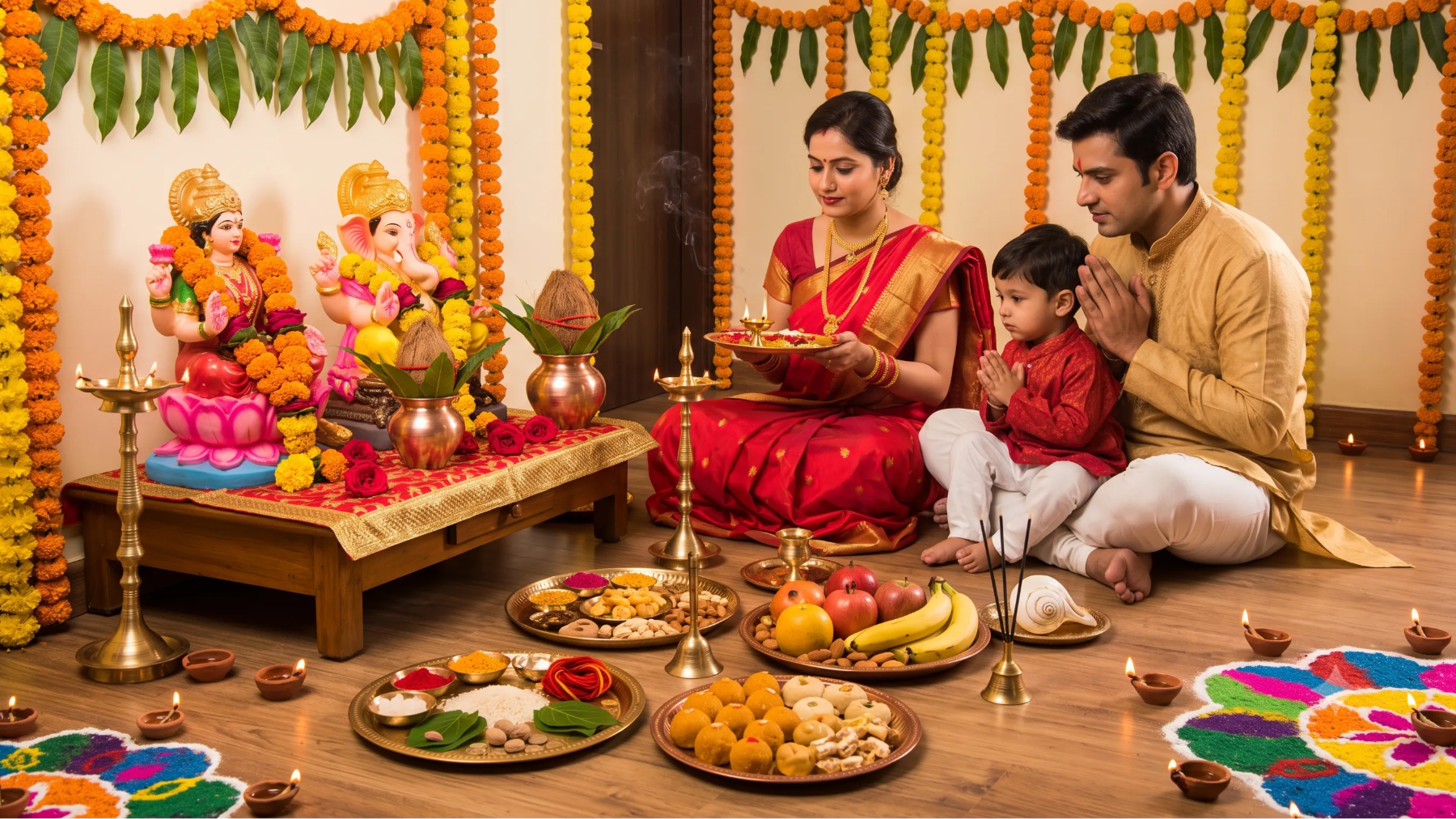
The grand festival of lights, enthusiasm, and devotion, Diwali, is celebrated with great pomp every year on the Amavasya tithi of the Kartik month. This sacred festival holds special significance in Hinduism because worshiping Goddess Lakshmi and Lord Ganesha on this day brings happiness, prosperity, peace, and abundance of wealth into the home. Everyone is filled with excitement regarding Diwali 2026 this year, and preparations are already underway. If you also want to know when is Diwali in 2026 and how to perform the Diwali 2026 Lakshmi Ganesh Puja to seek the blessings of Goddess Lakshmi and Lord Ganesha, this article is extremely useful for you. In this article, we will provide you with detailed information about the Diwali 2026 auspicious muhurat, the complete Lakshmi Ganesh puja samagri list, and the scripturally aligned Diwali puja vidhi.
When is Diwali 2026? Know the Exact Date
According to the Panchang, the festival of Diwali is celebrated every year on the Amavasya of the Kartik month. In the year Diwali 2026, the beginning and ending of the Amavasya tithi will be such that both householders and the business community can worship Goddess Lakshmi with proper rituals. In 2026, this grand festival of Diwali will fall in the second week of the month of November, creating a wonderful combination of Pradosh Kaal and Amavasya tithi. On this day, people decorate their homes with rows of lamps, make rangolis, and welcome Goddess Lakshmi.
Diwali 2026 Auspicious Muhurat: Significance of Pradosh Kaal and Vrishabh Lagna
It is considered best to always perform Diwali puja during Sthir Lagna (fixed ascendant) and Pradosh Kaal. According to astrology, worship performed in Sthir Lagna (such as Vrishabh Lagna) bestows long-lasting wealth and prosperity. Let us know about the Diwali 2026 auspicious muhurat:
- Pradosh Kaal Muhurat: Pradosh Kaal is the time that begins after sunset. Worshiping Goddess Lakshmi during this period is considered extremely fruitful. In 2026, the timing for Pradosh Kaal will be from approximately 5:30 PM to 8:15 PM in the evening.
- Vrishabh Lagna Muhurat (Sthir Lagna): Vrishabh Lagna is considered a symbol of stability. It is believed that worshiping Goddess Lakshmi in this lagna makes her reside permanently in the house. Under the Diwali 2026 auspicious muhurat, the time for Vrishabh Lagna will be between approximately 6:30 PM and 8:30 PM in the evening. Worship done during this time is considered the best.
- Nishith Kaal Muhurat (For Tantric and Special Sadhana): The middle part of the night is called Nishith Kaal. Businessmen and seekers perform puja at this time to attain special spiritual powers and the grace of Goddess Lakshmi.
Lakshmi Ganesh Puja Samagri List: Gather All These Items Before Worship
To ensure there are no obstacles in the puja and the rituals are completed properly, all necessary items should be gathered a day in advance. Here is a complete Lakshmi Ganesh puja samagri list:
- Idols of Deities: Seated clay or silver idols of Goddess Lakshmi and Lord Ganesha (ensure Lord Ganesha's trunk is turned towards the left and Goddess Lakshmi is seated on a lotus flower).
- Seat (Aasan): A new clean red or yellow cloth for the puja chowki.
- Grains and Kalash: A handful of whole rice (akshat) for the puja, a copper or brass pitcher (kalash), Gangajal, mango or ashoka leaves, and a coconut with a tuft (jata).
- Offering of Fruits and Sweets: Khil-batashe (mandatory especially on Diwali), Makhana dear to Goddess Lakshmi, betel leaf, betel nut, cardamom, cloves, and seasonal fruits (such as banana, apple, pomegranate).
- Lamps and Fire Items: Pure cow's ghee, sesame oil, earthen diyas (at least 11 or 21), a large five-faced lamp, cotton wicks, incense sticks, and camphor.
- Adornment and Clothing Items: Red cloth or chunri for Goddess Lakshmi, sindoor, kumkum, roli, turmeric roots, mica, perfume, mouli (sacred thread), janeu, and Goddess Lakshmi's adornment items (bangles, bindi, etc.).
- Flowers: Fresh flowers, rose or marigold garland, and specially a lotus flower (if available).
Diwali Puja Vidhi: Step-by-Step Complete Process
Happiness and prosperity enter the home only through the correct Diwali puja vidhi prescribed in the scriptures. Let us know the complete puja process:
Step 1: House Cleaning and Purification
Wake up early in the morning on the day of Diwali and thoroughly clean the entire house. Afterward, sprinkle Gangajal throughout the house to remove negative energy and promote the flow of positivity. Tie a bandhanwar of mango or ashoka leaves on the main entrance and decorate a beautiful rangoli.
Step 2: Setup of the Puja Chowki
Take a bath and wear clean clothes before the auspicious muhurat begins. Now place a chowki in the puja area or the northeast corner (Ishan Kon) and spread a red or yellow cloth over it. Make a small mound of rice (akshat) in the middle of the chowki and establish the kalash on it. Place water, Gangajal, betel nut, a coin, and mango leaves in the kalash, and top it with a coconut.
Step 3: Installation of Idols
Place the idol of Lord Ganesha on the right side of the chowki (your left) and the idol of Goddess Lakshmi on the left side (your right). In front of the idols, draw a Swastika sign using roli or Navagraha on a copper or silver plate. Apply tilak to Lord Ganesha and Goddess Lakshmi and offer akshat.
Step 4: Sankalp and Achamana
Take a little water, akshat, and flowers in your hand, take the name of your Gotra, make a vow (sankalp) for the puja, and release the water at the feet of Lord Ganesha. Perform Achamana afterward.
Step 5: Shodashopachar Puja (Worship with Rituals)
Now offer flowers, garlands, janeu, and clothes to both deities. Adornment items and the lotus flower are very dear to Goddess Lakshmi, so be sure to offer them. Afterward, light incense and lamps. Light a large ghee lamp and many small diyas and place them in every corner of the house.
Step 6: Mantra Chanting and Aarti
During the puja, chant Lord Ganesha's mantra "Om Gam Ganapataye Namah" and Goddess Lakshmi's mantra "Om Shreem Mahalakshmyai Namah" for at least one mala. Afterward, systematically sing the aarti of Goddess Lakshmi and Lord Ganesha using camphor and a ghee lamp. Finally, offer forgiveness prayers, asking the Goddess to accept your worship.
What to Do After Diwali Puja?
Once the aarti is completed, place lamps in all the rooms, kitchen, balcony, and main entrance of the house. Afterward, worship the safe or the place where wealth is kept. Seek blessings from the elders of the house and distribute prasad to everyone. After offering khil-batashe and sweets, consume the prasad with your family the next morning.
Thus, if you keep the correct Diwali 2026 auspicious muhurat in mind on the auspicious occasion of Diwali 2026, and follow the Lakshmi Ganesh puja samagri list and Diwali puja vidhi explained above, Goddess Lakshmi and Lord Ganesha will surely reside permanently in your home, and happiness and prosperity will remain in your life.
अक्सर पूछे जाने वाले प्रश्न (FAQ)
Q: When will Diwali 2026 be celebrated?
In the year 2026, the grand festival of Diwali will fall in the second week of November on the Amavasya tithi of the Kartik month.
Q: Who is worshiped on Diwali?
Goddess Lakshmi and Lord Ganesha are worshiped on the day of Diwali.
Q: What will be the timing for Pradosh Kaal puja on Diwali 2026?
In the year 2026, the timing for Pradosh Kaal will be from approximately 5:30 PM to 8:15 PM in the evening.
Q: What is the significance of worshiping in Vrishabh Lagna?
Vrishabh Lagna is a fixed ascendant, and it is believed that worshiping Goddess Lakshmi in this lagna makes her reside permanently in the house, bringing long-lasting wealth and prosperity.
Q: When will the auspicious muhurat of Vrishabh Lagna be on Diwali 2026?
Under Diwali 2026, the time for Vrishabh Lagna will be between approximately 6:30 PM and 8:30 PM in the evening.
Q: For what purpose is the Nishith Kaal muhurat used?
The Nishith Kaal muhurat is used by businessmen and spiritual seekers at night to attain special spiritual attainments and the grace of Goddess Lakshmi.
Q: How should the idols of Lakshmi-Ganesh be?
The idols of Goddess Lakshmi and Lord Ganesha should be in a seated posture, with Lord Ganesha's trunk turned towards the left and Goddess Lakshmi seated on a lotus flower.
Q: What color cloth should be used for the puja chowki?
A new clean red or yellow cloth should be used for the puja chowki.
Q: What is essential as grains in the puja samagri?
A handful of whole rice (akshat) must be present in the puja samagri.
Q: What items are needed for Kalash Sthapana?
For Kalash Sthapana, a copper or brass pitcher (kalash), Gangajal, mango or ashoka leaves, and a coconut with a tuft are required.

Author
Praarthana Editorial Team
The Praarthana Editorial Team shares daily spiritual guidance, authentic rituals, and deep insights from ancient Sanatan scriptures to support your spiritual journey.
ऐप डाउनलोड करें
पंचांग तिथि, त्यौहार, व्रत, उत्सव, एकादशी, आरती संग्रह, मंत्र, व्रत कथा



एक टिप्पणी छोड़ें