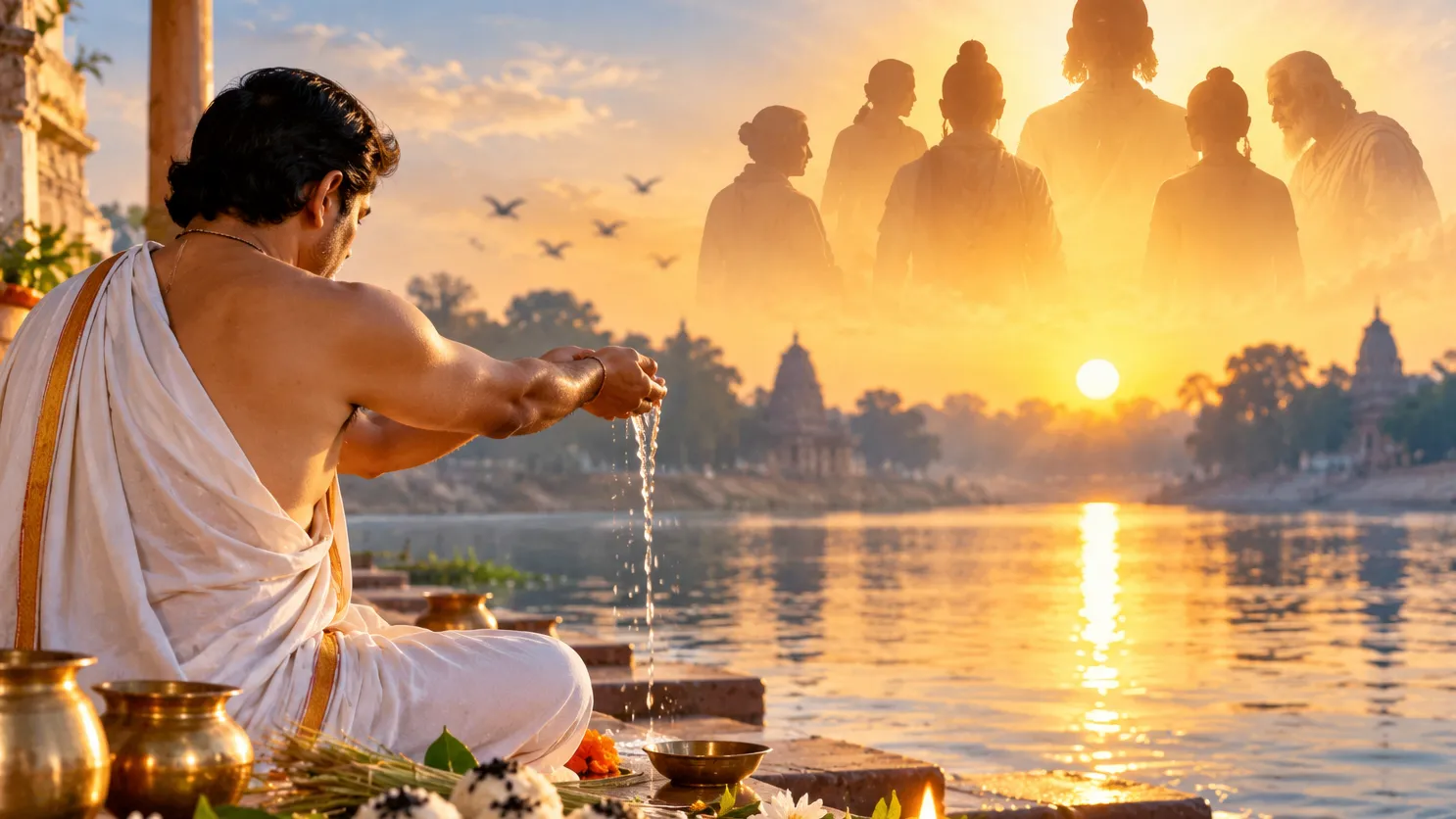
In Sanatan culture and Hindu dharma, traditions and Sanskars hold a very unique and profound spiritual significance. From birth to after death, certain rules and rituals have been laid down for every stage in our religion. One of these sacred rituals is Shraddha and Tarpan, which is a symbol of our unwavering reverence, love, and gratitude towards our ancestors—known as Pitrs. In the hustle and bustle of the modern era, the younger generation sometimes fails to fully understand the scientific and spiritual aspects of these traditions, leading to them being dismissed as mere superstitions. However, reality is quite the opposite. Let us explore in detail through this article what significance Shraddha and Tarpan hold in our lives and in Sanatan Dharma.
Pitru Paksha: The Special Period for Remembering Ancestors
The 16-day period starting from the Full Moon (Purnima) of the Bhadrapada month to the New Moon (Amavasya) of the Ashwin month is called Pitru Paksha. This period is also known as Mahalaya. According to the Hindu calendar, this is the time when the energy and subtle existence of ancestors come closest to the earthly realm. It is believed that during these sixteen days, our ancestors visit their families in a subtle form and are eager to see whether their descendants remember them or not. This is considered the best and most sacred time for remembering ancestors. The Shraddha rituals performed during these days bring satisfaction to the ancestors and they bless their descendants with happiness, peace, and good health.
The Significance of Shraddha: A Medium to Express Gratitude
The word 'Shraddha' originates from 'Shraddha' (faith), which means—an action performed for one's ancestors with complete devotion, faith, and surrender. The significance of Shraddha is not only vital from a religious perspective but also extremely important from psychological and social fabric perspectives. Think about it, who laid the foundation of the body, society, culture, and wealth that we enjoy today? Our parents and their ancestors.
Shraddha ritual is actually a beautiful way to express gratitude towards those ancestors because of whom our existence is on this earth. In Sanatan Dharma, various debts (Rinas) are mentioned—Deva Rina, Rishi Rina, and Pitru Rina. Among these, the only means to attain liberation from Pitru Rina is Shraddha and Tarpan. When we remember our ancestors, we remain connected to our roots. A person who forgets their roots can never have a flourishing future.
Tarpan Vidhi and its Spiritual Meaning
The literal meaning of the word Tarpan is—to satisfy. The process of offering water to deities, sages, and primarily to one's ancestors with the help of water, black sesame seeds (til), kusha grass, and kushagra is called Tarpan Vidhi. It is considered mandatory to follow certain special rules while performing Tarpan:
- Time and Place: Tarpan is usually performed on the banks of a sacred river, beside a pond, or in a quiet and sacred corner of one's home. Early morning or midday is considered the best time for this.
- Use of Kusha and Til: Black sesame seeds hold special significance in Tarpan. Black sesame seeds are associated with Lord Vishnu and Shani Dev, which ward off negative energy and bring peace to the ancestors. Additionally, Kusha is a special grass considered to be a conductor of energy.
- Position of the Sacred Thread (Janeu): While performing Tarpan, the Janeu (Upavita) is placed on the right shoulder, facing right (Apasavya) towards the southern direction, as the southern direction is considered the direction of Yama and the ancestors.
- Water Tarpan: Water is taken in the palm (anjali), mixed with barley, sesame, and flowers, and Tarpan is performed by chanting the ancestral Gotra. Through this, ancestors attain water satisfaction.
Pind Daan: The Process of Giving Momentum to the Soul's Journey
Another most important component of the Shraddha ritual is Pind Daan. Pind Daan is mainly performed at sacred pilgrimage sites like Gaya, Prayagraj, and Haridwar, although it can also be performed at home. The round balls made by mixing rice, barley flour, milk, ghee, honey, and sugar are called 'Pind'.
From a spiritual perspective, Pind Daan does not merely mean the donation of food, but it is about providing gross energy to the soul traveling away from the physical body. When a person dies, their soul requires energy to take the next birth or attain its position in the Pitru Loka. The Pind Daan performed by descendants provides satisfaction and further momentum to that wandering or subtle soul. This is proof that even after death, our connection with our loved ones remains intact.
The Tradition of Brahmin Feeding and Charity
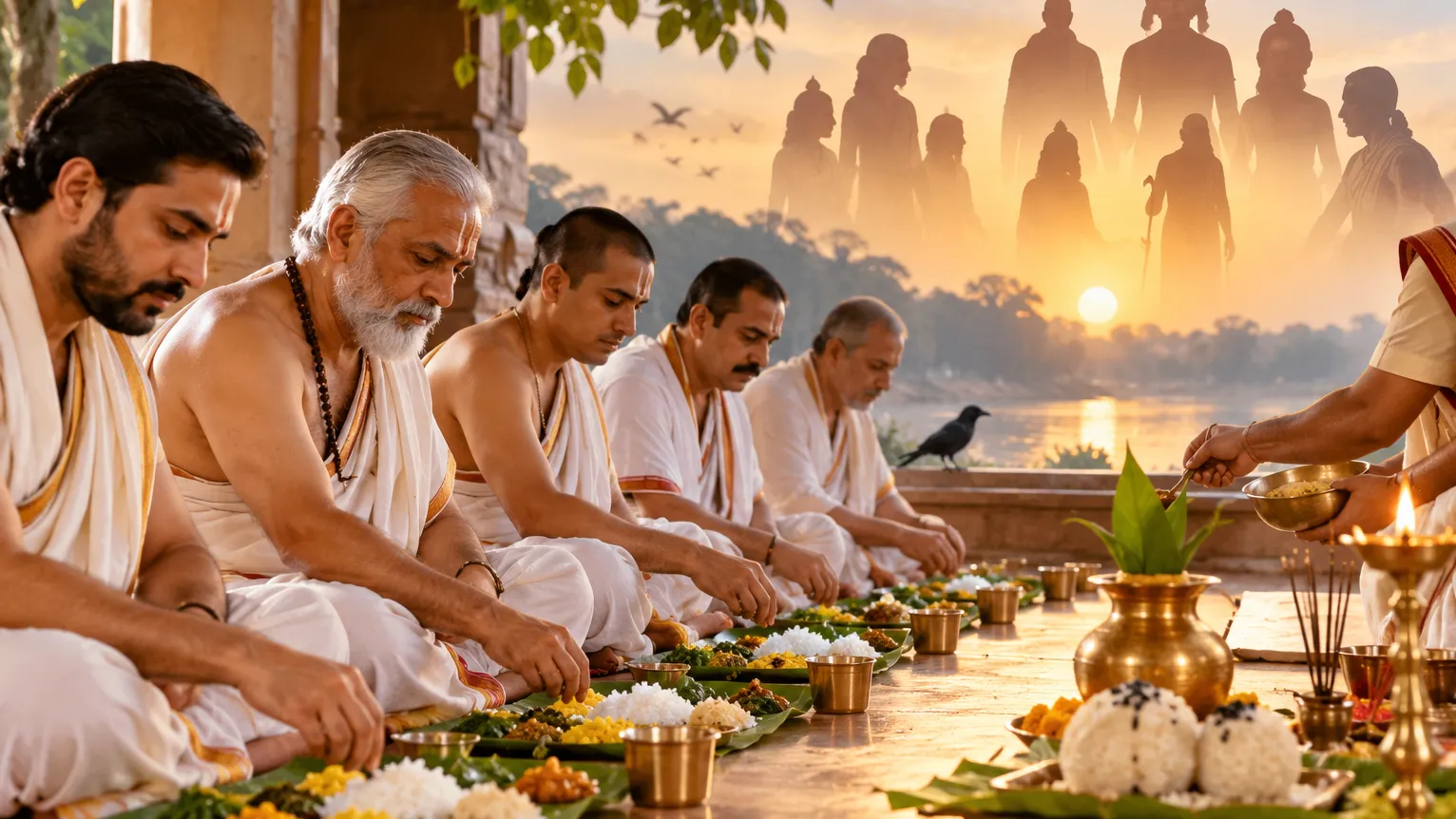
Feeding Brahmins and giving charity to the poor during Pitru Paksha and Shraddha holds immense importance. It is believed in the scriptures that the food we offer to Brahmins on this day for the sake of our ancestors reaches our ancestors in a subtle form.
Rules of Brahmin Feeding:
- Sattvic food (without onion and garlic) should be prepared on the day of Shraddha.
- Having Kheer or Poori in the meal is considered extremely auspicious, as ancestors dearly love sweets and Kheer.
- Before feeding Brahmins, a portion of the food (Panchbali) is set aside for cows, dogs, crows, and ants. This is also known as Bhuta-Yajna, which shows our compassion for all living beings.
- Brahmins are fed with respect, and blessings are sought by giving Dakshina and clothes.
Why Does Remembering Ancestors Bring Peace and Prosperity to Life?
People often wonder whether the dead actually consume the food or water offered by us. Science may look at it through the law of conservation of energy, but आध्यात्मिकता unveils a deeper layer. When we remember our ancestors, we become filled with a sense of gratitude.
Gratitude is a positive energy that eliminates ego, malice, and negativity from our minds. When all family members come together to remember their ancestors, the sense of unity, love, and cultural values within the family is strengthened. With the blessings of the ancestors (Pitru Ashirwad), obstacles in the house are removed, the lineage grows, and mental peace is attained. Homes where ancestors are disrespected or forgotten are believed to be abodes of unrest and discord.
Conclusion
Shraddha and Tarpan are not merely rituals or formalities, but the living heartbeat of our Sanatan culture that keeps us connected to our roots. They teach us that life is perishable, but love, relationships, and gratitude are immortal. Pitru Paksha gives us the opportunity to take some time out of our busy lives to remember those on whose shoulders we stand today to view the world. Let us perform Shraddha and Tarpan this Pitru Paksha with full devotion, discipline, and emotion, seek the blessings of our ancestors, and fill our lives with happiness, peace, and prosperity.
अक्सर पूछे जाने वाले प्रश्न (FAQ)
Q: What is the importance of Shraddha and Tarpan in Sanatan culture?
In Sanatan culture, Shraddha and Tarpan symbolize our unwavering reverence, love, and gratitude towards our ancestors, holding deep significance in life and spirituality.
Q: What is Pitru Paksha and how many days does it last?
The 16-day period starting from the Full Moon of Bhadrapada to the New Moon of Ashwin is called Pitru Paksha.
Q: What is another name for Pitru Paksha?
Pitru Paksha is also known as Mahalaya.
Q: Where does the word Shraddha originate from and what does it mean?
The word Shraddha originates from 'Shraddha' (faith), which means an action performed for ancestors with complete devotion, faith, and surrender.
Q: What is the only means to attain liberation from Pitru Rina?
The only means to attain liberation from Pitru Rina is Shraddha and Tarpan.
Q: What is the literal meaning of Tarpan?
The literal meaning of the word Tarpan is to satisfy.
Q: What items are used in the Tarpan Vidhi?
Water, black sesame seeds, kusha grass, and kushagra are used in the Tarpan Vidhi.
Q: Which time is considered the best for performing Tarpan?
Early morning or midday is considered the best time for performing Tarpan.
Q: What is the significance of black sesame seeds in Tarpan?
Black sesame seeds ward off negative energy and bring peace to ancestors, as they are associated with Lord Vishnu and Shani Dev.
Q: What are ancestors eager to see during Pitru Paksha?
During Pitru Paksha, ancestors are eager to see whether their descendants remember them or not.

Author
Praarthana Editorial Team
The Praarthana Editorial Team shares daily spiritual guidance, authentic rituals, and deep insights from ancient Sanatan scriptures to support your spiritual journey.
ऐप डाउनलोड करें
पंचांग तिथि, त्यौहार, व्रत, उत्सव, एकादशी, आरती संग्रह, मंत्र, व्रत कथा



एक टिप्पणी छोड़ें