Mahadev's Ardhanarishvara Form: A Wonderful Confluence of आध्यात्मिकता and Science
In Sanatan Dharma, Lord Shiva is worshipped in many forms, and each form embodies a deep mystery, philosophy, and unique significance in itself. Among all these forms, Mahadev's Ardhanarishvara form is the most profound and contemplative. This is not just an idol, but a living symbol of the creation, sustenance, and balance of the entire universe. This form not only reflects the eternal union of Shiva and Shakti, but also highlights those subtle principles of आध्यात्मिकता and science that lie at the root of creation.
Ardhanarishvara, which literally translates to "the Lord who is half-man and half-woman," represents the inseparable form of Lord Shiva and his divine consort Goddess Parvati. This is that divine manifestation where the masculine (Shiva) and nature (Shakti) become one in a single body, transforming the duality of the universe into non-duality. In this form, we not only understand the root of creation, but also become acquainted with the profound secrets of the eternal balance of life, energy, and existence. Let us deeply explore the spiritual, symbolic, and scientific dimensions of this wonderful form.
Detailed Description of the Ardhanarishvara Form: An Unmatched Confluence of Divinity
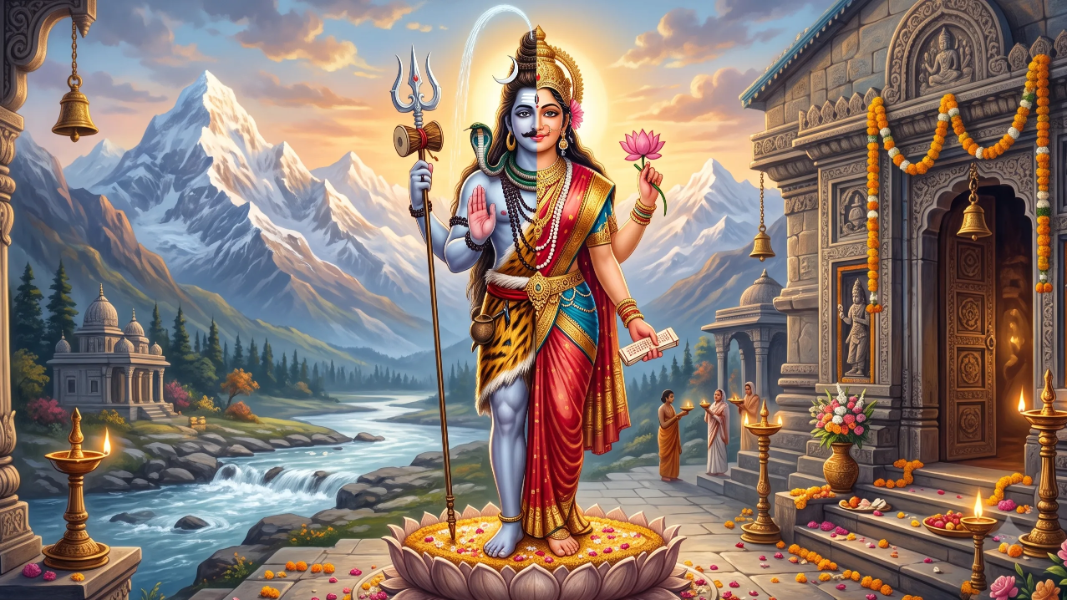
Mahadev's Ardhanarishvara form is mesmerizing to the eyes and plunges the mind into deep contemplation. In this form, half of Lord Shiva's body is male, and the other half is female, representing Goddess Parvati. This very sight expresses a cosmic truth in itself.
- Male Form (Right Side): This represents Lord Shiva, who is the master of creation, preservation, and dissolution.
- Hair: Shiva's matted locks (Jatajuta), which are often adorned with the flow of the Ganga and a crescent moon.
- Forehead: Shiva's third eye, a symbol of knowledge and wisdom, adorned with sacred ash (Bhasma).
- Ear: Often adorned with a Rudraksha or serpent earring (Kundal).
- Attire: Tiger skin (Vaghambar) or the naked ascetic form (Digambar), showing detachment and oneness with nature.
- Hands: Holding a Trishula (symbolizing control over the three gunas of creation - Satva, Rajas, Tamas) or a Damru (symbolizing sound, creation, and time) in the right hand.
- Color: This part is generally white, blue, or ash-colored due to the sacred ash, symbolizing detachment, peace, and infinity.
- Female Form (Left Side): This represents Goddess Parvati, Shakti, who is the source of all energy, creation, and nourishment.
- Hair: Well-groomed, beautifully adorned hair, depicting feminine beauty and attractiveness.
- Forehead: Adorned with a Bindi or Tilak, symbolizing good fortune and power.
- Ear: Featuring beautiful earrings or ornaments.
- Attire: Silky, colored garments (such as red or green), denoting the vibrancy and beauty of life.
- Hands: Holding a lotus (symbol of purity and creation), a mirror (symbol of self-reflection and Maya), or a parrot (symbol of love and communication) in the left hand.
- Color: This part is usually golden, deep red, or green, symbolizing fertility, prosperity, love, and activity.
This wonderful arrangement is not just a display of beauty, but reveals a profound philosophical truth: the masculine and feminine elements in the universe are inseparable. The existence of one is impossible without the other.
Spiritual Significance and Symbolic Meaning: The Eternal Union of Shiva and Shakti
The spiritual significance of the Ardhanarishvara form is extremely deep and multi-dimensional. It is not just a union of two deities, but a symbol of the merging of cosmic principles.
1. The Indissoluble Bond of Shiva and Shakti:
The union of Shiva and Shakti is the central message of the Ardhanarishvara form. Shiva is 'Purusha', representing pure consciousness, passive, immutable, and foundational principle. He is the static, unmanifested aspect of the universe, which is inert without Shakti. Shakti is 'Prakriti', representing energy, dynamism, activity, and creation. She is the manifested, dynamic aspect of the universe, which is directionless and chaotic without Shiva.
Ardhanarishvara shows that Shiva and Shakti are incomplete without each other. Shiva without Shakti is 'Shava' (a dead body), and Shakti without Shiva is 'blind energy'. Their integration provides momentum, life, and balance to the universe. This idea is echoed in all Indian philosophies from the Vedas to the Upanishads and Tantras.
2. From Duality to Non-Duality (Advaita):
This form pierces the illusory veil of dualism and reveals the supreme truth of non-duality (Advaita). We generally view the world in duality - male/female, day/night, happiness/sorrow, creation/destruction. Ardhanarishvara shows that all these dualities are actually two aspects of the same cosmic reality, which are complementary to each other, not opposing. It teaches us that the perfection of life lies in accepting these seemingly opposing poles and integrating them. It inspires us to go beyond narrow thinking and adopt a comprehensive perspective where everything is interconnected.
3. Confluence of Cosmic Energy:
The Ardhanarishvara form is the source of all cosmic energy. Shiva is passive consciousness, and Shakti is active energy. The confluence of these two gives birth to all kinds of energies - physical, mental, and spiritual. This is the primal force of creation that brings everything into existence, from atoms to galaxies. This confluence is often associated with the awakening of Kundalini Shakti, where the masculine and nature energies located within the Sushumna Nadi unite, leading to enlightenment and liberation. This form tells us that to maintain balance in life, we must accept and harmonize both our inner masculine energy (logic, stability) and feminine energy (emotion, creativity).
Ardhanarishvara in Ancient Scriptures and Tales
Mahadev's Ardhanarishvara form is not just a imagination, but its detailed description and many stories associated with it are found in ancient Indian scriptures, which further strengthen its importance.
1. Description in Linga Purana:
The origin of Ardhanarishvara is described in detail in the Linga Purana. This story tells that once Lord Brahma was facing difficulty in expanding creation because he was only creating males. Then he sought help from Lord Shiva. Dividing his energy, Shiva assumed the Ardhanarishvara form, after which Brahma was inspired to create both female and male, making the expansion of creation possible. This story clearly shows that both male and female elements are equally important for creation.
2. Skanda Purana and Matsya Purana:
The form of Ardhanarishvara is also mentioned in these Puranas, glorifying the oneness of Shiva and Parvati. They present this form as a symbol of the supreme spiritual state, where all dualities cease to exist.
3. The Story of Sage Bhringi:
This story is one of the most famous tales explaining the importance of Ardhanarishvara. Sage Bhringi was an ardent devotee of Lord Shiva and worshipped only Shiva. He did not give importance to Parvati as Shakti and while circumambulating Shiva, he would leave out Parvati. Parvati felt sad about this and complained to Shiva. Then Shiva gave half a place in his body to Parvati and assumed the form of Ardhanarishvara, so that Sage Bhringi could realize that Shiva and Shakti are actually one and cannot be separated. Seeing this form, Sage Bhringi realized his mistake and from then on started worshipping the Ardhanarishvara form. This story teaches us that perfection cannot be attained by abandoning any single aspect.
4. Kalidasa's Raghuvamsha:
The great poet Kalidasa, at the very beginning of his epic Raghuvamsha, describes Shiva and Parvati as inseparable like Vāk and Artha (word and meaning), and worships them hinting at the Ardhanarishvara form. This shows that this concept is deeply embedded not only religiously, but also culturally and literarily.
The Scientific Aspect of Cosmic Balance: Confluence of आध्यात्मिकता and Science
Mahadev's Ardhanarishvara form is not just a mythological concept, but a wonderful representation of the profound scientific principles of cosmic balance and energy. This form shows the foresight of ancient Indian sages who understood many principles of modern science centuries ago.
1. Dualism and the Principle of Balance:
Modern science also accepts the importance of dualism in the universe. Complementary opposing pairs exist everywhere in nature: positive-negative charge, matter-antimatter, attraction-repulsion, creation-destruction, etc. The balance of these dualistic forces keeps the universe stable and active. Just as the balance of matter and antimatter is necessary in the universe, the balance of the two fundamental poles of energy is also essential for creation. Ardhanarishvara is the symbol of this cosmic dualism, where the masculine (Shiva) and feminine (Shakti) elements together establish a complete balance.
2. Conservation and Transformation of Energy:
A fundamental law of science is the law of conservation of energy, according to which energy can neither be created nor destroyed, but can only be transformed from one form to another. In the Ardhanarishvara form, Shiva is often seen as passive, unmanifested energy (potential energy), while Shakti is seen as active, manifested energy (kinetic energy). The confluence of these two gives rise to the continuous flow and transformation of energy, which is the root of all activities in the universe. This dance runs the cycle of creation, sustenance, and dissolution, just like various forms of energy keep transforming into each other in science.
3. Modern Physics and Connection with Ardhanarishvara:
- Quantum Physics: At the quantum level, particles can behave as both waves and particles simultaneously (wave-particle duality). This may seem contradictory, but it is reality. The form of Ardhanarishvara also embodies a similar duality (male-female) into a single unit, showing wholeness. It shows two complementary aspects of the same truth.
- Big Bang Theory: The Big Bang theory of the origin of the universe talks about a primordial singularity, in which the energy and matter of the entire universe were accumulated at one point. Ardhanarishvara can be seen as that primordial confluence of cosmic consciousness and energy from which everything originated.
- Yin and Yang: Eastern philosophy, especially the concept of Yin and Yang in Taoism, shares similarities with the principle of Ardhanarishvara. Yin (female, darkness, passive) and Yang (male, light, active) are complementary to each other and incomplete without each other. Their balance brings harmony and dynamism. This concept also depicts the cosmic balance represented by Ardhanarishvara.
Thus, the Ardhanarishvara form shows us that there is a deep connection between ancient spiritual philosophy and modern science. Both strive to understand the inherent unity and balance of the universe, even if their approaches and terminology differ.
Profound Message of Ardhanarishvara in Present Context: Relevance in Today's Era
Mahadev's Ardhanarishvara form is not limited to ancient stories and philosophy, but it also holds many profound messages for today's modern society and personal life.
1. Gender Equality and Acceptance:
In today's era, when gender equality and gender identity are being widely discussed, the form of Ardhanarishvara gives a powerful message. It teaches us that both men and women are equally important and inseparable aspects of the Divine. It inspires us to rise above gender discrimination and respect the divine masculine (logical, stable) and divine feminine (emotional, creative) qualities inherent in every individual. It also teaches us that both types of energies exist within every person, and we should balance them to build a complete personality. It is a symbol of inclusivity and respect for all genders.
2. Importance of Balance in Life:
In the hustle and bustle of modern life, we often lose balance – whether it is work-life balance, the balance of material and spiritual aspirations, or the balance of logic and emotion within us. The Ardhanarishvara form gives a message to establish balance at all these levels. It shows that both action (Shakti) and contemplation (Shiva) are necessary for success and peace in life. Along with our activity and ambition, we should also value moments of self-reflection and peace. Balance with nature, balance with society, and balance within oneself – all these are part of the message of Ardhanarishvara.
3. Attainment of Integrity and Wholeness:
This form inspires us to recognize our inner integrity. We all have masculine and feminine traits within us, regardless of our gender. Accepting, nurturing, and integrating all these inner strengths leads toward wholeness. It tells us that we should not suppress any single aspect, but harmonize all of them. This is a journey of accepting oneself completely and recognizing one's inherent divinity. It shows the path to being internally peaceful and complete, where you embrace all aspects of your identity.
4. Balance of Environment and Nature:
The message of Ardhanarishvara is not limited to human society, but it also reflects our relationship with nature. Shiva is one with nature, and Shakti is the very form of nature itself. Their union teaches that the relationship between human and nature is unbreakable. Exploiting nature is like exploiting oneself. Both आध्यात्मिकता and science are emphasizing the need for environmental balance today, and the form of Ardhanarishvara is an eternal symbol of this balance.
Conclusion
Mahadev's Ardhanarishvara form is much more than just an artistic expression or a mythological tale. It is a profound philosophical principle that highlights the basic structure of the universe, the eternal dance of energy, and the balance of life. It is a symbol of that indissoluble union of Shiva and Shakti, without which neither creation is possible, nor its operation, nor its dissolution.
This form calls upon us to move from duality to non-duality, internalize gender equality, establish balance in life, and recognize our inner wholeness. Whether we look at it from a spiritual perspective or a scientific lens, the message of Ardhanarishvara is universal and timeless. It teaches us that where contradictions meet, perfection is born. It shows us the path to harmonize with nature, ourselves, and the Divine, and reminds us that all diversities of existence are an integral part of the same ultimate truth. Contemplation of this wonderful form inspires us to understand the deep mysteries of life and live a balanced, fulfilled life.
अक्सर पूछे जाने वाले प्रश्न (FAQ)
Q: What does the Ardhanarishvara form depict?
The Ardhanarishvara form represents the inseparable aspect of Lord Shiva and Goddess Parvati, where the masculine (Shiva) and nature (Shakti) become one in a single body.
Q: What is the literal meaning of the word Ardhanarishvara?
The literal meaning of the word Ardhanarishvara is 'the Lord who is half-man and half-woman'.
Q: What is the main philosophical message of the Ardhanarishvara form?
This form depicts the inseparability of the male and female elements in the universe, showing that the existence of one is impossible without the other.
Q: Whom does the right side represent in the Ardhanarishvara form?
In the Ardhanarishvara form, the right side represents Lord Shiva, i.e., the male form, who is the master of creation, preservation, and dissolution.
Q: Whom does the left side represent in the Ardhanarishvara form?
In the Ardhanarishvara form, the left side represents Goddess Parvati, i.e., the female form, who is the source of all energy, creation, and nourishment.
Q: How are the hair described in Lord Shiva's Ardhanarishvara form?
Shiva's matted locks (Jatajuta), which are often adorned with the flow of the Ganga and a crescent moon, are described in this form.
Q: How are the hair described in Goddess Parvati's Ardhanarishvara form?
Goddess Parvati's well-groomed, beautifully adorned hair, depicting feminine beauty and attractiveness, are described in this form.
Q: What symbols are held in Lord Shiva's right hand?
Lord Shiva holds a Trishula (symbol of control over the three gunas of creation) or a Damru (symbol of sound, creation, and time) in his right hand.
Q: What symbols are held in Goddess Parvati's left hand?
Goddess Parvati holds a lotus (symbol of purity and creation), a mirror (symbol of self-reflection and Maya), or a parrot (symbol of love and communication) in her left hand.
Q: What is the color of Shiva's part in the Ardhanarishvara form and what does it symbolize?
This part is generally white, blue, or ash-colored due to sacred ash, symbolizing detachment, peace, and infinity.
Q: What is the color of Parvati's part in the Ardhanarishvara form and what does it symbolize?
This part is usually golden, deep red, or green, symbolizing fertility, prosperity, love, and activity.
Q: What does the third eye on Shiva's forehead symbolize?
Shiva's third eye is a symbol of knowledge and wisdom.
Q: What does the Bindi or Tilak on Goddess Parvati's forehead denote?
The Bindi or Tilak on Goddess Parvati's forehead is a symbol of good fortune and power.
Q: What does the Ardhanarishvara form convey in the context of the universe?
This form is a living symbol of the creation, operation, and balance of the entire universe, transforming the duality of the cosmos into non-duality.
Q: How are Shiva's garments described in the Ardhanarishvara form?
Shiva's garments are tiger skin (Vaghambar) or the naked ascetic form (Digambar), showing detachment and oneness with nature.

Author
Praarthana Editorial Team
The Praarthana Editorial Team shares daily spiritual guidance, authentic rituals, and deep insights from ancient Sanatan scriptures to support your spiritual journey.

ऐप डाउनलोड करें
पंचांग तिथि, त्यौहार, व्रत, उत्सव, एकादशी, आरती संग्रह, मंत्र, व्रत कथा



एक टिप्पणी छोड़ें