Temples
Unsolved Mysteries of Kailasa Temple: The Marvel of Indian Engineering That Still Astounds Scientists Today!
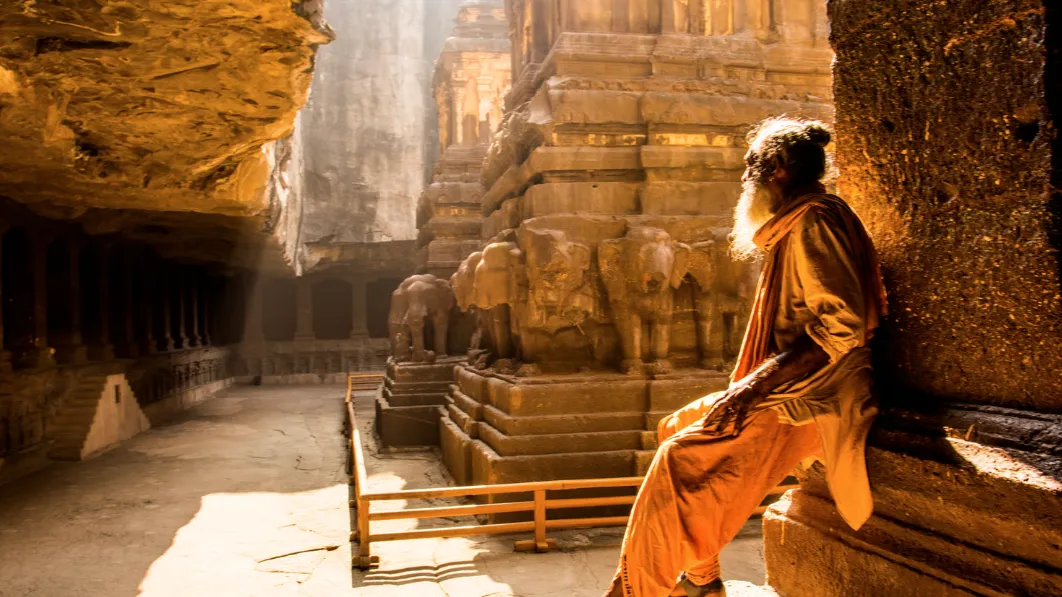
The land of India is filled with mysteries and wonders, and one of the most extraordinary among them is the Kailasa Temple located in the Ellora Caves of Maharashtra. This is not just a temple, but a unique example of ancient Indian engineering, architecture, and art that continues to astound scientists, historians, and archaeologists centuries later. Imagine carving a grand and complex temple from a massive mountain, from top to bottom, approximately 1200 years ago, when modern technology was non-existent! This thought alone can amaze anyone.
The Kailasa Temple is renowned for its unique 'rock-cut' architecture, where the entire temple has been carved from a single massive rock. After seeing it, the question often arises: 'How was it built?' There is no straightforward or simple answer to this question, and this is what makes it one of the world's greatest unsolved mysteries. Let's delve deep into this amazing Indian heritage and try to understand its unsolved mysteries, engineering marvels, and artistic grandeur.
The Glory of Ellora: Introduction to Kailasa Temple
A Marvelous World Carved from a Single Rock
The Ellora Caves, located near Aurangabad, Maharashtra, are a UNESCO World Heritage Site. These 34 caves contain sculptures and artifacts related to Hinduism, Buddhism, and Jainism, created between the sixth and tenth centuries CE. Among all of them, the Kailasa Temple in Cave No. 16 holds a distinct position due to its grandeur and construction style. It is dedicated to Lord Shiva, and its construction is believed to have begun during the reign of King Krishna I of the Rashtrakuta dynasty (circa 756-773 CE).
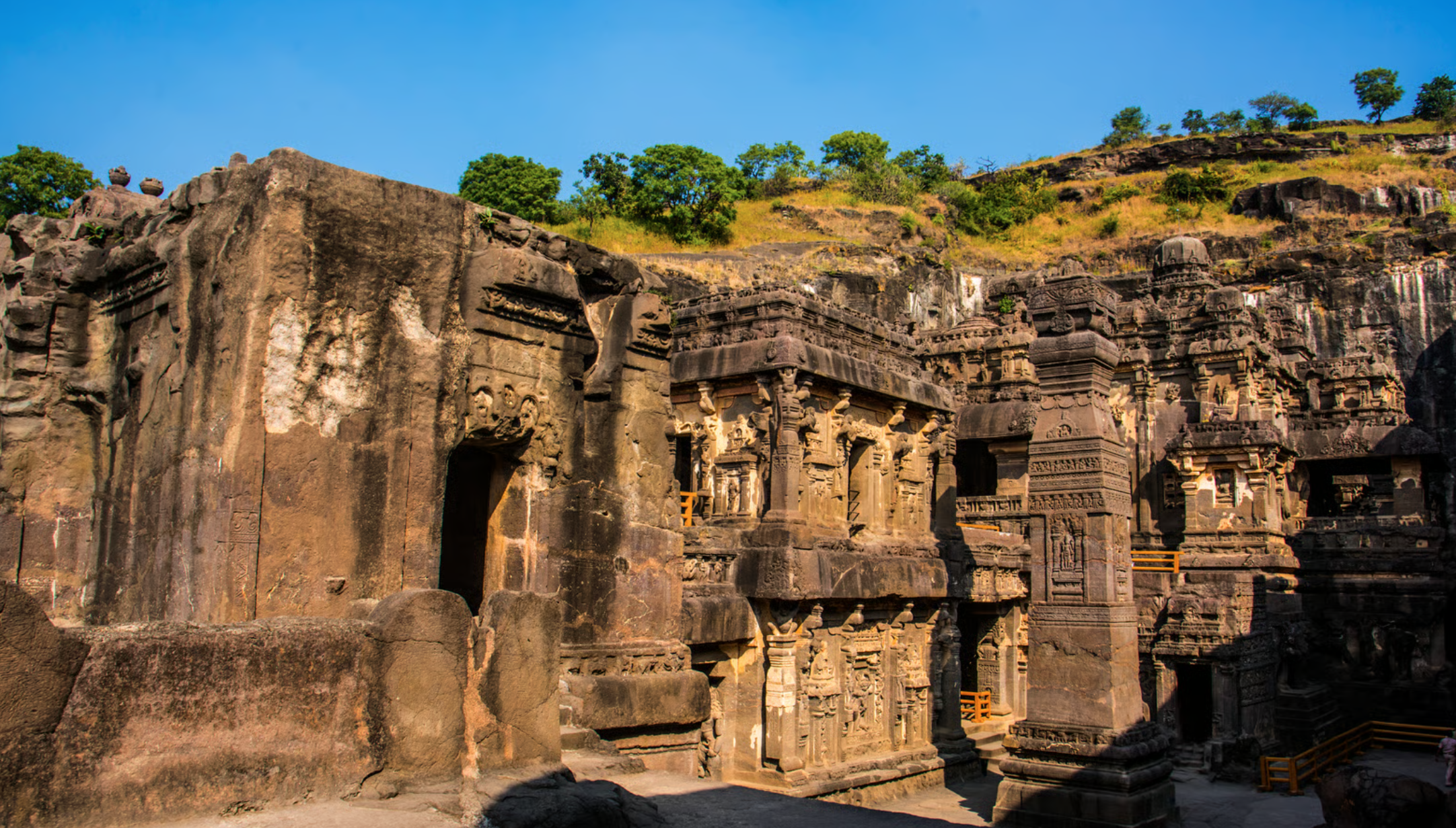
Most temples are built from bricks, stones, and mortar, but the Kailasa Temple is entirely different in this regard. It is not merely a cave carved into a cliff, but a massive basalt rock carved from top to bottom, from outside to inside, to form a free-standing, multi-story temple complex. It is difficult to even imagine how artisans of that era accomplished this feat without any modern machinery, requiring such precision, planning, and immense labor.
The Mysterious Saga of Construction: An Unparalleled Example of Ancient Engineering
The Amazing "Top-down" Technique
The most astonishing feature of the Kailasa Temple's construction is its "top-down" technique. While temples are usually built upwards from the foundation, in the construction of the Kailasa Temple, artisans began excavation and carving from the top of the mountain and gradually moved downwards. This means they first isolated a colossal block from the mountain's summit and then carved that block from the inside out, shaping the complex structure of the temple.
- Planning and Design: This technique would have required extraordinary foresight and detailed planning. The artisans must have had a clear blueprint of the entire structure, its dimensions, internal chambers, pillars, sculptures, and carvings already prepared in their minds or perhaps on an initial model. Even a single wrong cut could have ruined the entire project.
- Water Drainage: This process involved removing a large amount of rock from the mountain. They not only constructed the temple but also designed a complex system for rainwater drainage to prevent any negative impact of water on the temple structure.
- Stability: The top-down carving provided incredible stability to the structure, as it is an integral part of the original rock, increasing its resilience against earthquakes or other natural disasters.
The Challenge of Carving a Gigantic Rock
Historians and geologists estimate that over 400,000 tons of rock would have been removed from the mountain to carve the Kailasa Temple. This figure alone is astonishing. Without modern machinery like dynamite, excavators, or cranes, removing such a vast amount of rock using only chisels, hammers, and possibly other simple tools, and then carving it with such artistry, is an incredible achievement.
- Limitations of Tools: Only hand tools were available at that time. Cutting, breaking, and then performing such intricate carvings on hard basalt rock with these tools would have been a slow and laborious task.
- Physical Labor: This work would have involved thousands of skilled artisans and unskilled laborers. It was not merely a display of physical strength, but the result of profound artistic vision, mathematical precision, and unwavering devotion.
Estimated Time and Human Labor
There are various estimates regarding how long the construction of the Kailasa Temple took, but most experts agree that it was a marathon project spanning decades. Some historians believe it would have taken at least 100 years to complete, while others suggest around 150-200 years between the 7th and 9th centuries CE. This colossal project would have been completed by artisans across several generations rather than one or two. It is also a symbol of an unbroken tradition and the transfer of knowledge.
Rashtrakuta King Krishna I initiated its construction, but subsequent rulers must have also made significant contributions to its completion. This temple symbolizes the wealth, organizational capacity, and dedication to art of Indian civilization at that time. Completing such a massive project with such precision required strong political will, continuous funding, and a skilled workforce.
The Unmatched Architecture and Artistry of Kailasa Temple
Multi-Level Structure and Precise Design
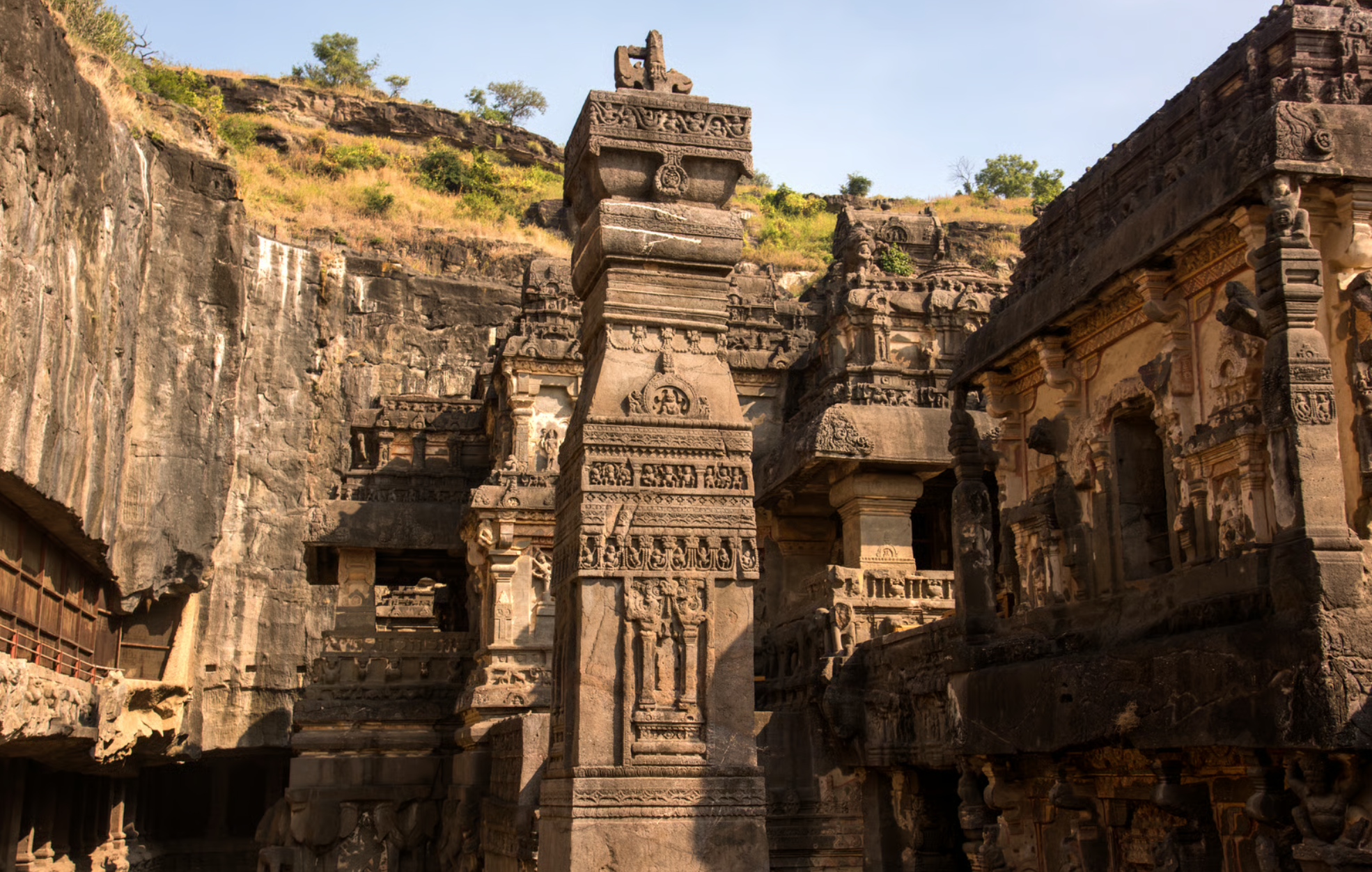
The Kailasa Temple is not a simple building; it is an entire temple complex that includes the main shrine, the Nandi Mandapa, several smaller temples, corridors, pillars, and grand gateways. It is approximately 50 meters long, 33 meters wide, and 30 meters high, which is about half the height of the Qutub Minar in Delhi. The temple's structure is divided into three levels, with intricate staircases, bridges, and galleries connecting them.
- Nandi Mandapa: In front of the main temple, there is a separate pavilion with a massive sculpture of Nandi, Lord Shiva's vehicle, connected to the main temple by a rocky bridge.
- Dwarapalas and Deities: At the entrance of the temple stand colossal dwarapalas (gatekeepers) and sculptures of Hindu deities, captivating devotees with their grandeur.
- Precise Orientation: The temple faces exactly west, which creates a spectacular interplay of light and shadow during sunrise and sunset. This is also evidence of astronomical knowledge and architectural coordination.
A Marvelous World of Sculpture
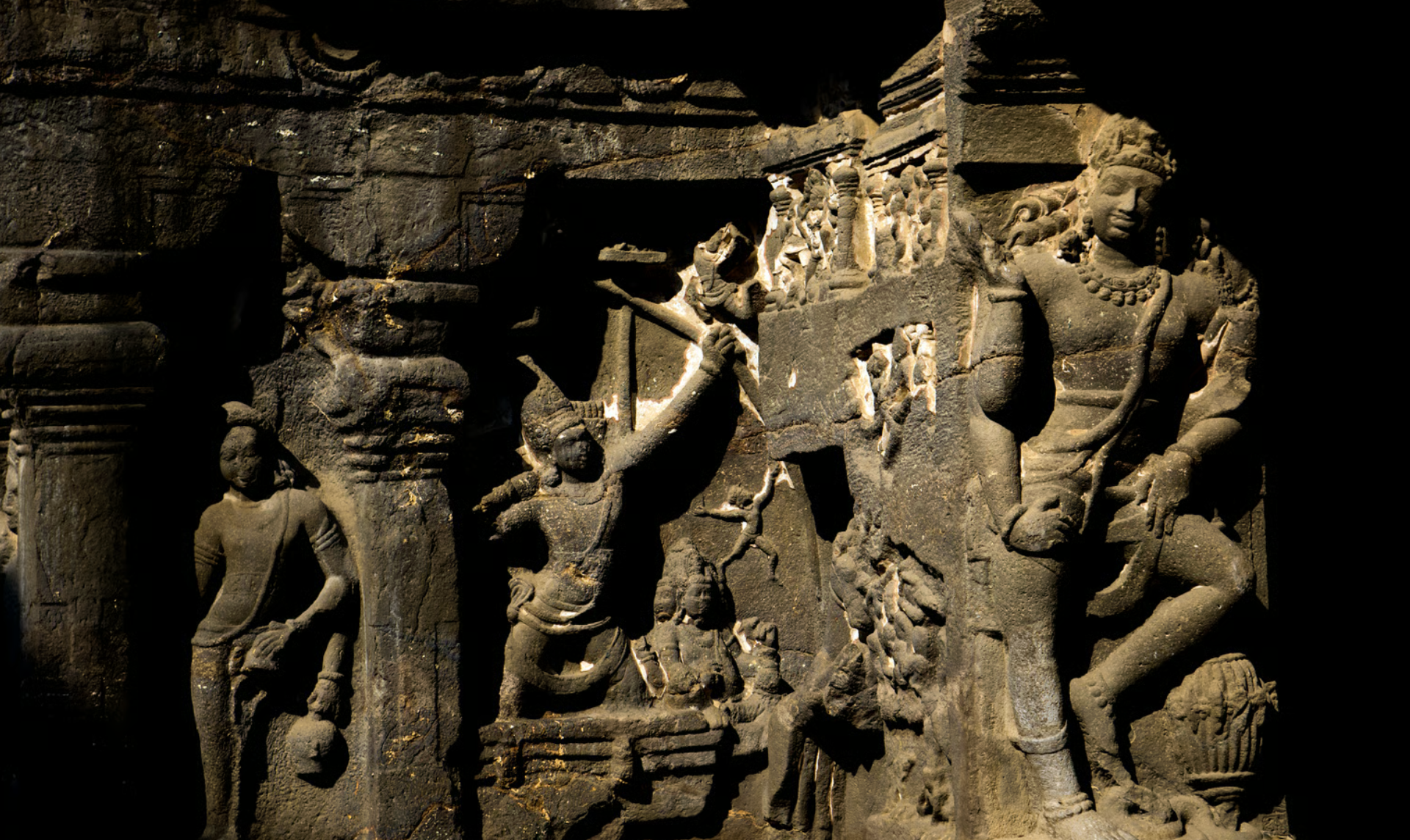
The walls, pillars, and ceilings of the Kailasa Temple are adorned with thousands of intricate sculptures inspired by Hindu scriptures. These sculptures are not only aesthetically appealing but also depict Indian mythology and philosophy.
- Leelas of Shiva: Various forms of Lord Shiva and his divine plays, such as Shiva's Tandava dance, the descent of Ganga, the marriage of Shiva and Parvati, and other benevolent and fierce forms of Shiva, are intricately carved here.
- Ravana Lifting Mount Kailasa: One of the temple's most famous carved scenes depicts the demon king Ravana attempting to lift Mount Kailasa (where Shiva resides). This sculpture portrays extremely vivid and powerful emotions.
- Scenes from Ramayana and Mahabharata: Episodes from epics like the Ramayana and Mahabharata are also intricately carved on the temple walls, showcasing the amazing storytelling ability of the artists of that era.
- Animals and Flora: Besides deities and humans, the temple also features carvings of elephants, lions, and various types of flowers and leaves, which reflect the ancient Indians' love for nature. In the lower section of the temple, there is a row of elephants, which appear as if they are bearing the weight of the entire temple on their shoulders.
A Marvel of Acoustics and Lighting
The artisans of the Kailasa Temple not only carved stones but also understood the principles of acoustics and lighting.
- Echoes of Sound: Certain parts of the temple have specially designed acoustic properties, causing the sounds of mantras and hymns to reverberate wonderfully. This continues to provide a divine experience to devotees even today.
- Natural Light: Natural light also enters the interior parts of the temple in such a way that it dramatically illuminates the sculptures and carvings, creating a mysterious and spiritual atmosphere. This demonstrates the deep understanding of architecture and physics possessed by the artisans of that era.
Legends and Theories Associated with the Construction of Kailasa Temple
The uniqueness of the Kailasa Temple and the complexity of its construction process have made it the subject of many legends and theories. Since no detailed written records regarding its construction are available, people have woven many stories based on their imagination and beliefs.
The Hand of Supernatural Powers?
According to local legends and folklore, the construction of the Kailasa Temple was not possible by ordinary humans. Some believe it was built with the help of gods or supernatural powers. The scale and complexity of the temple are so incredible that for many, it is hard to believe it could have been built solely by human efforts and limited tools. This belief emphasizes that the work was impossible without a higher power or divine inspiration.
The Mystery of "Lost Technology"
Some researchers and enthusiasts have theorized that ancient Indians possessed advanced technologies or tools that were lost over time. They argue that more than just chisels and hammers would have been required to cut and remove hard rocks with such precision and speed. This "lost technology" theory often comes up in discussions concerning other ancient wonders like the Egyptian pyramids, Stonehenge, and ancient sites in South America. However, there is no concrete archaeological evidence to suggest that such advanced technology existed.
Contribution of Aliens or Unknown Civilizations
One of the most extreme theories is that the Kailasa Temple was built by aliens or an unknown, highly advanced ancient civilization. Proponents of this theory often present the temple's massive scale, its allegedly impossible construction method, and some intricate details as their arguments. However, this theory is widely rejected by mainstream archaeologists and historians as there is no scientific evidence to support it. These theories often underestimate human capabilities and attempt to explain wonders that we still do not fully comprehend.
The Legend of One-Night Construction
A popular local legend also states that the Kailasa Temple was built in just one night. This legend is perhaps a way to depict the temple's colossal and complex nature, and to suggest how rapidly and miraculously it was built, as if by magic. Although constructing such a massive structure in one night is physically impossible, this legend expresses people's awe and reverence for the temple.
Scientific and Historical Perspectives: Still a Puzzle Today
Challenges for Archaeologists and Historians
Modern archaeologists and historians have extensively studied the Kailasa Temple. They believe its construction is the result of human endeavors, but they too are astonished by its precision, scale, and techniques.
- Lack of Records: No detailed contemporary records or plans regarding the temple's construction process have been found. This is the biggest challenge, as it directly prevents us from knowing what procedures the artisans followed.
- Replication of Technique: Even with today's modern technology, carving such a complex structure from a single rock on such a massive scale would be extremely expensive and challenging. This emphasizes how extraordinary the efficiency of ancient artisans was.
- Proportional Knowledge: The artisans likely used the 'Golden Ratio' and other mathematical principles, which gave the temple a unique beauty and balance.
Proof of Ancient Indian Knowledge and Skill
The scientific community agrees that the Kailasa Temple is a unique testament to ancient Indian engineering and artistic skill. It demonstrates that Indians at that time possessed a deep understanding of geology, structural engineering, planning, sculpture, and architecture.
- Knowledge of Rock: The artisans had a deep understanding of the characteristics of basalt rock - how it breaks, how it can be carved, and how its structural integrity could be maintained.
- Organization and Coordination: Such a massive project required extraordinary organization and coordination among thousands of people. Different teams would have worked simultaneously - some in rock removal, some in carving, and some in finalizing sculptures.
- Patience and Perseverance: The construction of this temple was not only a result of skill but also of immense patience and perseverance, spanning many generations.
Inspiration for Modern Engineering
Even today, engineers, architects, and artists worldwide view the Kailasa Temple as an inspiration. It is proof that with human imagination, devotion, and determination, nothing is impossible. It also teaches us that even with limited resources, extraordinary results can be achieved if there is a clear vision, skillful planning, and a dedicated workforce. It is a symbol of India's cultural and technological superiority, which challenges and teaches the modern world as well.
Kailasa Temple: An Unforgettable Indian Heritage
Cultural and Spiritual Significance
The Kailasa Temple is not merely an engineering marvel; it is a living Shiva temple that continues to attract devotees and visitors today. It symbolizes the rich traditions, artistic expression, and religious devotion of Hinduism. Every carving, every sculpture inside and outside the temple tells a story, expresses a philosophy. It reflects the deep faith and love for art in Indian society that has continued for centuries. It connects us to our roots and gives us an opportunity to be proud of our rich cultural heritage.
Recognition as a World Heritage Site
Due to its uniqueness and global significance, the Kailasa Temple, as part of the Ellora Caves complex, was designated a UNESCO World Heritage Site in 1983. This recognition underscores the importance of its preservation and its cultural relevance worldwide. It is our collective duty to ensure that this extraordinary monument remains preserved for future generations, so that they too can ponder its mysteries and experience its grandeur.
The Kailasa Temple is a marvel that transcends the boundaries of time and logic. It is an unparalleled example of Indian engineering and artistry that continues to astound scientists and ordinary people alike. Its mysteries compel us to reflect on the capabilities of our ancient civilizations and remind us how powerful and creative the human spirit can be. If you ever visit Ellora, be sure to experience the grandeur of this magnificent temple. Every carving, every stone within it holds centuries of mystery and boundless artistry, offering an unforgettable experience.
संबंधित तस्वीरें (Related Images)
अक्सर पूछे जाने वाले प्रश्न (FAQ)
Q: Where is Kailasa Temple located?
Kailasa Temple is located in the Ellora Caves near Aurangabad, Maharashtra.
Q: What is Kailasa Temple famous for?
Kailasa Temple is famous for its unique 'rock-cut' architecture, where the entire temple has been carved from a single massive rock. It is an unparalleled example of ancient Indian engineering and art.
Q: Who built the Kailasa Temple?
The construction of Kailasa Temple is believed to have begun during the reign of King Krishna I of the Rashtrakuta dynasty (circa 756-773 CE).
Q: To which deity is Kailasa Temple dedicated?
Kailasa Temple is dedicated to Lord Shiva.
Q: Approximately how many years ago was the Kailasa Temple built?
The Kailasa Temple was built approximately 1200 years ago, between the sixth and tenth centuries CE.
Q: What is the construction style of Kailasa Temple that makes it unique?
The most unique feature of Kailasa Temple is its amazing "top-down" technique, where excavation and carving began from the top of the mountain.
Q: Why are the Ellora Caves a UNESCO World Heritage Site?
The Ellora Caves contain sculptures and artifacts related to Hinduism, Buddhism, and Jainism, created between the sixth and tenth centuries CE, and they are a UNESCO World Heritage Site due to their grandeur and historical significance.
Q: What type of rock was used in the construction of Kailasa Temple?
A massive basalt rock was used in the construction of Kailasa Temple, which was carved from top to bottom to form the temple.
Q: In which cave number is Kailasa Temple located?
Kailasa Temple is located in Cave No. 16 of Ellora.
Q: Why is the construction of Kailasa Temple called a marvel of ancient engineering?
It is called a marvel of ancient engineering because a grand and complex temple was carved from a massive mountain, from top to bottom, approximately 1200 years ago without any modern technology, requiring extraordinary precision and planning.
Q: Is Kailasa Temple just a cave?
No, Kailasa Temple is not merely a cave carved into a cliff; rather, a massive rock was carved from top to bottom, from outside to inside, to form a free-standing, multi-story temple complex.
Q: What is the significance of the 'top-down' approach for construction?
The significance of the 'top-down' approach is that it demands extraordinary foresight and detailed planning. Artisans had to prepare the blueprint of the entire structure in advance, as even a single wrong cut could have ruined the entire project.
Q: Which religions' artifacts are found in Kailasa Temple?
Kailasa Temple is primarily a Hindu temple dedicated to Lord Shiva.
Q: Was modern technology used in the Kailasa Temple?
No, Kailasa Temple was built approximately 1200 years ago, when modern technology was non-existent.
Q: Who is still astonished by the grandeur of Kailasa Temple today?
The grandeur of Kailasa Temple continues to astound scientists, historians, and archaeologists even today.

Author
Praarthana Editorial Team
The Praarthana Editorial Team shares daily spiritual guidance, authentic rituals, and deep insights from ancient Sanatan scriptures to support your spiritual journey.





ऐप डाउनलोड करें
पंचांग तिथि, त्यौहार, व्रत, उत्सव, एकादशी, आरती संग्रह, मंत्र, व्रत कथा



एक टिप्पणी छोड़ें