
Namo Devyai Mahadevyai Shivayai Satatam Namah | Namah Prakrityai Bhadrayai Niyatah Pranatah Smritam ||
महादेवी नमस्कार मंत्र (Namo Devyai Mahadevyai Shivayai) के गहन अर्थ, आध्यात्मिक लाभ और सही जाप विधि जानें। आंतरिक शांति और सुरक्षा के लिए शक्तिशाली देवी मंत्र।
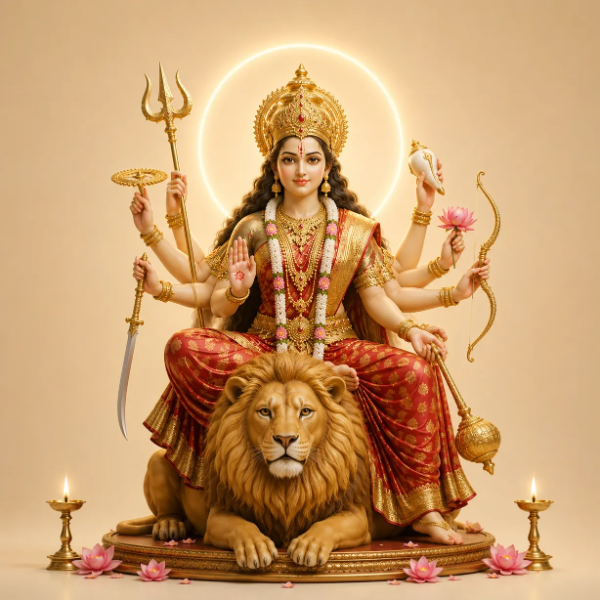
Meaning of Mantra
Our constant salutations to the Goddess, the Great Goddess, the auspicious one (consort of Shiva). Salutations to Prakriti (the primordial nature), the benevolent one. We who are devoted and constantly bow down to Her are remembered (by Her).
Benefits & Science
Benefits of Chanting:
Chanting the Mahadevi Namaskar Mantra regularly invokes the blessings of the Divine Mother, leading to profound spiritual and material benefits. It purifies the mind and heart, alleviating stress and anxiety, and filling the devotee with positive energy. The mantra acts as a shield, protecting against adverse circumstances and evil influences. By aligning oneself with the cosmic energy of Mahadevi, practitioners experience enhanced intuition, improved decision-making abilities, and a harmonious life path, ultimately leading to self-realization and liberation.
Scientific Perspective:
While direct 'scientific proof' for mantra efficacy in the empirical sense is challenging, neuroscientific studies suggest that rhythmic chanting and focused meditation (which chanting facilitates) can alter brainwave patterns, leading to states of deep relaxation (alpha and theta waves). This can reduce stress hormones like cortisol, improve cardiovascular health, and enhance cognitive functions such as concentration and memory. The vibrational aspect of sound, even in ancient traditions, is believed to positively influence the body's energy centers, potentially leading to holistic well-being.
Mythology & Origin
Mantra Origin Saga:
This mantra is a traditional Vedic-Puranic salutation to the Divine Mother, a core expression of reverence for Mahadevi, who is often identified with Parvati, Durga, or Adi Shakti. It emerges from the deep philosophical understanding of the feminine as the primordial creative force.
Scriptures Mentions:
Devi Mahatmyam (Markandeya Purana), Lalita Sahasranama (Brahmanda Purana), various Tantras and Puranas, particularly those associated with Shaktism.
Associated Rishi & Deity:
Primarily associated with Goddess Mahadevi (Durga, Parvati, Shakti) herself, and revered by countless sages (rishis) and devotees throughout Hindu history.
Historical Significance:
This mantra encapsulates the essence of Shaktism, one of the oldest and most significant traditions within Hinduism, emphasizing the supremacy of the Divine Feminine. Its widespread use signifies the enduring reverence for Mahadevi as the ultimate source of power, wisdom, and liberation, influencing countless generations of devotees and shaping Hindu philosophical thought.
Frequently Asked Questions (FAQs)
Who is Mahadevi?
What is the significance of 'Prakriti' in this mantra?
Can this mantra be chanted by anyone?
Is there a specific time of day best for chanting this mantra?
What kind of mala should be used for this mantra?
How long should one chant this mantra to see results?
Does chanting this mantra require initiation (Deeksha)?
What is the meaning of 'नियताः प्रणताः स्मृताम्' (Niyatah Pranatah Smritam)?
Mantra Sadhana Guidelines
Best Time to Chant
- Mondays are especially auspicious and beneficial.
- Early morning Brahma Muhurta (4:00 - 6:00 AM) is best.
- Highly fruitful during Pradosh Kaal and Mahashivratri.
- Chant before commencing any auspicious task or ritual.
Other Popular Adi Shakti Mantras
Other Devotional Categories

Download App
पंचांग तिथि, त्यौहार, व्रत, उत्सव, एकादशी, आरती संग्रह, मंत्र, व्रत कथा