
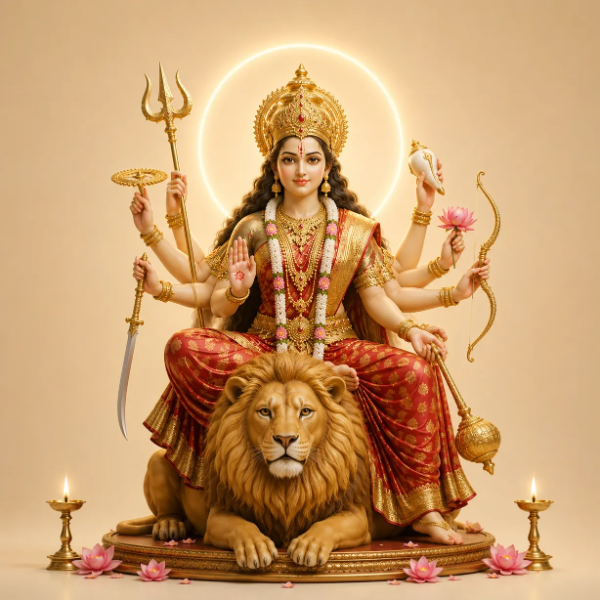
Ya Devi Sarvabhuteshu Shakti Rupena Samsthita. Namastasyai Namastasyai Namastasyai Namo Namah.
या देवी सर्वभूतेषु मंत्र का गहरा अर्थ जानें। इसके आध्यात्मिक लाभ, वैज्ञानिक महत्व, और सही उच्चारण के साथ अपनी आंतरिक शक्ति जागृत करें।
Meaning of Mantra
Salutations to that Divine Goddess who resides in all beings as the form of power. We bow to Her, we bow to Her, we bow to Her again and again.
Benefits & Science
Benefits of Chanting:
Chanting 'Ya Devi Sarvabhuteshu' regularly helps in recognizing the divine presence within and around oneself, leading to profound spiritual growth. It instills courage to face life's challenges, removes fear, and purifies the mind. By acknowledging the divine Shakti in all beings, it cultivates empathy, reduces ego, and fosters a sense of interconnectedness, ultimately leading to inner peace and external harmony. It acts as a shield against negativity and attracts positive vibrations, fulfilling desires aligned with one's higher self.
Scientific Perspective:
From a neuro-scientific standpoint, rhythmic chanting, especially of Sanskrit mantras, can induce a meditative state, lowering brainwave frequencies to alpha and theta states. This promotes relaxation, reduces stress hormones like cortisol, and enhances neural plasticity. The specific vibrations generated by 'Ya Devi Sarvabhuteshu' are believed to resonate with the body's energy centers (chakras), particularly those related to power and compassion, potentially improving overall well-being and cognitive function by enhancing focus and emotional regulation.
Mythology & Origin
Mantra Origin Saga:
This powerful mantra originates from the Devi Mahatmyam (also known as Durga Saptashati or Chandi Path), a part of the Markandeya Purana. It is recited by the Rishis (sages) in praise of the Divine Mother, Devi, particularly when she manifests to protect the cosmos and annihilate evil forces.
Scriptures Mentions:
Devi Mahatmyam (Durga Saptashati), Markandeya Purana.
Associated Rishi & Deity:
Goddess Durga (Mahadevi, Adi Shakti), Lord Brahma, various Rishis like Medha Rishi and King Suratha.
Historical Significance:
The mantra holds immense significance in Shaktism, the worship of the Divine Mother. It is a central hymn recited during Navaratri and other Devi festivals. Its historical role is to remind devotees of the omnipresent and omnipotent nature of Shakti, inspiring devotion and reinforcing the belief in divine protection and justice against all odds. It emphasizes the inherent divinity in all forms of life.
Frequently Asked Questions (FAQs)
Who is Devi in the mantra 'Ya Devi Sarvabhuteshu'?
What is the significance of 'Shakti-rupena Samsthita'?
Can anyone chant this mantra, regardless of religion?
Is there a specific time or day best for chanting this mantra?
What does chanting this mantra do to the mind?
Can this mantra be used for specific desires or wishes?
Is it necessary to use a mala (rosary) while chanting?
Mantra Sadhana Guidelines
Best Time to Chant
- Mondays are especially auspicious and beneficial.
- Early morning Brahma Muhurta (4:00 - 6:00 AM) is best.
- Highly fruitful during Pradosh Kaal and Mahashivratri.
- Chant before commencing any auspicious task or ritual.
Other Popular Adi Shakti Mantras
Other Devotional Categories


Download App
पंचांग तिथि, त्यौहार, व्रत, उत्सव, एकादशी, आरती संग्रह, मंत्र, व्रत कथा