
Om Ghrinih Suryaya Namah
Explore the profound Om Ghrinih Suryaya Namah mantra for vitality, health, and spiritual illumination. Learn its meaning, benefits, and chanting guide for positive energy. Deep Vedic wisdom explained.
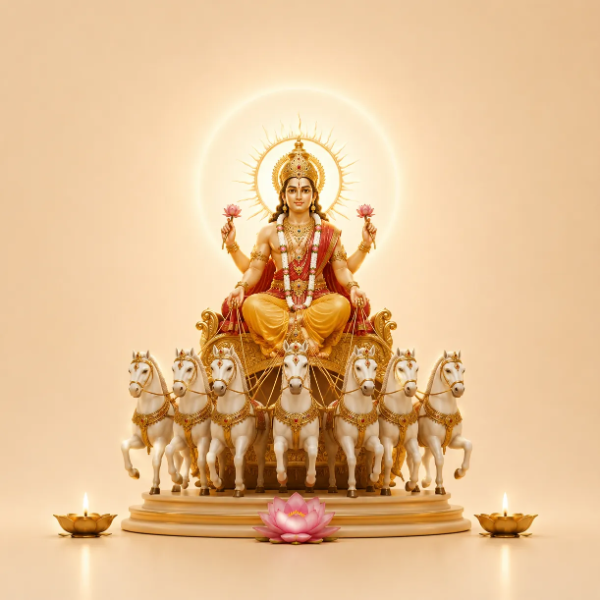
Meaning of Mantra
The mantra "Om Ghrinih Suryaya Namah" is a profound salutation to Lord Surya, the Sun God, recognizing him as the source of all light, energy, and life. "Om" invokes the ultimate reality and cosmic vibration. "Ghrinih" describes the radiant warmth, brilliance, and compassionate energy that emanates from the Sun, vitalizing all creation. "Suryaya" specifically addresses Surya, acknowledging his divine role. "Namah" signifies respectful bowing and surrender, expressing profound reverence for the celestial benefactor. In essence, it means: "Om, Salutations to Lord Surya, who is full of radiance and warmth, the giver of light and life."
Benefits & Science
Benefits of Chanting:
Chanting 'Om Ghrinih Suryaya Namah' regularly is believed to invoke the powerful life-giving energy of the Sun. This can lead to enhanced physical vitality, helping to strengthen immunity and support overall well-being. Mentally, the mantra is associated with improved clarity, focus, and sharper intellect, aiding in decision-making and problem-solving. Spiritually, it acts as a beacon, dispelling the darkness of ignorance and fostering inner wisdom and enlightenment. The radiant energy of Surya cultivates positive thoughts and removes mental blocks, leading to greater confidence, courage, and a more optimistic outlook on life. It is also believed to attract opportunities for growth, success, and prosperity by aligning the chanter with the universal source of abundance.
Scientific Perspective:
From a scientific standpoint, mantra chanting, including 'Om Ghrinih Suryaya Namah,' involves rhythmic vocalization and repetition, which can induce a meditative state. The sound vibrations resonate through the body, potentially stimulating the vagus nerve, which plays a crucial role in regulating heart rate, mood, and digestion, promoting a sense of calm and reducing stress. This meditative practice can lead to a reduction in stress hormones like cortisol and an increase in beneficial neurochemicals. The focused repetition can synchronize brainwave patterns, often shifting them towards alpha or theta states, associated with relaxation, heightened creativity, and improved cognitive function. While direct sunlight provides Vitamin D, the energetic invocation through sound is understood as harnessing subtle energies that can influence our psycho-physiological state positively, enhancing mental resilience and emotional balance.
Mythology & Origin
Mantra Origin Saga:
The worship of Surya, the Sun God, is one of the most ancient and fundamental practices in Vedic traditions. His hymns are found extensively in the Rig Veda, marking him as a primordial deity. The mantra 'Om Ghrinih Suryaya Namah' is a specific invocation, often considered a variation or a potent 'beej' (seed) mantra for Surya, drawing from the deep reverence for the Sun as the giver of life, sustenance, and light to the entire cosmos.
Scriptures Mentions:
Surya is revered across various Vedic scriptures. The Rig Veda contains numerous hymns (suktas) dedicated to him, extolling his virtues as the dispeller of darkness and disease. The Yajur Veda and Atharva Veda also mention him prominently. The Surya Upanishad is entirely dedicated to the philosophical and spiritual aspects of Surya worship. Furthermore, Puranic texts such as the Brahma Purana, Markandeya Purana, and Samba Purana narrate elaborate legends and glorify Surya Dev as a paramount deity, often associated with healing and prosperity.
Associated Rishi & Deity:
While the origin of many Vedic mantras is attributed to various Rishis, Surya himself is often considered the 'devata' (deity) to whom this mantra is addressed. The overarching wisdom associated with solar worship connects to ancient seers like Rishi Agastya and Rishi Vishwamitra, who are also credited with other powerful solar mantras, including the revered Gayatri Mantra, which is fundamentally a solar invocation.
Historical Significance:
Historically, Surya worship has been integral to Indian culture, influencing agriculture, calendar systems, and daily rituals. Ancient civilizations recognized the Sun's critical role in sustaining life, leading to the development of sophisticated astronomical observations and solar temples (like Konark Sun Temple). This mantra, along with practices like Surya Namaskar (Sun Salutation), reflects a deep-seated scientific and spiritual understanding of the Sun's influence on human health, well-being, and consciousness, practiced by kings, sages, and common people alike for centuries.
Frequently Asked Questions (FAQs)
Who is Surya Dev and why is this mantra addressed to him?
What is the significance of the word 'Ghrinih' in this mantra?
Can chanting this mantra help with specific health issues?
Is this mantra suitable for beginners in spiritual practice?
What is the connection between this mantra and the physical Sun?
Do I need a guru or initiation to chant this mantra?
How does chanting this mantra benefit my spiritual path?
What is the proper posture and environment for chanting?
Are there any specific days or times when chanting is more potent?
Mantra Sadhana Guidelines
Best Time to Chant
- Mondays are especially auspicious and beneficial.
- Early morning Brahma Muhurta (4:00 - 6:00 AM) is best.
- Highly fruitful during Pradosh Kaal and Mahashivratri.
- Chant before commencing any auspicious task or ritual.
Other Popular Lord Surya Dev Mantras
Other Devotional Categories



Download App
पंचांग तिथि, त्यौहार, व्रत, उत्सव, एकादशी, आरती संग्रह, मंत्र, व्रत कथा