Brahma Murari Surarchita Lingam Mantra
Explore the deep spiritual meaning, benefits, and origin of the Brahma Murari Surarchita Lingam Mantra. A powerful praise for Lord Shiva.
Meaning of Mantra
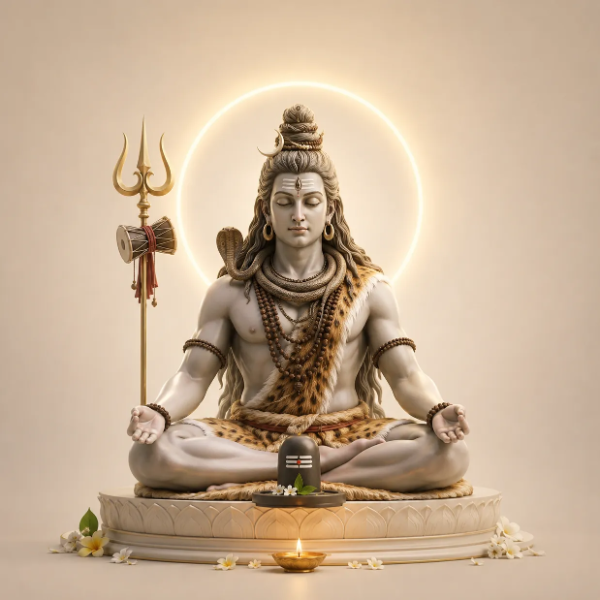
The Lingam worshipped by Brahma, Murari (Vishnu), and all the Devas; the Lingam that is pure, radiant, and splendid; the Lingam that annihilates the sorrows arising from the cycle of birth and death – to that Sadashiva Lingam, I offer my humble obeisance.
Benefits & Science
Benefits of Chanting:
Chanting the Brahma Murari Surarchita Lingam mantra with devotion offers a multitude of profound benefits. Spiritually, it acts as a powerful catalyst for **spiritual purification**, cleansing the mind of negative thought patterns and emotional impurities, thus fostering inner clarity. The meditative repetition can induce a state of **mental peace**, calming anxieties and reducing stress by focusing the mind on the divine. By invoking Lord Shiva, the destroyer of ignorance and suffering, practitioners may experience **relief from suffering** (Duhkha), addressing both emotional pain and the deeper existential unease. It bestows **divine protection**, creating a spiritual shield against negative influences and obstacles on one's path. Regular chanting significantly enhances **devotion** and strengthens one's connection to the divine, deepening faith and surrender. This connection, in turn, cultivates **inner strength** and resilience, enabling individuals to face life's challenges with courage. The contemplation inherent in the mantra leads to **clarity of thought**, helping in decision-making and understanding complex situations. Ultimately, invoking Sadashiva brings **auspiciousness** into one's life, inviting positive energies and favorable circumstances, and effectively **destroys negativity**, transforming detrimental patterns and environments into opportunities for growth and well-being.
Scientific Perspective:
From a scientific lens, the practice of chanting this mantra engages several psychophysiological mechanisms. The rhythmic recitation of Sanskrit syllables creates specific **sound vibrations** that resonate within the body and mind. These vibrations, particularly when sustained, can lead to **brainwave entrainment**, shifting the brain from high-frequency beta waves (associated with alertness and stress) towards lower-frequency alpha (relaxed awareness) and theta waves (deep relaxation, meditation, creativity) states. This shift is conducive to reduced anxiety and enhanced mental clarity. The act of vocalization and controlled breathing inherent in chanting stimulates the **vagus nerve**, a crucial component of the parasympathetic nervous system. Vagal nerve activation promotes a 'rest and digest' state, reducing heart rate, blood pressure, and cortisol levels, thereby inducing a profound sense of calm and well-being. Consistent practice can also contribute to **neuroplasticity**, strengthening neural pathways associated with focus, emotional regulation, and self-awareness. The structured repetition helps in cultivating mindfulness, improving attention span, and fostering a sense of inner balance, all of which are increasingly recognized benefits within contemporary neuroscience and psychology.
Mythology & Origin
Mantra Origin Saga:
This profound verse is a prominent part of the 'Lingashtakam', an octet of hymns revered in Shaivism, widely attributed to the great philosopher-saint Adi Shankaracharya (8th century CE). The Lingam itself, as a symbol of Shiva, predates recorded history, with archaeological evidence suggesting its worship in the Indus Valley Civilization. The most compelling mythological origin narrative associated with the Lingam is the 'Jyotirlingam' legend. According to the Shiva Purana, Lord Brahma and Lord Vishnu once debated their supremacy. To resolve this, Lord Shiva manifested as an infinite, blazing pillar of light – the Jyotirlingam – whose beginning and end neither Brahma nor Vishnu could find. This cosmic pillar represents Shiva's supreme, formless, and infinite nature, transcending all creation and preservation.
Scriptures Mentions:
The concept and worship of Shiva Lingam are extensively detailed in major Puranas such as the **Shiva Purana**, **Linga Purana**, and **Skanda Purana**. These texts elaborate on the significance of various Lingam forms, their installation, and the rituals associated with their worship. The philosophical underpinnings of Shiva's formless aspect are also touched upon in the later Upanishads and various Agamic traditions.
Associated Rishi & Deity:
The primary deity worshipped is **Lord Shiva**, specifically in his formless yet all-encompassing manifestation as the Lingam, and referred to as **Sadashiva** (the eternally auspicious one). The mantra explicitly mentions **Lord Brahma** (the creator), **Lord Murari** (Vishnu, the preserver), and **Suras** (all other celestial deities) as being its worshippers, highlighting Shiva's supreme position in the cosmic hierarchy. The composition of the broader 'Lingashtakam' is attributed to **Adi Shankaracharya**, whose profound philosophical insights solidified the Advaita Vedanta tradition and contributed immensely to the resurgence of Sanatana Dharma.
Historical Significance:
The worship of the Shiva Lingam has been a cornerstone of Shaivism, one of the oldest and most widespread branches of Hinduism, for millennia. Historically, it signifies a profound philosophical understanding of divinity that transcends anthropomorphic forms, representing the cosmic creative and destructive energies in a unified symbol. Temples dedicated to Shiva Lingam, from ancient cave shrines to grand architectural marvels, dot the Indian subcontinent and beyond, testifying to its enduring cultural and spiritual importance. It played a crucial role in the development and spread of Shaivite traditions, integrating diverse regional beliefs into a cohesive spiritual framework and influencing art, architecture, and philosophical thought throughout Indian history.
Frequently Asked Questions (FAQs)
What is a Shiva Lingam?
Who composed this specific mantra?
What does 'Sadashiva' signify in this mantra?
Is prior initiation (Diksha) required to chant this mantra?
What are the primary spiritual benefits of regularly chanting this mantra?
Can chanting this mantra help with everyday problems?
Is there a specific time or day considered most potent for chanting this mantra?
Does understanding the Sanskrit meaning enhance the mantra's effect?
Mantra Sadhana Guidelines
Best Time to Chant
- Mondays are especially auspicious and beneficial.
- Early morning Brahma Muhurta (4:00 - 6:00 AM) is best.
- Highly fruitful during Pradosh Kaal and Mahashivratri.
- Chant before commencing any auspicious task or ritual.
Other Popular Lord Shiva Mantras
Other Devotional Categories


Download App
पंचांग तिथि, त्यौहार, व्रत, उत्सव, एकादशी, आरती संग्रह, मंत्र, व्रत कथा