
Nagendraharaya Trilochanaaya Bhasmangaraagaya Maheshwaraaya. Nityaaya Shuddhaaya Digambaraaya Tasmai Nakaaraaya Namah Shivaaya.
नागेन्द्रहाराय त्रिलोचनाय शिव ध्यान स्तोत्र का गहरा अर्थ जानें। भगवान शिव के दिव्य गुणों का वर्णन, आध्यात्मिक लाभ, जप विधि, और नियम खोजें।
Meaning of Mantra
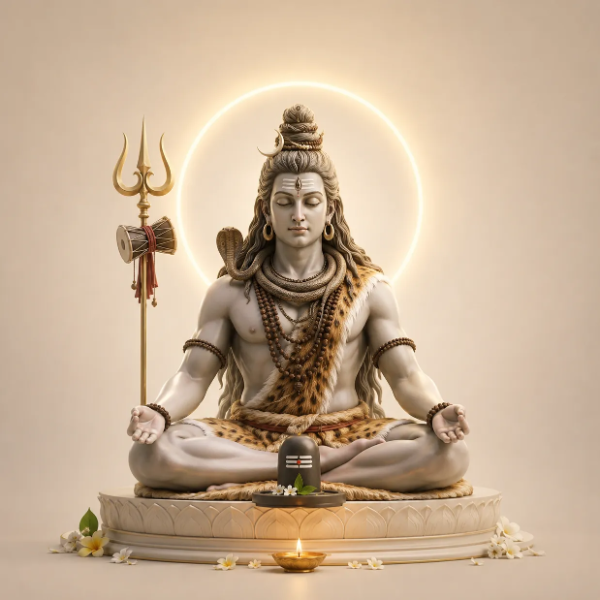
Salutations to Lord Shiva, who wears the king of snakes as a garland, who has three eyes, whose body is adorned with sacred ashes, the Great Lord, the Eternal, the Pure, who is clad in the directions (unbound by material possessions), to that form of the syllable 'Na' (in Namah Shivaya), I bow.
Benefits & Science
Benefits of Chanting:
Chanting the Nagendraharaya Stotram is a powerful spiritual practice that connects the devotee with the cosmic energy of Lord Shiva. It systematically invokes different aspects of Shiva's glory, leading to purification of thoughts, emotional stability, and spiritual enlightenment. The repeated contemplation of Shiva's attributes – His detachment, purity, and power over cosmic forces – instills these qualities within the chanter. It acts as a shield against negativity, promotes a sense of inner balance, and guides the practitioner towards moksha (liberation) by fostering an understanding of the true self.
Scientific Perspective:
From a scientific viewpoint, mantra chanting, including this stotram, involves rhythmic sound vibrations that can positively impact the brain and body. The repetition and focus required for chanting act as a form of meditation, reducing stress hormones and promoting a state of relaxation. The specific Sanskrit phonetics are believed to stimulate different parts of the brain, enhancing cognitive functions and emotional regulation. The consistent practice can lead to improved memory, better concentration, and a greater sense of well-being, similar to the effects observed in mindfulness practices.
Mythology & Origin
Mantra Origin Saga:
This verse is the first shloka (verse) of the renowned 'Shiva Panchakshara Stotram', a powerful hymn dedicated to Lord Shiva. It is widely attributed to the great philosopher and theologian Adi Shankaracharya, who lived in the 8th century CE.
Scriptures Mentions:
The Shiva Panchakshara Stotram is a standalone devotional text. Its philosophical underpinnings align with Vedic wisdom, particularly as expounded in the Upanishads and Shaiva Agamas, which describe Shiva as the supreme reality.
Associated Rishi & Deity:
Adi Shankaracharya is traditionally credited with composing this stotram, among many other hymns and philosophical treatises that consolidated the Advaita Vedanta philosophy.
Historical Significance:
The Shiva Panchakshara Stotram, including this verse, holds immense historical and spiritual significance in Hinduism, particularly within the Shaiva tradition. It is a cornerstone of devotional literature that helped popularize the worship of Shiva in a structured and philosophical manner, making complex spiritual truths accessible through simple yet profound verses.
Frequently Asked Questions (FAQs)
Who is this Stotram dedicated to?
What is the significance of 'Nagendraharaya'?
Why is Shiva referred to as 'Trilochana' (three-eyed)?
What does 'Digambara' signify in the context of Shiva?
Can beginners chant this Stotram?
Mantra Sadhana Guidelines
Best Time to Chant
- Mondays are especially auspicious and beneficial.
- Early morning Brahma Muhurta (4:00 - 6:00 AM) is best.
- Highly fruitful during Pradosh Kaal and Mahashivratri.
- Chant before commencing any auspicious task or ritual.
Other Popular Lord Shiva Mantras
Other Devotional Categories



Download App
पंचांग तिथि, त्यौहार, व्रत, उत्सव, एकादशी, आरती संग्रह, मंत्र, व्रत कथा