
Om Chandrashekharaya Namah
Explore the profound meaning, benefits, and correct chanting methods of Om Chandrashekharaya Namah mantra. Connect with Lord Shiva for inner peace, wisdom, and spiritual protection.
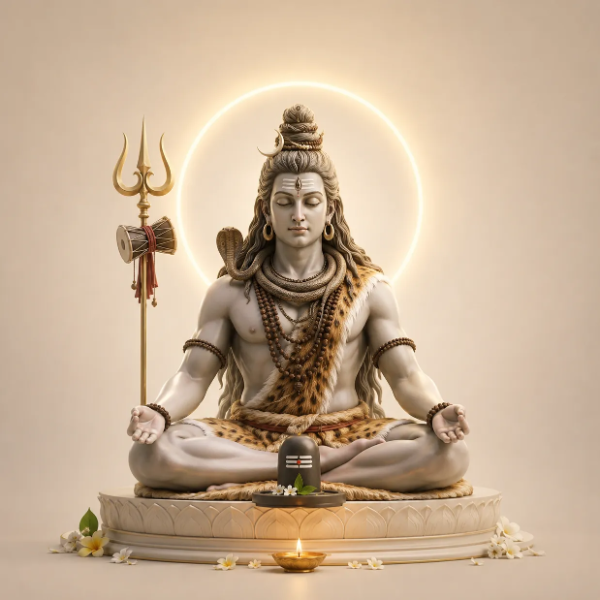
Meaning of Mantra
This mantra translates to "Salutations to Lord Shiva, who bears the crescent moon upon His head." It is a profound invocation of Lord Shiva in His form as Chandrashekhara, emphasizing His serene, powerful, and mind-controlling attributes. Chanting this mantra connects the devotee with the divine energy of Shiva, seeking His blessings for peace, wisdom, and spiritual well-being.
Benefits & Science
Benefits of Chanting:
Regular chanting of "Om Chandrashekharaya Namah" is widely believed to cultivate profound mental peace by calming the restless mind and alleviating anxiety. It aids in achieving emotional equilibrium, thereby reducing stress and promoting a sense of inner well-being. Devotees often report a heightened sense of protection from negative influences and an accelerated path towards spiritual awakening. The mantra is said to enhance wisdom, strengthen one's devotion towards the divine, and assist in gracefully navigating and overcoming various life obstacles. Through consistent practice, it can lead to improved intuition, a deep and abiding inner serenity, and even contribute to harmonizing planetary influences, particularly for the Moon (Chandra graha) in one's astrological chart, promoting holistic health and spiritual evolution.
Scientific Perspective:
The rhythmic chanting of "Om Chandrashekharaya Namah" generates specific sonic vibrations that resonate through the vocal cords, chest, and skull. The primordial sound 'Om' is particularly noted for its ability to stimulate the vagus nerve, a critical component of the parasympathetic nervous system. This stimulation can induce a 'rest and digest' state, effectively reducing physiological stress markers like cortisol and promoting relaxation. The repetitive nature of the mantra helps to synchronize brainwave patterns, often leading to the dominance of alpha and theta waves, associated with deep relaxation, meditation, and enhanced cognitive functions such as focus and creativity. The consistent resonance created by these sacred syllables is believed to facilitate a harmonious internal environment, supporting neurochemical balance and overall psychological well-being.
Mythology & Origin
Mantra Origin Saga:
The epithet 'Chandrashekhara' (the one who bears the moon on his head) for Lord Shiva stems from several ancient Hindu Puranic narratives. A prominent story is from the Samudra Manthan (churning of the cosmic ocean). When the deadly poison Halahala emerged, threatening to annihilate all creation, Lord Shiva consumed it to protect the universe. The moon god Chandra, who was afflicted by a curse from Daksha Prajapati, sought refuge from Shiva. Out of immense compassion, Shiva placed Chandra on his forehead, thereby alleviating his suffering and granting him an eternal place of honor. This act solidified Shiva's identity as Chandrashekhara, symbolizing His benevolence, healing power, and role as the ultimate protector of both mortals and deities.
Scriptures Mentions:
The form of Shiva as Chandrashekhara is extensively revered across numerous Hindu scriptures. He is extolled in the Shiva Purana, Linga Purana, Skanda Purana, and the Mahabharata, among others. His name 'Chandrashekhara' frequently appears in Shiva Sahasranamavalis (lists of 1000 names) and various Stotras (hymns) dedicated to Lord Shiva, such as the Chandrashekhara Ashtakam. These scriptures elaborate on the mythological accounts, philosophical implications, and the profound benefits of worshipping Shiva in this compassionate and majestic form, solidifying its importance in Hindu spiritual practices.
Associated Rishi & Deity:
The primary deity associated with this mantra is Lord Shiva Himself, revered as Chandrashekhara. While many mantras are revealed through specific Rishis (sages), the Chandrashekhara mantra is a direct invocation of a specific divine attribute and form of Shiva. Historically, sages like Markandeya and Vamadeva are profoundly connected with Shiva worship and revelation of Shiva mantras, contributing to the rich tradition of Shiva bhakti.
Historical Significance:
The worship of Chandrashekhara Shiva holds significant historical prominence, deeply embedded in India's cultural and spiritual heritage. Ancient temples, particularly those dating back to the Pallava, Chola, and Chalukya dynasties, feature intricate sculptures and inscriptions depicting Shiva as Chandrashekhara, showcasing its widespread reverence. This form has inspired countless devotional hymns, classical dances, and artistic representations, underscoring Shiva's universal appeal as the supreme deity who embodies both fierce cosmic power and boundless compassion. Its historical presence testifies to its enduring influence on spiritual practices and the collective consciousness of devotees over millennia.
Frequently Asked Questions (FAQs)
Who is Chandrashekhara in Hindu mythology?
What are the core spiritual benefits of chanting Om Chandrashekharaya Namah?
Is this mantra suitable for beginners or those new to mantra chanting?
What is the significance of the crescent moon on Lord Shiva's head?
How does chanting this mantra relate to astrology, particularly the Moon (Chandra)?
Are there any specific days or times considered best for chanting this mantra?
What is the role of Rudraksha mala while chanting 'Om Chandrashekharaya Namah'?
Can this mantra offer protection from negative influences?
Mantra Sadhana Guidelines
Best Time to Chant
- Mondays are especially auspicious and beneficial.
- Early morning Brahma Muhurta (4:00 - 6:00 AM) is best.
- Highly fruitful during Pradosh Kaal and Mahashivratri.
- Chant before commencing any auspicious task or ritual.
Other Popular Lord Shiva Mantras
Other Devotional Categories


Download App
पंचांग तिथि, त्यौहार, व्रत, उत्सव, एकादशी, आरती संग्रह, मंत्र, व्रत कथा