
Om Neelakanthaya Namah
Discover the profound meaning, benefits, and chanting guide for Om Neelakanthaya Namah. Invoke Lord Shiva's protective and healing energies. Learn pronunciation, mythology, and FAQs for spiritual growth.
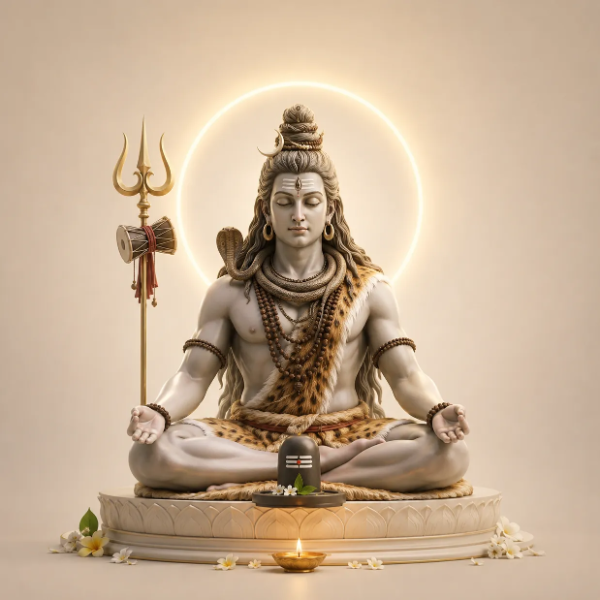
Meaning of Mantra
This mantra translates to "Salutations to the blue-throated one (Lord Shiva)." It is a heartfelt invocation and reverence to Lord Shiva in his manifestation as Neelakantha, who selflessly consumed the Halahala poison during the Samudra Manthan (churning of the cosmic ocean) to safeguard the entire universe. Chanting this mantra is a profound act of acknowledging Shiva's immense compassion, protective power, and his ability to transmute all forms of negativity and suffering into purity.
Benefits & Science
Benefits of Chanting:
Chanting "Om Neelakanthaya Namah" is revered for its profound benefits. It is believed to invoke Lord Shiva's divine protection, shielding the devotee from various forms of negativity, psychic attacks, and environmental toxins. The mantra's potent vibrations work to cleanse and purify the aura, mind, and spirit, potentially aiding in the removal of karmic impurities. Many practitioners report a significant reduction in stress, anxiety, and fear, leading to a state of profound inner peace and mental clarity. It is thought to support the body's natural healing mechanisms, fostering resilience against physical ailments by harmonizing the subtle energy channels. Furthermore, it helps in overcoming life's obstacles, cultivating immense spiritual strength, and developing compassion, allowing one to face challenges with grace and equanimity, embodying Shiva's own transformative power.
Scientific Perspective:
From a scientific perspective, the rhythmic chanting of "Om Neelakanthaya Namah" can induce a meditative state that alters brainwave patterns, typically shifting from high-frequency beta waves to more relaxed alpha or even theta waves. The resonant 'Om' sound is particularly known to stimulate the vagus nerve, which influences the parasympathetic nervous system, leading to a 'rest and digest' response that reduces heart rate, blood pressure, and muscle tension. The repetitive vocalization and focused attention required for mantra recitation can enhance neural plasticity, improve concentration, and regulate hormone levels, including a reduction in stress hormones like cortisol. This psycho-physiological effect contributes to improved mood, cognitive function, and an overall sense of well-being, aligning with the ancient understanding of sound as a therapeutic tool for balancing the bio-energetic system.
Mythology & Origin
Mantra Origin Saga:
The epithet 'Neelakantha' (blue-throated) for Lord Shiva originates from the ancient Hindu legend of Samudra Manthan, the churning of the cosmic ocean. During this colossal event, undertaken by both Devas (gods) and Asuras (demons) to obtain the elixir of immortality (Amrita), a deadly poison named Halahala emerged from the ocean's depths. This potent poison threatened to annihilate all creation. Out of immense compassion for the universe and all its beings, Lord Shiva volunteered to consume the Halahala. As he drank it, Goddess Parvati, his consort, pressed his throat to prevent the poison from descending into his body and affecting the cosmos. The poison remained in his throat, turning it blue, thus giving him the revered name 'Neelakantha'.
Scriptures Mentions:
The detailed account of the Samudra Manthan and Lord Shiva becoming Neelakantha is prominently narrated in several revered Hindu scriptures, including: The Shiva Purana (especially the Rudra Samhita and Jnanasamhita), The Bhagavata Purana (Skanda 8, Chapter 7), The Vishnu Purana, and The Brahmanda Purana. These texts extensively elaborate on the events leading to Shiva's selfless act and the profound significance of his blue throat.
Associated Rishi & Deity:
The primary deity associated with this mantra is Lord Shiva, specifically in his Neelakantha form. Goddess Parvati is also intricately linked through her act of preventing the poison from spreading. No particular Rishi is traditionally credited with the 'creation' of this specific nama mantra, as it is a direct invocation derived from the mythological event involving these cosmic deities.
Historical Significance:
The legend of Neelakantha Shiva holds immense historical and cultural significance, forming a cornerstone of Shaivism and pan-Hindu devotional practices. It serves as a timeless allegory for selfless sacrifice, cosmic responsibility, and the triumph of divine benevolence over destructive forces. Historically, this narrative has inspired countless temples dedicated to Shiva, iconic artistic representations depicting his blue throat, and a rich tradition of devotional poetry and hymns. It reinforces the ancient Hindu values of Dharma (righteous conduct) and Lok Kalyan (welfare of the world), deeply influencing philosophical thought and the ethical framework of devotees across millennia. The veneration of Neelakantha continues to be a powerful symbol of hope and protection in times of crisis.
Frequently Asked Questions (FAQs)
What is the primary significance of the "Neelakantha" epithet for Lord Shiva?
Can anyone chant "Om Neelakanthaya Namah," or are there restrictions?
What are the perceived benefits of chanting this mantra for physical health?
How does this mantra help in overcoming negative emotions or thoughts?
Is there any specific time or day considered most auspicious for chanting "Om Neelakanthaya Namah"?
What is the significance of using a mala (rosary) while chanting?
Can this mantra be used for specific healing purposes?
What does the blue color of Shiva's throat signify symbolically?
Mantra Sadhana Guidelines
Best Time to Chant
- Mondays are especially auspicious and beneficial.
- Early morning Brahma Muhurta (4:00 - 6:00 AM) is best.
- Highly fruitful during Pradosh Kaal and Mahashivratri.
- Chant before commencing any auspicious task or ritual.
Other Popular Lord Shiva Mantras
Other Devotional Categories


Download App
पंचांग तिथि, त्यौहार, व्रत, उत्सव, एकादशी, आरती संग्रह, मंत्र, व्रत कथा