
Om Namah Shivaya
Explore the profound spiritual meaning, powerful benefits, and complete chanting guide for the sacred Om Namah Shivaya mantra. Connect with Lord Shiva.
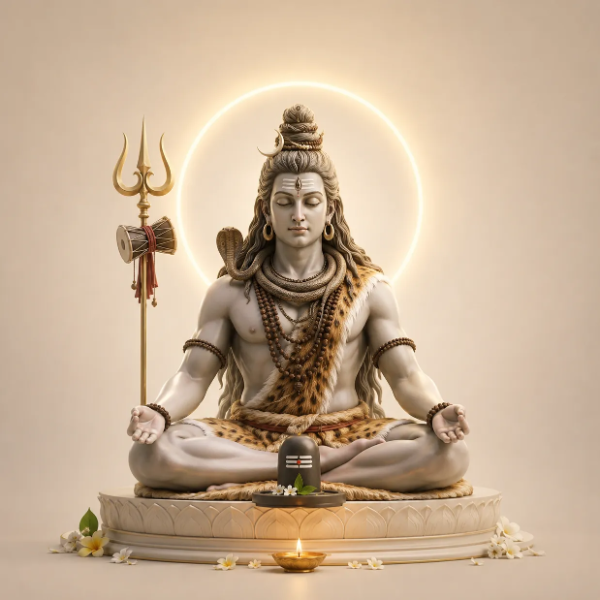
Meaning of Mantra
I bow to Shiva or Salutations to Shiva, the Auspicious One. It signifies the surrender of the individual ego to the divine and the recognition of Shiva's presence within and without.
Benefits & Science
Benefits of Chanting:
Chanting 'Om Namah Shivaya' regularly brings profound peace, clarity, and spiritual elevation. It acts as a powerful shield against negative influences and fosters a deeper connection with the divine. Devotees experience enhanced inner strength, courage to face challenges, and removal of various obstacles in life. It is believed to purify the karma and lead one towards liberation and ultimate well-being.
Scientific Perspective:
From a scientific standpoint, chanting mantras generates specific vibrational frequencies that can positively impact the brain's neural pathways. The rhythmic repetition can induce a meditative state, reducing stress, improving focus, and enhancing cognitive functions. The vibrations from the sound 'Om' are known to resonate with the body's natural frequencies, promoting relaxation and well-being.
Mythology & Origin
Mantra Origin Saga:
The Panchakshari Mantra 'Namah Shivaya' is considered one of the oldest and most potent mantras. Its origin is deeply rooted in Vedic traditions, often appearing in the context of praises and salutations to Lord Shiva. The addition of 'Om' (Aum) before it signifies its universal and primordial nature.
Scriptures Mentions:
It is prominently found in the Shri Rudram Chamakam section of the Krishna Yajurveda, where it is mentioned as 'Namah Shivaya cha Shivataraya cha'. It is also extensively revered and explained in Shaivite scriptures like the Shiva Purana, Linga Purana, and various Agamas.
Associated Rishi & Deity:
While the mantra itself is a direct address to Lord Shiva, its propagation and significance have been emphasized by numerous ancient sages (rishis) and Shaivite saints, including the Nayanars in South India. Lord Shiva himself is believed to have revealed its power.
Historical Significance:
The mantra has been a cornerstone of Shaivism for millennia, influencing countless devotees, philosophers, and spiritual traditions across India and beyond. It represents a fundamental expression of devotion and the core philosophy of Shiva worship, emphasizing simplicity and direct connection to the divine.
Frequently Asked Questions (FAQs)
Who can chant Om Namah Shivaya?
Is there a specific time to chant this mantra?
Do I need a guru to chant Om Namah Shivaya?
What are the benefits of chanting Om Namah Shivaya 108 times?
Can women chant Om Namah Shivaya during menstruation?
What if I don't have a mala for chanting?
What is the significance of 'Om' in the mantra?
How should I conclude my chanting?
Mantra Sadhana Guidelines
Best Time to Chant
- Mondays are especially auspicious and beneficial.
- Early morning Brahma Muhurta (4:00 - 6:00 AM) is best.
- Highly fruitful during Pradosh Kaal and Mahashivratri.
- Chant before commencing any auspicious task or ritual.
Other Popular Lord Shiva Mantras
Other Devotional Categories



Download App
पंचांग तिथि, त्यौहार, व्रत, उत्सव, एकादशी, आरती संग्रह, मंत्र, व्रत कथा