
Hare Krishna Maha Mantra
Explore the profound meaning, spiritual benefits, and detailed chanting guide for the Hare Krishna Maha Mantra. Discover its origins, philosophical depth, scientific perspective, and how to practice this universal chant for inner peace, divine connection, and spiritual liberation in Kali Yuga.
Meaning of Mantra
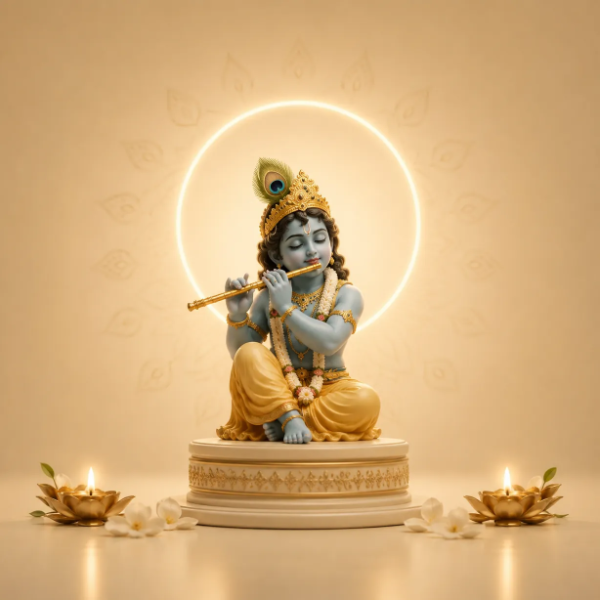
The Hare Krishna Maha Mantra is a fervent plea to the Supreme Lord and His divine energy to engage one in His transcendental loving service and free one from material miseries. It means, in essence, 'O energy of the Lord, O Lord Krishna, O Lord Rama, please engage me in Your devotional service and purify my consciousness.' This invocation is a direct call for spiritual connection and purification.
Benefits & Science
Benefits of Chanting:
Consistent chanting of the Hare Krishna Maha Mantra systematically purifies the mind, heart, and consciousness, leading to a profound sense of inner peace and freedom from anxiety. The rhythmic repetition serves as a powerful meditative tool, calming the nervous system, reducing mental chatter, and fostering heightened mental clarity and focus. Devotees often experience a palpable sense of divine connection, which naturally cultivates pure love (Bhakti) for the Supreme. This practice aids in emotional regulation, helps dissipate negative energies accumulated from daily life, and guides individuals towards transcending the fleeting nature of material desires. Over time, it facilitates spiritual liberation and deep, lasting contentment by aligning one with their true spiritual self.
Scientific Perspective:
The rhythmic, repetitive vocalization inherent in chanting the Maha Mantra generates specific sound vibrations that can profoundly influence brainwave patterns. Research in neurophysiology suggests that such practices can shift brain activity from beta states (associated with alertness and stress) towards alpha and theta states, indicative of deep relaxation, heightened creativity, and meditative absorption. This resonant vocalization actively stimulates the vagus nerve, a critical component of the parasympathetic nervous system, triggering the body's 'relaxation response' which lowers heart rate, reduces blood pressure, and mitigates stress hormone production. The sustained focus and breath control required for chanting also enhance neuroplasticity, strengthening neural pathways associated with attention, emotional regulation, and cognitive resilience, thereby contributing to overall mental well-being and improved cognitive function.
Mythology & Origin
Mantra Origin Saga:
The Hare Krishna Maha Mantra is celebrated as the 'Maha-mantra' or 'Great Mantra' for deliverance in the current age of Kali Yuga. Its profound significance and wide propagation were particularly revitalized by Sri Chaitanya Mahaprabhu in the 15th century in Bengal, who is revered as a direct incarnation of Lord Krishna Himself, specifically appearing to inaugurate the sankirtana movement (congregational chanting of Holy Names). While the mantra itself has ancient roots in Vedic scriptures, Chaitanya Mahaprabhu's movement made it the central and most accessible practice for spiritual awakening for the masses, cutting across all social and religious barriers.
Scriptures Mentions:
The Maha Mantra is explicitly mentioned in several ancient Vedic scriptures, most notably the Kali-Santarana Upanishad, where it is unequivocally declared as the only effective means of salvation and spiritual upliftment in the turbulent age of Kali Yuga. It is also deeply alluded to, and its principles of devotional chanting are extensively glorified and discussed, in magnum opuses like the Bhagavad Gita, Srimad Bhagavatam (Bhagavata Purana), various Puranas, and Samhitas, which consistently emphasize the chanting of the Holy Names of the Lord as the supreme spiritual practice for attaining divine love and liberation.
Associated Rishi & Deity:
The primary deities invoked are Lord Krishna (the Supreme Personality of Godhead) and Lord Rama (His expansion, the ideal king). The mantra's global dissemination is largely attributed to Sri Chaitanya Mahaprabhu (an incarnation of Krishna) in the 15th century, and in the modern era, to A.C. Bhaktivedanta Swami Prabhupada, who founded the International Society for Krishna Consciousness (ISKCON) and brought the mantra to the Western world.
Historical Significance:
Historically, the Hare Krishna Maha Mantra became the foundational practice of the widespread Bhakti movement, particularly in Bengal and Odisha, through the revolutionary efforts of Sri Chaitanya Mahaprabhu. His movement transcended caste and religious boundaries, making spiritual realization accessible to all through sankirtana (congregational chanting). In the 20th century, A.C. Bhaktivedanta Swami Prabhupada meticulously translated and elucidated Vedic scriptures, and more importantly, single-handedly carried this sacred tradition globally. He established the International Society for Krishna Consciousness (ISKCON) in 1966, introducing the Maha Mantra to millions worldwide, and transforming it into one of the most recognized and chanted Hindu mantras globally. Its propagation led to a significant spiritual and cultural revival, advocating for peace, simple living, vegetarianism, and universal brotherhood.
Frequently Asked Questions (FAQs)
What is the core significance of 'Hare' in the Maha Mantra?
Can individuals from any religious background chant the Hare Krishna Maha Mantra?
Is there a specific method or posture recommended for chanting this mantra?
Why is the Hare Krishna Maha Mantra particularly significant for the Kali Yuga?
Do I experience immediate benefits after chanting the Maha Mantra?
What is the difference between Krishna and Rama mentioned in the mantra?
Can the Hare Krishna Maha Mantra be chanted silently, or must it be audible?
Is the Maha Mantra associated with any specific diet or lifestyle?
Mantra Sadhana Guidelines
Best Time to Chant
- Mondays are especially auspicious and beneficial.
- Early morning Brahma Muhurta (4:00 - 6:00 AM) is best.
- Highly fruitful during Pradosh Kaal and Mahashivratri.
- Chant before commencing any auspicious task or ritual.
Other Popular Lord Sri Krishna Mantras
Other Devotional Categories


Download App
पंचांग तिथि, त्यौहार, व्रत, उत्सव, एकादशी, आरती संग्रह, मंत्र, व्रत कथा