
Krishna Govinda Hare Murare Hey Natha Narayana Vasudeva
Explore the divine Krishna Govinda Hare Murare mantra. Learn its deep spiritual meaning, philosophical insights, benefits, pronunciation, and how to chant for inner peace and divine connection.
Meaning of Mantra
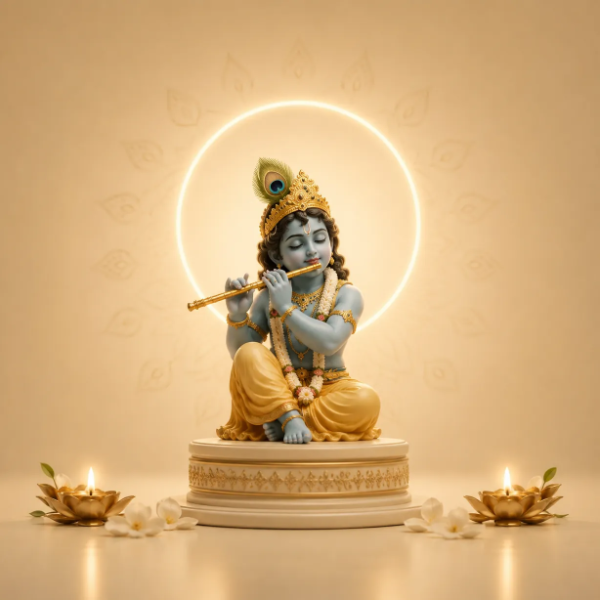
This mantra is a fervent invocation and surrender to Lord Krishna, addressing Him by several of His divine names. 'Krishna' signifies the all-attractive one, drawing devotees towards divine love. 'Govinda' refers to Him as the protector of cows and the giver of joy to the senses and the earth. 'Hare' is a call to Hari, the remover of all obstacles and miseries. 'Murare' specifically acknowledges Krishna as the slayer of the formidable demon Mura, symbolizing the vanquisher of inner demons and external adversities. 'He Natha' is a humble address, meaning 'O Lord' or 'O Master,' expressing complete dependence and devotion. 'Narayana' identifies Him as the supreme cosmic being, the supporter of all creation, often associated with Vishnu. Finally, 'Vasudeva' confirms His identity as the son of Vasudeva, emphasizing His human manifestation while retaining His divine essence. Together, these names form a powerful prayer for protection, guidance, and spiritual liberation.
Benefits & Science
Benefits of Chanting:
Regular chanting of 'Krishna Govinda Hare Murare Hey Natha Narayana Vasudeva' can lead to profound psychological and spiritual benefits. The vibrational sounds of the mantra have a calming effect on the nervous system, potentially reducing stress and anxiety and fostering a deep sense of inner peace. Spiritually, it strengthens one's connection to the divine, cultivating devotion (Bhakti) and a feeling of surrender, which can alleviate mental burdens. The consistent focus required for chanting can enhance mental clarity, improve concentration, and lead to better decision-making. Devotees often report a protective shield against negative influences and an attraction of positive energy, leading to overall well-being and harmony in life. Over time, it is believed to contribute to the purification of past karmas and guide the individual towards self-realization by deepening their understanding of their true spiritual nature and their relationship with the Supreme.
Scientific Perspective:
From a scientific perspective, mantra chanting engages several physiological and neurological processes. The rhythmic repetition of sounds creates specific brainwave patterns, often leading to a state of relaxed alertness, similar to what is observed during meditation (alpha and theta waves). This can reduce the activity in the amygdala, the brain's fear center, thereby lowering stress and anxiety responses. The vocalization of mantras stimulates the vagus nerve, which plays a crucial role in regulating heart rate variability, digestion, and the body's 'rest and digest' parasympathetic response. This stimulation promotes physiological calming, reduces inflammation, and enhances overall well-being. The focused attention required during chanting also acts as a form of mindfulness, improving cognitive function, attention span, and emotional regulation. The resonance of specific syllables is believed to activate different energy centers or chakras, potentially leading to a harmonious flow of energy within the body, though this aspect is primarily experiential and deeply rooted in yogic science.
Mythology & Origin
Mantra Origin Saga:
This mantra, being a string of divine names of Lord Krishna, doesn't have a single, definitive 'origin story' like some specific Vedic hymns. Instead, it is a compilation of epithets and names that emerged organically from the deep devotion of saints, sages, and devotees across millennia, celebrating Krishna's various lilas (divine plays) and attributes. It encapsulates the essence of Bhakti Yoga, where the chanting of the Lord's names (Nama Japa) is considered a direct and powerful means of connecting with the Divine. The names like Krishna, Govinda, Hari, Murare, Narayana, and Vasudeva have been used interchangeably and reverently in countless scriptures, poems, and devotional songs throughout Indian history, testifying to their ancient roots in the Bhakti tradition.
Scriptures Mentions:
The names in this mantra are prominently featured across a vast array of Hindu scriptures, including the Bhagavad Gita, Srimad Bhagavatam (Bhagavata Purana), Vishnu Purana, Mahabharata, and various other Puranas and devotional texts. The Srimad Bhagavatam, in particular, glorifies Lord Krishna's names, forms, pastimes, and qualities extensively. The 'Vishnu Sahasranama' also lists many of these names, signifying their ancient and revered status within the Vedic tradition. The practice of chanting these names is a cornerstone of the Bhakti movement, which flourished across India, particularly emphasized by saints like Chaitanya Mahaprabhu who propagated the chanting of the Maha Mantra, which also includes 'Hare Krishna'.
Associated Rishi & Deity:
The primary Deity associated with this mantra is Lord Krishna, who is worshipped as the Supreme Personality of Godhead, an incarnation of Lord Vishnu. While no specific Rishi (sage) is traditionally attributed to the 'composition' of this particular string of names, numerous sages, acharyas (spiritual teachers), and devotees throughout history have extensively glorified and popularized these names through their teachings, bhajans, and kirtans. Prominent figures like Vyasa (compiler of Puranas), Shukadeva Goswami (narrator of Bhagavatam), and later Bhakti saints like Narada, Prahlada, Ramanuja, Madhva, Nimbarka, Vallabha, and particularly Chaitanya Mahaprabhu (who popularized congregational chanting of Hari Nama) are deeply connected with the propagation and deep understanding of Krishna's divine names.
Historical Significance:
The historical significance of chanting Krishna's names lies in its central role in the Bhakti movement, a spiritual revolution that emphasized personal devotion and love for God over elaborate rituals and caste distinctions. This movement, gaining momentum from the 6th century CE onwards, democratized spirituality, making the path to divine realization accessible to all. The constant invocation of names like Krishna, Govinda, Hari, Narayana became a powerful tool for spiritual awakening, social cohesion, and cultural expression. It led to the flourishing of devotional literature, music, and art, profoundly shaping the religious landscape of India. The mantra represents a continuous tradition of surrender and heartfelt prayer that has sustained millions of devotees through various historical periods, providing solace, strength, and a profound sense of purpose.
Frequently Asked Questions (FAQs)
Who is Lord Krishna?
What is the significance of calling Krishna by multiple names in this mantra?
Can anyone chant this mantra, regardless of their religious background?
How often should I chant this mantra?
Is there a specific time or place best suited for chanting?
What is the meaning of 'Murare'?
Can chanting this mantra help with mental peace?
Is there any specific deity to visualize while chanting?
What is the importance of 'Vasudeva'?
Can this mantra be used for specific material desires?
Mantra Sadhana Guidelines
Best Time to Chant
- Mondays are especially auspicious and beneficial.
- Early morning Brahma Muhurta (4:00 - 6:00 AM) is best.
- Highly fruitful during Pradosh Kaal and Mahashivratri.
- Chant before commencing any auspicious task or ritual.
Other Popular Lord Sri Krishna Mantras
Other Devotional Categories


Download App
पंचांग तिथि, त्यौहार, व्रत, उत्सव, एकादशी, आरती संग्रह, मंत्र, व्रत कथा