
Om Krishnaya Namah
Explore 'Om Krishnaya Namah' mantra meaning, spiritual significance, benefits for peace, and a complete chanting guide. Connect with Lord Krishna's divine energy.
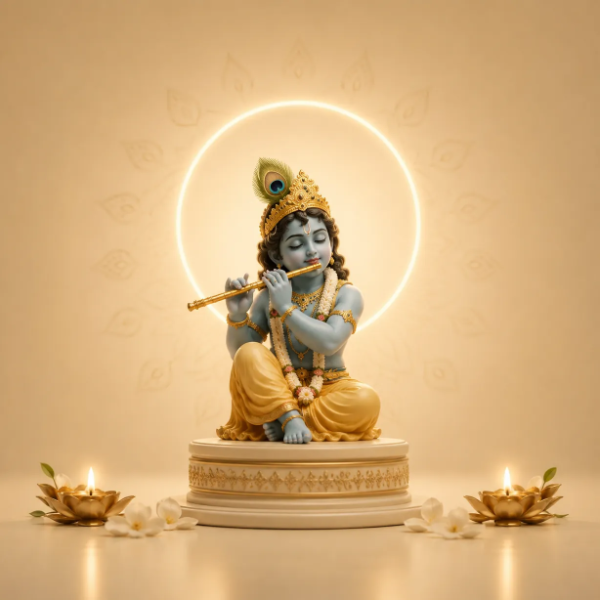
Meaning of Mantra
This sacred mantra, 'Om Krishnaya Namah,' is a profound invocation and expression of devotion to Lord Krishna. 'Om' represents the ultimate reality, the cosmic sound from which all creation emanates. 'Krishnaya' signifies 'to Krishna,' referring to the Supreme Personality of Godhead, who is known for His enchanting beauty, wisdom, and compassionate playfulness. 'Namah' means 'salutations' or 'I bow,' implying a complete surrender of the ego and an acknowledgment of the divine presence within and without. Together, the mantra translates to 'Salutations to Lord Krishna' or 'I bow to the all-attractive Lord Krishna,' serving as a powerful conduit for connecting with the divine essence of love, joy, and spiritual wisdom embodied by Krishna.
Benefits & Science
Benefits of Chanting:
Regular chanting of 'Om Krishnaya Namah' is believed to foster a profound sense of peace and tranquility, reducing stress and anxiety. The rhythmic sound vibrations can help quiet the mind, leading to improved focus and mental clarity. Devotees often experience an upliftment in mood and a deeper connection to their spiritual core, which can aid in emotional healing and cultivating a more positive outlook on life. This mantra is a powerful tool for spiritual growth, helping individuals to overcome internal obstacles, attract auspicious circumstances, and feel a pervasive sense of divine protection and grace. It purifies the subtle energy channels (nadis), contributing to overall well-being and a harmonious inner state.
Scientific Perspective:
From a scientific perspective, chanting 'Om Krishnaya Namah' involves repetitive vocalization and focused attention, which can lead to a meditative state. The 'Om' sound, in particular, has been studied for its potential to elicit a relaxation response. The vibrations generated during chanting can stimulate the vagus nerve, which plays a crucial role in regulating heart rate variability, digestion, and stress responses, potentially shifting the autonomic nervous system towards a parasympathetic (rest and digest) state. This can lead to reduced cortisol levels, lower blood pressure, and enhanced brainwave patterns (alpha and theta waves) associated with calmness, creativity, and introspection. The rhythmic repetition also engages the brain's prefrontal cortex, improving concentration and potentially fostering neuroplasticity conducive to positive mental states.
Mythology & Origin
Mantra Origin Saga:
The worship of Krishna is ancient, deeply rooted in Vedic traditions. While 'Om Krishnaya Namah' specifically is a Nama Mantra (name mantra), its components trace back to the Upanishads for 'Om' and the Mahabharata, Bhagavad Gita, and Puranas for Lord Krishna. Krishna's divine lila (play) and teachings are extensively detailed in texts like the Bhagavata Purana, solidifying His position as a central deity. This mantra encapsulates the essence of surrendering to this supreme divine form.
Scriptures Mentions:
This mantra, or variations of it, resonates throughout Vaishnava scriptures. The 'Om' is omnipresent in Vedic literature. 'Krishnaya' references are abundant in the Bhagavad Gita (where Krishna Himself is the speaker), Srimad Bhagavatam (Bhagavata Purana), Vishnu Purana, and Harivamsa. Its simple yet potent form makes it a fundamental mantra for Krishna devotees, often cited in various Puranic and Tantric traditions as a path to devotion.
Associated Rishi & Deity:
Lord Krishna Himself is the presiding deity of this mantra. While specific Rishis for this short Nama Mantra are not typically attributed in the same way as longer Vedic mantras, the tradition of Krishna Bhakti (devotion) was propounded and spread by numerous revered saints and acharyas throughout history, including Ramanujacharya, Madhvacharya, Nimbarkacharya, Vallabhacharya, Chaitanya Mahaprabhu, Mirabai, and many others, all of whom engaged deeply with Krishna's names and forms.
Historical Significance:
The historical significance of 'Om Krishnaya Namah' lies in its role as a fundamental mantra in the Bhakti movement, which swept across India from the 6th century AD onwards. It provided an accessible means for spiritual connection, transcending caste and social barriers, allowing anyone to directly engage with the divine through love and devotion. It remains a cornerstone of Vaishnavism and has been instrumental in preserving and propagating the rich cultural and spiritual heritage associated with Lord Krishna.
Frequently Asked Questions (FAQs)
Who is Lord Krishna?
What is the primary purpose of chanting 'Om Krishnaya Namah'?
Can anyone chant this mantra, regardless of their religious background?
Is there a specific time to chant this mantra?
Do I need a guru to chant 'Om Krishnaya Namah'?
What is the significance of the 'Om' in the mantra?
How does this mantra contribute to stress reduction?
Can chanting 'Om Krishnaya Namah' improve focus and concentration?
Mantra Sadhana Guidelines
Best Time to Chant
- Mondays are especially auspicious and beneficial.
- Early morning Brahma Muhurta (4:00 - 6:00 AM) is best.
- Highly fruitful during Pradosh Kaal and Mahashivratri.
- Chant before commencing any auspicious task or ritual.
Other Popular Lord Sri Krishna Mantras
Other Devotional Categories


Download App
पंचांग तिथि, त्यौहार, व्रत, उत्सव, एकादशी, आरती संग्रह, मंत्र, व्रत कथा