
Sacchidananda Krishnaya Mantra for Supreme Devotion and Relief from Miseries
Explore the profound spiritual meaning and transformative benefits of Sacchidananda Krishnaya Mantra for inner peace, cosmic understanding, and relief from suffering. A guide to devotion.
Meaning of Mantra
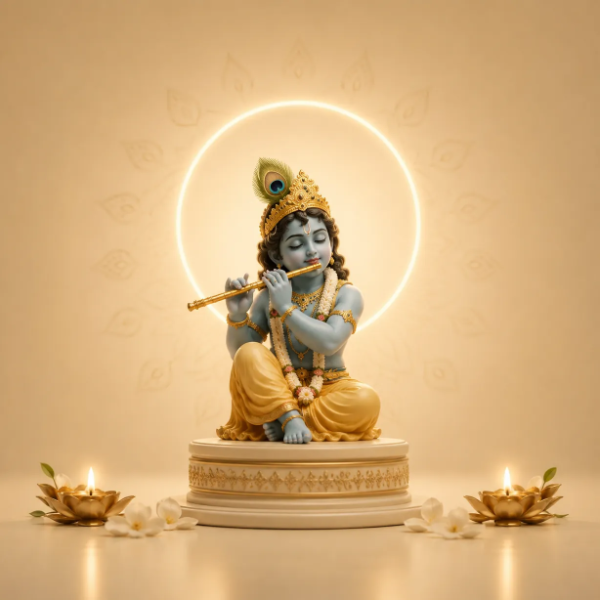
We offer our obeisance to Lord Shri Krishna, whose very form is Sat (Eternal Existence), Chit (Pure Consciousness), and Ananda (Absolute Bliss). He is the primal cause behind the creation, sustenance, and ultimate dissolution of this entire universe. We bow to Him who is the destroyer of the three kinds of miseries that afflict humanity – the Adhyatmika (self-inflicted, body/mind), Adhidaivika (divine or natural calamities), and Adhibhautika (external, from other beings). This mantra encapsulates a profound philosophical truth, identifying Krishna with the ultimate reality, the source of all existence and the alleviator of all suffering.
Benefits & Science
Benefits of Chanting:
Chanting the Sacchidananda Krishnaya mantra can lead to multifaceted benefits. Spiritually, it fosters a deeper connection with the divine, cultivating pure devotion (Bhakti) and aiding in the realization of the Self's true nature as eternal, conscious, and blissful. Psychologically, regular chanting helps in calming the mind, reducing mental anxieties, and fostering inner peace and emotional stability. By focusing on the supreme source of all existence, practitioners may experience enhanced clarity of thought and an elevated perspective, enabling them to navigate life's challenges with greater equanimity. The promise of 'Tapatrayavinashaya' suggests a spiritual mechanism for alleviating suffering, not by magically removing external problems, but by transforming one's internal response and spiritual resilience, thereby diminishing the impact of physical, mental, and environmental distress. This devotional practice aligns the individual consciousness with cosmic consciousness, leading to a sense of holistic well-being and profound spiritual growth.
Scientific Perspective:
From a neuroscientific standpoint, chanting mantras involves rhythmic vocalization and repetition, which can induce a meditative state. The repetitive nature of the sounds (phonemes) acts as an auditory anchor, diverting attention from distracting thoughts and promoting mental focus. This process can lead to changes in brainwave patterns, often shifting from beta (alert, active) to alpha (relaxed, calm) and even theta (deep relaxation, meditation) states. The vibration produced by chanting resonates in the cranial and chest cavities, stimulating the vagus nerve – a key component of the parasympathetic nervous system. Vagal nerve stimulation is associated with reduced heart rate, decreased blood pressure, and activation of the 'rest and digest' response, countering the 'fight or flight' stress response. Furthermore, the precise articulation of Sanskrit sounds (especially those found in Vedic mantras) is believed to create specific sonic patterns that can harmonize internal energies and promote a sense of well-being, influencing neural pathways and potentially enhancing cognitive functions and emotional regulation.
Mythology & Origin
Mantra Origin Saga:
This mantra is a classical devotional verse, often found in Stotra literature, eulogizing Lord Krishna. It encapsulates core Vedanta philosophies. While not attributed to a single dramatic origin story like some Puranic tales, its essence is deeply rooted in the Bhagavad Gita and Bhagavata Purana, which describe Krishna as the ultimate reality. It serves as a concise summary of Krishna's attributes as Parabrahman, the Supreme Being.
Scriptures Mentions:
The philosophical concepts in this mantra are deeply resonant with teachings from the Bhagavad Gita (e.g., Chapter 7, 9, 10), Srimad Bhagavatam (Bhagavata Purana), Vishnu Purana, and Brahma Samhita. While this exact verse might not be a direct quote from these primary Puranas, its philosophical content aligns perfectly with them, embodying the essence found in verses describing Krishna as the supreme source and controller of the cosmos.
Associated Rishi & Deity:
This mantra is associated with countless devotees, rishis, and Vaishnava acharyas across various traditions who composed prayers and commented on Krishna's supreme nature. Primarily, Lord Krishna Himself is the worshipped deity, embodying the 'Sacchidananda' form. Great sages like Vyasa and Shukadeva, who compiled and narrated the Puranas, laid the philosophical groundwork for such devotional expressions.
Historical Significance:
This mantra represents a crystallized devotional philosophy that developed over centuries within the Bhakti movement, emphasizing Krishna as the ultimate reality (Sacchidananda Brahman) and the remover of all miseries. It highlights the Advaita-Vishishtadvaita synthesis often seen in later Vaishnava thought, where the personal God (Krishna) is identical with the impersonal Absolute (Brahman). Its continuous chanting has helped shape the spiritual landscape of India, fostering a deep personal connection with the divine.
Frequently Asked Questions (FAQs)
What is the primary purpose of chanting the Sacchidananda Krishnaya Mantra?
Can anyone chant this mantra, or are there specific initiation requirements?
What are the 'three types of miseries' (Tapatraya) mentioned in the mantra?
How does chanting this mantra help in relieving suffering?
Is there a specific time of day or direction recommended for chanting this mantra?
What is the significance of Krishna being described as "Vishvotpattyadihetve"?
What kind of spiritual growth can one expect from regular chanting?
Can this mantra be used for meditation?
Mantra Sadhana Guidelines
Best Time to Chant
- Mondays are especially auspicious and beneficial.
- Early morning Brahma Muhurta (4:00 - 6:00 AM) is best.
- Highly fruitful during Pradosh Kaal and Mahashivratri.
- Chant before commencing any auspicious task or ritual.
Other Popular Lord Sri Krishna Mantras
Other Devotional Categories


Download App
पंचांग तिथि, त्यौहार, व्रत, उत्सव, एकादशी, आरती संग्रह, मंत्र, व्रत कथा