
Govindam Madhavam Devam Namami Madhusudanam
Explore the powerful Govindam Madhavam Devam Namami Madhusudanam mantra. Discover its deep spiritual meaning, profound benefits for inner peace, protection, and detailed chanting guide. Connect with Lord Vishnu.
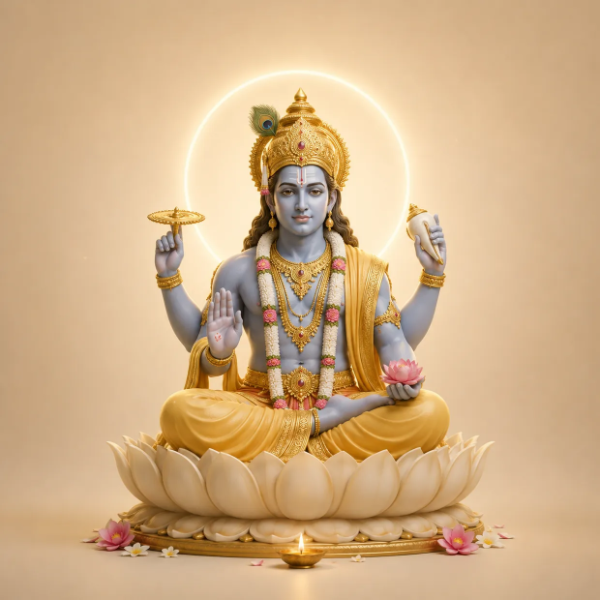
Meaning of Mantra
This sacred mantra translates to, 'I bow to Govinda, Madhava, the divine Lord, and Madhusudana.' It is a profound salutation to Lord Vishnu, invoking him through four of his glorious epithets. Each name encapsulates a unique divine attribute: Govinda as the protector and all-pervading consciousness, Madhava as the lord of creation and prosperity, Deva signifying his celestial and luminous nature, and Madhusudana as the vanquisher of evil and ignorance. The mantra serves as an expression of complete surrender and devotion to the Supreme Being.
Benefits & Science
Benefits of Chanting:
Chanting 'Govindam Madhavam Devam Namami Madhusudanam' cultivates a profound sense of inner peace and serenity by directing the mind towards divine contemplation. This practice deepens one's connection with the Supreme Being, fostering significant spiritual growth and a heightened state of devotion. The mantra is revered for its ability to provide protection from negative influences, internal conflicts, and external obstacles, thereby enabling practitioners to navigate life's challenges with greater resilience and wisdom. Regular recitation can lead to enhanced mental clarity, improved focus, and a greater capacity for emotional healing, helping to stabilize mood and reduce anxiety. By invoking the divine names of Vishnu, individuals may experience a subtle attraction of positive energies, grace, and prosperity, aligning their consciousness with universal abundance.
Scientific Perspective:
From a scientific perspective, the rhythmic chanting of 'Govindam Madhavam Devam Namami Madhusudanam' can induce a meditative state characterized by alpha and theta brainwave activity, leading to deep relaxation and enhanced focus. The production of specific sound vibrations during chanting stimulates the vagus nerve, which plays a pivotal role in regulating the parasympathetic nervous system. This activation reduces the 'fight or flight' response, lowers cortisol levels (stress hormone), decreases heart rate, and promotes a sense of calm and well-being. The sustained vocalization and repetitive nature of mantra chanting also improve respiratory function, oxygen intake, and can lead to increased coherence between brain hemispheres, potentially enhancing cognitive functions, emotional regulation, and overall mental resilience.
Mythology & Origin
Mantra Origin Saga:
This mantra draws its essence from the rich tapestry of Hindu Puranas and the Vaishnava tradition, which glorifies Lord Vishnu and his numerous avatars. The names Govinda, Madhava, and Madhusudana are ancient epithets that find their roots in epic narratives and Vedic hymns, signifying Vishnu's various cosmic roles as creator, preserver, and destroyer of evil. The phrase itself is a concise devotional prayer, likely developed and popularized within the Bhakti movement, which emphasized personal devotion and chanting of divine names as a path to spiritual liberation.
Scriptures Mentions:
The names 'Govinda,' 'Madhava,' and 'Madhusudana' are extensively mentioned across various Hindu scriptures. 'Govinda' is famously used in the Bhagavata Purana (Srimad Bhagavatam) to address Lord Krishna and appears in the Vishnu Sahasranama from the Mahabharata. 'Madhava' is also a prominent name in the Vishnu Sahasranama and is significant in texts describing Lord Krishna's relationship with Lakshmi. 'Madhusudana' is notably used by Arjuna to address Lord Krishna in the Bhagavad Gita (e.g., Chapter 1, Verse 35), signifying Krishna's role as the remover of inner doubts and external adversaries, paralleling his mythical feat of slaying the demon Madhu.
Associated Rishi & Deity:
This mantra is primarily dedicated to Lord Vishnu, who is addressed through his various manifestations and attributes embodied in Govinda (often associated with Krishna, the cowherd boy and supreme protector), Madhava (the husband of Lakshmi, representing divine abundance and grace), and Madhusudana (the destroyer of the demon Madhu, symbolizing victory over evil and ignorance). While no single sage is attributed to the exact phrasing, the tradition of glorifying Vishnu through his names has been upheld by countless ancient Rishis like Vyasa and devotional saints throughout history, especially during the Bhakti movement.
Historical Significance:
The tradition of chanting Vishnu's names, including those found in this mantra, has been a cornerstone of Vaishnavism for thousands of years. Its historical significance lies in its role as a simple yet powerful means of spiritual practice, making divine connection accessible to all. During periods of social and spiritual transformation, especially the Bhakti movement (c. 6th-17th century CE), such mantras became central to communal worship (Kirtan) and personal devotion, fostering a sense of unity, spiritual solace, and direct relationship with the Divine, transcending rigid ritualistic barriers. It continues to be a living tradition, a testament to its enduring power and appeal.
Frequently Asked Questions (FAQs)
Who are Govinda, Madhava, and Madhusudana in this mantra?
What is the primary benefit of regularly chanting this mantra?
Is there a specific way to pronounce the Sanskrit words?
Can this mantra be chanted by non-Hindus?
How does chanting affect mental health?
What is the significance of chanting 108 times?
Are there specific dietary or lifestyle restrictions when chanting this mantra?
Mantra Sadhana Guidelines
Best Time to Chant
- Mondays are especially auspicious and beneficial.
- Early morning Brahma Muhurta (4:00 - 6:00 AM) is best.
- Highly fruitful during Pradosh Kaal and Mahashivratri.
- Chant before commencing any auspicious task or ritual.
Other Popular Lord Vishnu Mantras
Other Devotional Categories



Download App
पंचांग तिथि, त्यौहार, व्रत, उत्सव, एकादशी, आरती संग्रह, मंत्र, व्रत कथा