
Namah Samastabhutanam Adibhutaya Bhubhrite | Anekarooparoopaya Vishnave Prabhavishnave ||
Unlock the power of 'Namah Samastabhutanam Adibhutaya Bhubhrite' Vishnu Mantra. Explore its deep meaning, spiritual benefits, and chanting guide for inner peace & cosmic connection.
Meaning of Mantra
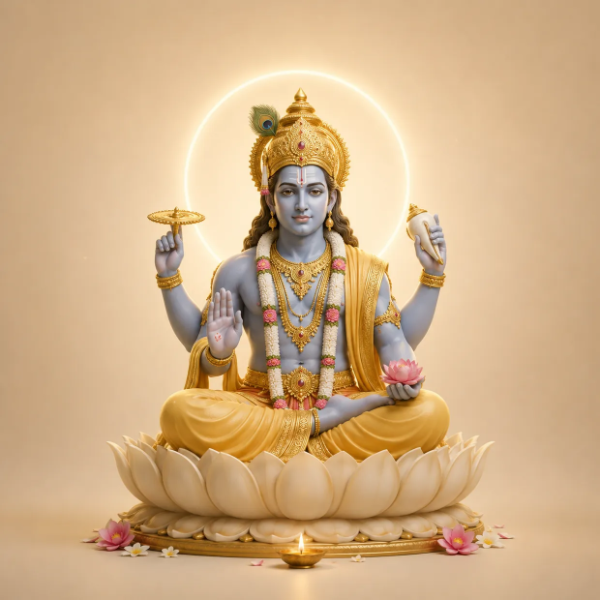
This profound Sanskrit mantra is a salutation to Lord Vishnu, revering Him as the primordial essence of all existence. It acknowledges Him as the 'Adibhutaya', the first and original being from whom everything originates, and 'Bhubhrite', the sustainer and supporter of the Earth and the entire cosmos. The mantra further extols Vishnu as 'Anekarooparoopaya', one who manifests in countless forms, representing the diverse aspects of the divine play (Lila) in the universe. Finally, He is invoked as 'Prabhavishnave', the supremely powerful and glorious one, the ultimate controller and source of all might. It is a comprehensive adoration of Vishnu's omnipresent, omniscient, and omnipotent nature, encapsulating His role as the preserver and cosmic administrator.
Benefits & Science
Benefits of Chanting:
Regular chanting of this Vishnu mantra can facilitate a profound shift in consciousness. The focused repetition helps quiet the mind, leading to increased mental clarity and inner peace. By invoking Vishnu as the protector and sustainer, practitioners may experience a sense of security and resilience against life's challenges, fostering emotional strength. The recognition of Vishnu's 'anekarooparoopaya' aspect can broaden one's perspective, enhancing empathy and a sense of interconnectedness with all beings, which naturally leads to more harmonious interactions and relationships. This mantra's vibrations are believed to align one's energy with the cosmic flow, potentially attracting positive opportunities and promoting overall well-being and a balanced state of mind, contributing to a more fulfilling life journey.
Scientific Perspective:
From a scientific viewpoint, mantra chanting involves rhythmic vocalization that can induce physiological and neurological changes. The resonant sound vibrations, particularly of Sanskrit, are known to stimulate the vagus nerve, which plays a crucial role in regulating heart rate, digestion, and mood. This stimulation can activate the parasympathetic nervous system, leading to a 'rest and digest' state, reducing stress and anxiety. The repetitive nature of chanting can also entrain brainwaves, potentially increasing alpha and theta wave activity associated with deep relaxation, meditation, and enhanced creativity. The focused attention required during chanting helps improve concentration and cognitive function. Furthermore, the practice can foster a sense of coherence and well-being through the synchronization of breath, rhythm, and intention, positively impacting overall mental and physical health by reducing physiological markers of stress.
Mythology & Origin
Mantra Origin Saga:
This shloka is a classical eulogy found in various Vaishnava traditions and Puranas, embodying the fundamental attributes of Lord Vishnu. While not attributed to a single specific origin story like some shorter Beej mantras, its structure and meaning are deeply rooted in the ancient Vedic understanding of Vishnu as the cosmic preserver and ultimate reality. It condenses the profound philosophical insights elaborated across numerous scriptures into a concise and powerful devotional verse.
Scriptures Mentions:
This mantra or similar eulogies to Vishnu are found across significant Hindu scriptures. It resonates with themes present in the Vishnu Purana, Bhagavata Purana, and various sections of the Mahabharata, particularly the 'Vishwaroopa Darshan' in the Bhagavad Gita, where Krishna reveals His manifold cosmic form (anekarooparoopaya). It also echoes the profound descriptions found in Vishnu Sahasranama, where each name elaborates on aspects of Vishnu's divine nature.
Associated Rishi & Deity:
The mantra is primarily dedicated to Lord Vishnu, the preserver deity in the Hindu Trimurti. While no specific Rishi is uniquely associated with the 'composition' of this particular verse, the wisdom it contains is attributed to ancient Vedic seers (Rishis) and later Puranic sages like Vyasa, Markandeya, and Narada, who extensively elaborated on the glories and attributes of Vishnu through their scriptures and narratives. It represents the collective spiritual realization of many enlightened beings.
Historical Significance:
This mantra holds immense historical significance as a cornerstone of Vaishnava devotion. Its popularity reflects the widespread reverence for Vishnu as the ultimate reality, preserver of dharma, and savior in times of crisis. Historically, such verses played a crucial role in consolidating the Bhakti movement, providing accessible means for devotees to connect with the divine. It has been instrumental in shaping the philosophical and devotional landscape of Hinduism, influencing countless hymns, temple rituals, and personal sadhanas, reinforcing the idea of a compassionate and all-encompassing Godhead accessible to all.
Frequently Asked Questions (FAQs)
Who can chant this mantra?
What is the primary benefit of chanting this mantra?
Do I need to be initiated to chant this mantra?
Can I chant this mantra mentally?
What is the significance of 'Anekarooparoopaya'?
Is this mantra from a specific scripture?
How often should I chant this mantra?
Does chanting this mantra help with worldly problems?
Mantra Sadhana Guidelines
Best Time to Chant
- Mondays are especially auspicious and beneficial.
- Early morning Brahma Muhurta (4:00 - 6:00 AM) is best.
- Highly fruitful during Pradosh Kaal and Mahashivratri.
- Chant before commencing any auspicious task or ritual.
Other Popular Lord Vishnu Mantras
Other Devotional Categories



Download App
पंचांग तिथि, त्यौहार, व्रत, उत्सव, एकादशी, आरती संग्रह, मंत्र, व्रत कथा