
Om Hrishikeshaya Namaha
Explore the profound spiritual and philosophical meaning of Om Hrishikeshaya Namaha mantra. Learn its benefits for sensory control, mental clarity, and inner peace, backed by Vedic wisdom and scientific perspective.
Meaning of Mantra
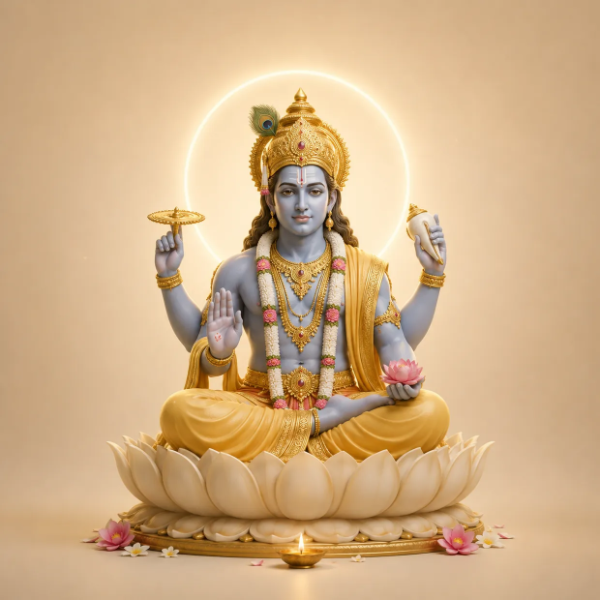
Om, Salutations to Hrishikesha, the Lord of the senses, the master of our inner faculties. This mantra is a profound invocation to Lord Vishnu in His aspect as Hrishikesha, who guides and governs the senses, mind, and intellect. Chanting it expresses devotion and surrender, seeking divine assistance in mastering one's sensory perceptions and achieving inner stability and clarity.
Benefits & Science
Benefits of Chanting:
Chanting 'Om Hrishikeshaya Namaha' systematically cultivates mastery over the senses and the mind. It helps in reducing mental agitation, fostering a state of calm and focus crucial for meditation and daily life. Regular practice is observed to enhance self-discipline, promoting better decision-making and emotional regulation. Devotees often report a deeper spiritual connection, leading to a profound sense of inner peace and contentment. The mantra's vibrations are believed to purify the subtle energy channels, supporting overall well-being and paving the way for spiritual growth and self-realization by aligning individual consciousness with the divine. It aids in navigating life's challenges with greater equanimity and wisdom.
Scientific Perspective:
From a scientific viewpoint, mantra chanting involves rhythmic vocalization that can induce a meditative state by modulating brainwave patterns. The repetitive sounds of 'Om Hrishikeshaya Namaha,' particularly the 'Om' (AUM) sound, are known to stimulate the vagus nerve, which plays a crucial role in regulating heart rate, digestion, and mood. This stimulation can activate the parasympathetic nervous system, promoting relaxation and reducing the body's 'fight or flight' response (stress hormones like cortisol). The focused attention required during chanting enhances neural coherence and can improve cognitive functions such as concentration and memory. The resonant frequencies generated by chanting impact the auditory cortex and other brain regions, potentially leading to increased alpha and theta brainwave activity, associated with calm, creativity, and introspection. This bio-neurological response contributes to the observed benefits of reduced anxiety, improved emotional regulation, and a sense of well-being.
Mythology & Origin
Mantra Origin Saga:
The name Hrishikesha originates from ancient Vedic scriptures and Puranas, primarily referring to Lord Vishnu. It signifies His role as the ultimate controller and guide of the senses. This name is famously associated with Krishna (an avatar of Vishnu) in the Bhagavad Gita, where Arjuna addresses Krishna as Hrishikesha, acknowledging His divine authority over the senses and the cosmic order, especially before the Mahabharata war.
Scriptures Mentions:
The name Hrishikesha is prominently featured in the Bhagavad Gita (e.g., Chapter 1, Verse 15 and 24; Chapter 2, Verse 9; Chapter 11, Verse 36), Vishnu Sahasranama (as one of the thousand names of Vishnu), and various Puranas such as the Vishnu Purana and Bhagavata Purana. These scriptures extol Lord Hrishikesha as the one who controls the senses of all beings, the source of all senses, and the ultimate master of all existence.
Associated Rishi & Deity:
The mantra is primarily associated with Lord Vishnu/Krishna. While not directly linked to a specific Rishi for its origin as a mantra, its philosophical underpinnings are deeply rooted in the wisdom imparted by sages like Vyasa (the compiler of Puranas and the Mahabharata, including the Bhagavad Gita) and other Vedic seers.
Historical Significance:
Historically, the worship of Vishnu as Hrishikesha underscores the ancient emphasis on self-control and sensory mastery within Hindu spiritual traditions. Its prominence in the Bhagavad Gita, a text central to Hindu philosophy and dharma, cemented its significance. It reflects the understanding that true devotion and spiritual progress require reigning in the turbulent mind and senses, a timeless struggle for spiritual aspirants across millennia. The mantra continues to be a cornerstone of Vaishnava traditions and a guiding principle for yogis and devotees seeking inner discipline.
Frequently Asked Questions (FAQs)
Who is Hrishikesha?
What is the primary purpose of chanting this mantra?
Can anyone chant 'Om Hrishikeshaya Namaha'?
How does this mantra help with sensory control?
What is the significance of 'Om' in this mantra?
Are there any specific rituals or offerings required?
How long does it take to experience benefits?
Is this mantra only for Vaishnavites?
Can chanting help with stress and anxiety?
What is the meaning of 'Namaha' in this mantra?
Mantra Sadhana Guidelines
Best Time to Chant
- Mondays are especially auspicious and beneficial.
- Early morning Brahma Muhurta (4:00 - 6:00 AM) is best.
- Highly fruitful during Pradosh Kaal and Mahashivratri.
- Chant before commencing any auspicious task or ritual.
Other Popular Lord Vishnu Mantras
Other Devotional Categories


Download App
पंचांग तिथि, त्यौहार, व्रत, उत्सव, एकादशी, आरती संग्रह, मंत्र, व्रत कथा