
Om Namo Narayanaya Mantra / Ashtakshara Mantra
Explore the profound meaning, spiritual benefits, and correct chanting of Om Namo Narayanaya, the powerful Ashtakshara Mantra dedicated to Lord Vishnu (Narayana). Achieve inner peace & divine connection.
Meaning of Mantra
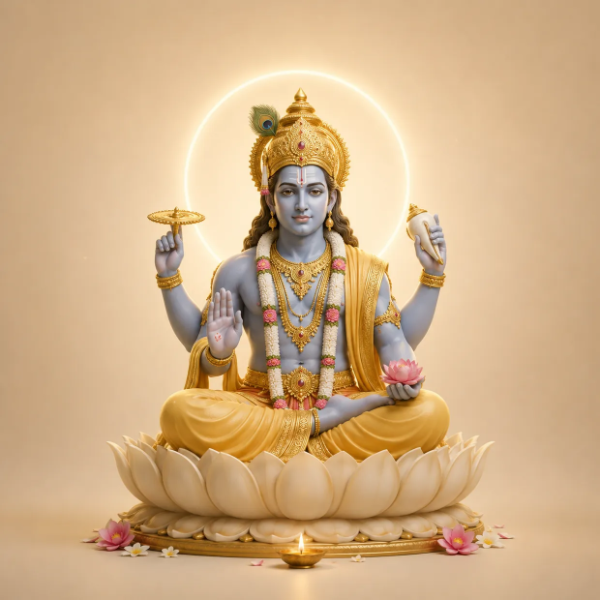
The mantra "Om Namo Narayanaya" translates to "Om, I offer my humble salutations to Lord Narayana." It is a profound expression of reverence and surrender to Narayana, who is Lord Vishnu, the preserver of the universe. Chanting this mantra invokes the cosmic energy and protective grace of the Supreme Being, acknowledging Him as the ultimate source and refuge for all existence. It is a direct invocation of divine connection and an appeal for spiritual guidance.
Benefits & Science
Benefits of Chanting:
The consistent chanting of "Om Namo Narayanaya" cultivates profound spiritual benefits. By focusing the mind on the divine sound vibrations, practitioners often experience a reduction in mental chatter, leading to enhanced inner peace and emotional stability. The mantra's resonance is believed to harmonize the body's energy centers, promoting overall well-being and mitigating stress. Devotees often report a stronger sense of divine protection and guidance, fostering courage and resilience in the face of life's challenges. Over time, regular practice can facilitate purification of karma, deepen one's devotion (Bhakti), and align the individual with higher consciousness, potentially paving the way towards spiritual liberation (Moksha) by dissolving ego and fostering a deep sense of universal oneness. These benefits are cumulative and manifest gradually through sustained practice and genuine devotion.
Scientific Perspective:
From a scientific perspective, chanting "Om Namo Narayanaya" can be seen as a form of auditory meditation. The rhythmic repetition of sacred sounds (mantra) generates specific neural pathways and brainwave patterns, often shifting the brain from a high-frequency beta state to calmer alpha and theta states, associated with relaxation, introspection, and deep meditation. The 'Om' vibration, in particular, is known to stimulate the vagus nerve, which plays a crucial role in regulating the body's parasympathetic nervous system (responsible for 'rest and digest' functions), thereby reducing cortisol levels, lowering blood pressure, and enhancing heart rate variability. The coherent vibrations can also lead to improved neuroplasticity, enhanced focus, and a greater sense of well-being by releasing endorphins and other neurochemicals. This practice acts as a self-regulating mechanism for the mind and body, promoting mental clarity and emotional resilience.
Mythology & Origin
Mantra Origin Saga:
The concept of Narayana is deeply ancient, predating many organized religions. He is depicted in Vedic texts as the primordial being existing before creation, often seen reclining on the cosmic serpent Ananta Shesha, floating on the causal ocean (Kshira Sagara). This represents the state of cosmic dissolution (pralaya) before the universe manifests. The mantra itself is a core Vaishnava prayer, affirming the supremacy and all-pervasiveness of Narayana, who is Lord Vishnu.
Scriptures Mentions:
This mantra finds its roots in various sacred Hindu scriptures including the Yajurveda, where Narayana is glorified. It is prominently featured in the Puranas, especially the Vishnu Purana and Bhagavata Purana, which extensively narrate the glories and avatars of Lord Vishnu. The Narayana Upanishad, a minor Upanishad, is entirely dedicated to this deity. Its significance is also found in the Pancharatra Agamas, which are foundational texts for Vaishnava worship and rituals.
Associated Rishi & Deity:
The primary deity associated with this mantra is Lord Narayana, who is synonymous with Lord Vishnu, the preserver of the universe. While no specific Rishi is credited with its 'discovery' as it is considered a fundamental, eternal sound (anadi), many ancient Rishis and sages, such as Narada, Valmiki, and later acharyas like Ramanujacharya, have meditated upon and propagated its power, emphasizing its role in achieving spiritual liberation and divine grace.
Historical Significance:
The "Om Namo Narayanaya" mantra, often referred to as the Ashtakshara (eight-syllable) mantra, holds immense historical significance as one of the foundational mantras of the Vaishnava tradition. It has been central to the Bhakti movements across India for millennia, inspiring countless saints, poets, and devotees. Philosophers like Ramanujacharya (11th century CE) formalized its role within Vishishtadvaita Vedanta, establishing it as a potent means for salvation and divine communion. Its widespread adoption across various sects and regional traditions underscores its universal appeal and enduring spiritual power in Hindu history.
Frequently Asked Questions (FAQs)
Who is Lord Narayana?
What is the significance of the sound 'Om' in this mantra?
Can anyone chant the Om Namo Narayanaya mantra?
How long does it take to experience the benefits of chanting?
Is using a mala (prayer beads) necessary for chanting?
What does 'Ashtakshara' mean in the context of this mantra?
Can I chant this mantra silently?
Is this mantra associated with any specific festivals?
Mantra Sadhana Guidelines
Best Time to Chant
- Mondays are especially auspicious and beneficial.
- Early morning Brahma Muhurta (4:00 - 6:00 AM) is best.
- Highly fruitful during Pradosh Kaal and Mahashivratri.
- Chant before commencing any auspicious task or ritual.
Other Popular Lord Vishnu Mantras
Other Devotional Categories



Download App
पंचांग तिथि, त्यौहार, व्रत, उत्सव, एकादशी, आरती संग्रह, मंत्र, व्रत कथा