
Om Vishnave Namaha
Explore the profound "Om Vishnave Namaha" mantra: its meaning, spiritual significance, powerful benefits for protection & harmony, scientific basis, and complete chanting guide. Connect with Lord Vishnu's divine energy.
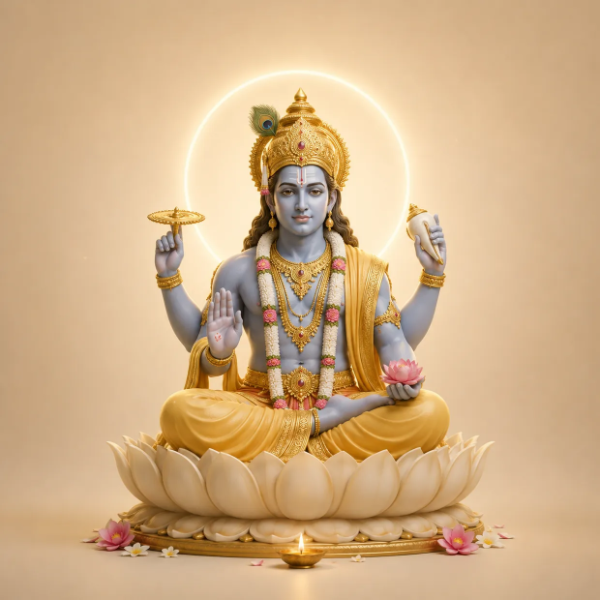
Meaning of Mantra
“Om, I bow to Lord Vishnu.” This mantra is a profound expression of devotion and surrender to Lord Vishnu, the preserver and sustainer of the universe. Chanting "Om Vishnave Namaha" invokes the divine energy of Vishnu, seeking his protection, guidance, and blessings for cosmic order, harmony, and well-being. It acknowledges Vishnu's omnipresence and omnipotence as the supreme being responsible for maintaining dharma and balance in creation, fostering a deeper connection with the divine principle of sustenance.
Benefits & Science
Benefits of Chanting:
Regular chanting of "Om Vishnave Namaha" is believed to foster a deep sense of divine protection, shielding the practitioner from negative influences and obstacles by invoking the protective energies of Lord Vishnu. It cultivates inner peace and mental tranquility by connecting one to the steady, sustaining energy of the cosmos. This mantra can enhance spiritual stability, promoting a harmonious internal and external environment. Many find it beneficial for developing clearer intuition, improving decision-making, and aligning their life path with righteous conduct (Dharma). Over time, consistent practice may lead to a more balanced mind, reduced stress, and an increased capacity for compassion and universal love, gently guiding the practitioner towards holistic well-being and a sense of abundance in all aspects of life.
Scientific Perspective:
Chanting "Om Vishnave Namaha" involves specific phonetic vibrations that resonate within the body and mind. The 'Om' sound, in particular, is a well-researched primordial sound that activates the vagus nerve, which plays a crucial role in regulating heart rate, digestion, and mood. This activation can lead to a 'relaxation response,' shifting the nervous system from sympathetic (fight-or-flight) to parasympathetic (rest-and-digest) dominance. The rhythmic repetition creates a meditative state, inducing alpha and theta brainwave patterns associated with deep relaxation, heightened creativity, and reduced anxiety. The precise articulation of Sanskrit syllables generates subtle energetic patterns that can potentially influence brain chemistry, promoting mental clarity and emotional stability. The focused breath and vocalization during chanting also contribute to improved respiratory function and overall physiological balance, enhancing mindfulness and well-being.
Mythology & Origin
Mantra Origin Saga:
The mantra "Om Vishnave Namaha" is deeply rooted in the ancient Puranic and Vaishnava traditions of Hinduism. It is not attributed to a single origin story but rather emerged as a fundamental form of devotion to Lord Vishnu, whose role as the preserver of the universe has been celebrated since Vedic times. Its simplicity, profound meaning, and potency have made it a cornerstone of Vaishnava worship for millennia, passed down through generations of spiritual aspirants.
Scriptures Mentions:
This mantra and variations of it are widely found in various Puranas, such as the Vishnu Purana, Bhagavata Purana, and Narada Purana, which extensively detail the glories, avatars, and manifestations of Lord Vishnu. It is also alluded to in the Upanishads and several Vaishnava Agamas as a potent means of connecting with the divine, embodying the essence of devotion and surrender.
Associated Rishi & Deity:
While not directly composed by a single sage in a specific instance, this mantra is universally revered by all Vaishnava acharyas, devotees, and spiritual masters. Lord Vishnu himself is the presiding deity, the focus of this devotion. Great sages and devotees like Narada Muni, Prahlada Maharaja, and Dhruva Maharaja are often associated with profound devotion to Vishnu, embodying the spirit and power of this mantra through their lives and teachings.
Historical Significance:
The chanting of Vishnu mantras, including "Om Vishnave Namaha," has been a central practice in India's spiritual landscape for thousands of years. It represents the enduring tradition of Bhakti Yoga (the path of devotion) and played a crucial role in the spread and consolidation of Vaishnavism as a major branch of Hinduism, influencing art, literature, and philosophy across the subcontinent. Its continuous practice underscores its timeless relevance and spiritual efficacy.
Frequently Asked Questions (FAQs)
Who is Lord Vishnu and what is his role in Hinduism?
What is the primary purpose of chanting "Om Vishnave Namaha"?
Can anyone chant this mantra, regardless of their religious background?
How often should I chant this mantra for beneficial effects?
What is the significance of the "Om" syllable in this mantra?
Can chanting "Om Vishnave Namaha" help in overcoming challenges or obstacles?
Are there any specific benefits for mental health when chanting this mantra?
Mantra Sadhana Guidelines
Best Time to Chant
- Mondays are especially auspicious and beneficial.
- Early morning Brahma Muhurta (4:00 - 6:00 AM) is best.
- Highly fruitful during Pradosh Kaal and Mahashivratri.
- Chant before commencing any auspicious task or ritual.
Other Popular Lord Vishnu Mantras
Other Devotional Categories


Download App
पंचांग तिथि, त्यौहार, व्रत, उत्सव, एकादशी, आरती संग्रह, मंत्र, व्रत कथा