
Shantakaram Bhujagashayanam Padmanabham Suresham
Explore the profound meaning, spiritual benefits, and correct pronunciation of Shantakaram Bhujagashayanam, a powerful Lord Vishnu Dhyana Shloka for peace & protection.
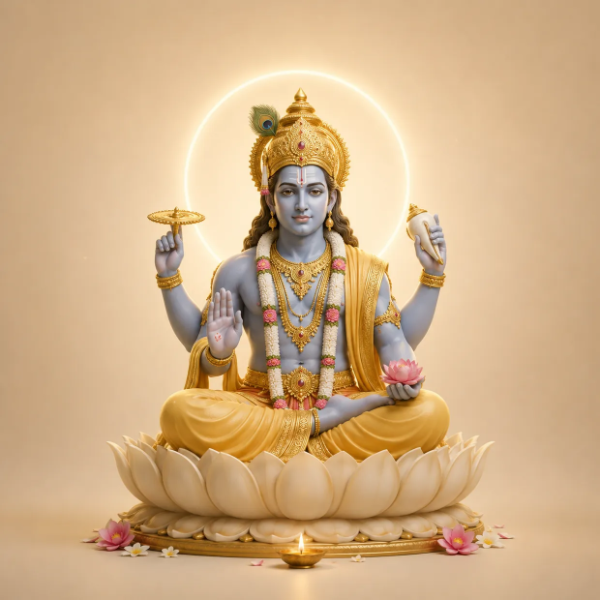
Meaning of Mantra
I bow to Lord Vishnu, whose form is utterly peaceful, who reclines on the great serpent Shesha, from whose navel sprouts a lotus, and who is the Lord of all gods. He is the very foundation of the universe, vast and pervasive like the sky, whose complexion is like that of a monsoon cloud, and whose body is supremely auspicious. He is the beloved consort of Lakshmi, whose eyes are beautiful like lotuses, and who is realized by yogis through deep meditation. I offer my salutations to that Vishnu, who removes the fear of worldly existence (samsara) and is the sole master of all worlds.
Benefits & Science
Benefits of Chanting:
Regular recitation of the Shantakaram mantra cultivates a profound sense of inner peace and tranquility, mirroring Vishnu's serene form. The vibrant vibrations of the mantra are believed to calm the nervous system, reducing stress, anxiety, and deep-seated fears ('Bhavabhayaharam'). Meditating on Vishnu's cosmic attributes enhances spiritual clarity and wisdom, fostering a deeper understanding of one's place in the universe. This mantra aids in elevating meditative experiences, improving focus and concentration by drawing the mind towards the sublime. Devotees often report a protective shield against negative influences and a stronger connection to the divine cosmic energy, leading to a sense of security and well-being. By aligning with the preserving energy of Vishnu, practitioners may experience greater harmony in life, attract auspiciousness, and cultivate a sense of righteousness and dharma, thereby promoting overall prosperity and holistic mind-body balance.
Scientific Perspective:
From a scientific perspective, the rhythmic chanting of mantras like Shantakaram induces a state of mindfulness and physiological coherence. The repetitive sonic vibrations engage the auditory cortex and stimulate the vagus nerve, which plays a crucial role in regulating the body's parasympathetic nervous system, leading to a 'relaxation response.' This can lower heart rate, blood pressure, and muscle tension. The consistent vocalization and mental focus required during chanting can synchronize brainwave patterns, often shifting them from active beta states to more relaxed alpha or even theta states, associated with deep meditation, creativity, and reduced stress. The meditative imagery associated with Vishnu's attributes, such as peace and cosmic expanse, further activates neural pathways related to positive emotions and cognitive restructuring, enhancing emotional regulation and mental resilience. The disciplined practice trains the brain for sustained concentration and emotional equanimity.
Mythology & Origin
Mantra Origin Saga:
This Dhyana Shloka is a classic invocatory verse, not attributed to a single historical sage in its current form, but rather a devotional composition that has become an integral part of Vaishnava worship. It serves as a descriptive meditation (Dhyana) on Lord Vishnu's majestic and serene form, typically recited before major Vishnu mantras or prayers like the Vishnu Sahasranama to invoke the deity's presence and prepare the mind for deeper contemplation. Its timeless nature reflects the devotional tradition passed down through generations.
Scriptures Mentions:
While not found as a standalone mantra in the Vedas, this Dhyana Shloka is prominently featured in the introductory verses (purvabhaga) to the renowned Vishnu Sahasranama, which itself is found in the Anushasana Parva of the Mahabharata. It is also widely used in various Puranas, Smritis, and Hindu ritual texts (Paddhati) as a preparatory verse for any worship dedicated to Lord Vishnu.
Associated Rishi & Deity:
The primary deity associated with this mantra is Lord Vishnu, the Preserver in the Hindu Trinity. While no single sage is credited with its composition in the same way a Rishi is for a Vedic Sukta, its inclusion in the Vishnu Sahasranama is traditionally associated with Vyasa, the legendary compiler of the Vedas and Puranas, who transmitted much of this sacred knowledge.
Historical Significance:
This Dhyana Shloka holds immense historical and cultural significance as a cornerstone of Vaishnava devotional practice. For millennia, it has served as a powerful meditative tool, guiding devotees to visualize Vishnu's divine attributes before commencing any worship or mantra recitation. Its consistent presence in sacred texts and daily rituals underscores its role in shaping the spiritual landscape of Hinduism, fostering devotion, and maintaining the continuity of ancient traditions. It represents a continuous lineage of devotion to the Supreme Lord Vishnu, offering solace and spiritual direction to countless individuals throughout history.
Frequently Asked Questions (FAQs)
What is the primary purpose of chanting the Shantakaram mantra?
Is this mantra suitable for beginners in meditation?
How does chanting this mantra help in reducing fear?
Can women chant this mantra?
What is the significance of Vishnu reclining on Sheshnag (serpent)?
Is it necessary to understand the Sanskrit meaning while chanting?
What role does Lord Vishnu play in the Hindu pantheon?
How can this mantra help with modern-day stress?
Mantra Sadhana Guidelines
Best Time to Chant
- Mondays are especially auspicious and beneficial.
- Early morning Brahma Muhurta (4:00 - 6:00 AM) is best.
- Highly fruitful during Pradosh Kaal and Mahashivratri.
- Chant before commencing any auspicious task or ritual.
Other Popular Lord Vishnu Mantras
Other Devotional Categories


Download App
पंचांग तिथि, त्यौहार, व्रत, उत्सव, एकादशी, आरती संग्रह, मंत्र, व्रत कथा