
Om Narayanaya Vidmahe Vasudevaya Dhimahi Tanno Vishnuh Prachodayat
Explore the profound Vishnu Gayatri Mantra "Om Narayanaya Vidmahe Vasudevaya Dhimahi Tanno Vishnuh Prachodayat". Learn its meaning, benefits, and spiritual significance for enlightenment and inner peace.
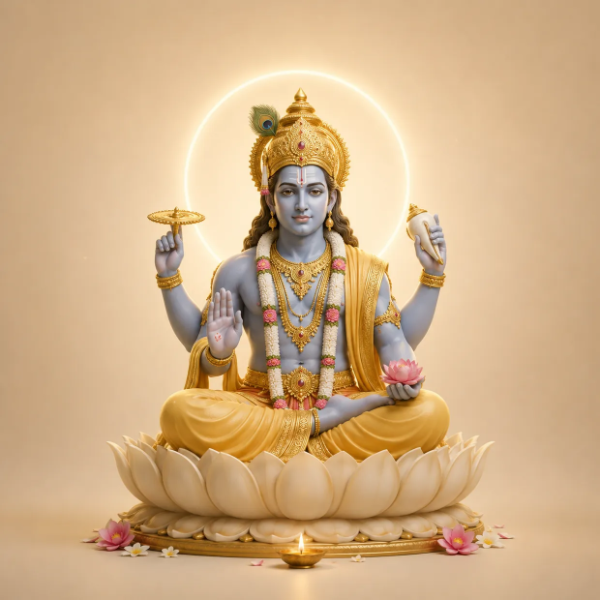
Meaning of Mantra
This profound Vishnu Gayatri Mantra implores the supreme Lord Vishnu, also known as Narayana and Vasudeva, to illuminate our minds and intellect. It signifies a deep meditation on the omnipresent preserver of the universe, seeking divine guidance and spiritual awakening. The chanter expresses a yearning to understand the cosmic truth embodied by Vishnu and requests His grace to steer their intellect towards righteousness and ultimate wisdom. It is a powerful invocation for spiritual clarity and a deeper connection with the divine principle of sustenance and order.
Benefits & Science
Benefits of Chanting:
Chanting the Vishnu Gayatri Mantra regularly is believed to foster profound spiritual growth by aligning the individual's consciousness with the supreme divine. It cultivates inner peace and tranquility, helping to alleviate stress and anxiety, and promoting emotional stability. The mantra is revered for its ability to sharpen the intellect, leading to greater wisdom, clarity of thought, and improved decision-making. Devotees often experience a sense of divine protection, shielding them from negative influences and promoting a positive aura. Consistent practice can deepen one's connection with the divine, fostering a sense of purpose and guiding the chanter towards a life aligned with universal principles of righteousness (Dharma). It is a spiritual tool for overall well-being and the realization of one's higher self.
Scientific Perspective:
From a scientific perspective, mantra chanting involves specific sound vibrations that can positively impact brain activity and physiological responses. The rhythmic repetition and focused attention inherent in chanting can induce a meditative state, characterized by a shift from beta brainwaves to alpha and theta waves, promoting relaxation and enhanced cognitive function. The controlled exhalation during chanting stimulates the vagus nerve, which plays a crucial role in regulating the parasympathetic nervous system, leading to reduced heart rate, lower blood pressure, and a calming effect on the body and mind. The coherent sound patterns of Sanskrit mantras are thought to create resonance within the body's energy centers, potentially harmonizing internal systems and fostering a sense of well-being. This can lead to improved concentration, reduced stress hormones, and a heightened state of mental clarity.
Mythology & Origin
Mantra Origin Saga:
The Gayatri Mantras, including this Vishnu Gayatri, are ancient Vedic hymns dedicated to various deities, seeking illumination and wisdom. While the most famous Gayatri Mantra is dedicated to Savitr, many Puranic Gayatri mantras were composed for different deities to invoke their specific energies. This specific mantra draws from the attributes of Lord Vishnu, emphasizing His Narayana and Vasudeva forms, making it a powerful invocation for His specific blessings. It is a variant of the broader Gayatri tradition, adapted to specifically connect with the Vaishnava tradition's supreme deity.
Scriptures Mentions:
This mantra, or similar forms, can be found in various Puranas, Upanishads (as part of broader Vishnu-related invocations), and devotional literature associated with Vaishnavism. Specifically, many "Devata Gayatri" mantras are outlined in scriptures like the Puranas (e.g., Garuda Purana, Agni Purana) and Tantras, providing specific Gayatri for different aspects of the Divine. Its structure is clearly aligned with the traditional Gayatri meter and intent.
Associated Rishi & Deity:
The primary deity associated is Lord Vishnu. While not attributed to a single Rishi in the same way as the Savitri Gayatri (Vishwamitra), the tradition of composing Gayatri mantras for various deities is ancient and rooted in Vedic scholarship. Lord Vishnu is the preserver of the universe, and the mantra invokes His divine energy in His forms as Narayana (cosmic ocean dweller) and Vasudeva (indweller of all).
Historical Significance:
The chanting of Vishnu mantras and Gayatri variants has been central to Hindu devotional practices for millennia. This mantra signifies the pervasive influence of Vaishnavism and the adoption of the Gayatri framework to worship specific forms of the Divine. Its historical significance lies in its role in fostering devotion to Vishnu, promoting spiritual growth, and preserving the rich tradition of mantra yoga within the vast landscape of Sanatana Dharma, guiding countless devotees towards self-realization and divine connection.
Frequently Asked Questions (FAQs)
What is the significance of "Narayana" and "Vasudeva" in this mantra?
Is this mantra only for Vaishnavites?
How does chanting this mantra influence the mind?
What is the meaning of "Prachodayat"?
Can beginners chant this mantra?
What is the significance of the Gayatri meter in this mantra?
Are there any specific offerings or rituals associated with this mantra?
Mantra Sadhana Guidelines
Best Time to Chant
- Mondays are especially auspicious and beneficial.
- Early morning Brahma Muhurta (4:00 - 6:00 AM) is best.
- Highly fruitful during Pradosh Kaal and Mahashivratri.
- Chant before commencing any auspicious task or ritual.
Other Popular Lord Vishnu Mantras
Other Devotional Categories


Download App
पंचांग तिथि, त्यौहार, व्रत, उत्सव, एकादशी, आरती संग्रह, मंत्र, व्रत कथा