
Priyangu Kalika Shyamam Budha Dhyana Mantra
Unlock sharper intellect and clearer communication with the powerful Budha Dhyana Mantra. Explore its deep spiritual meaning, benefits, and scientific insights for mental clarity and success. #BudhaMantra #Mercury #Intelligence
Meaning of Mantra
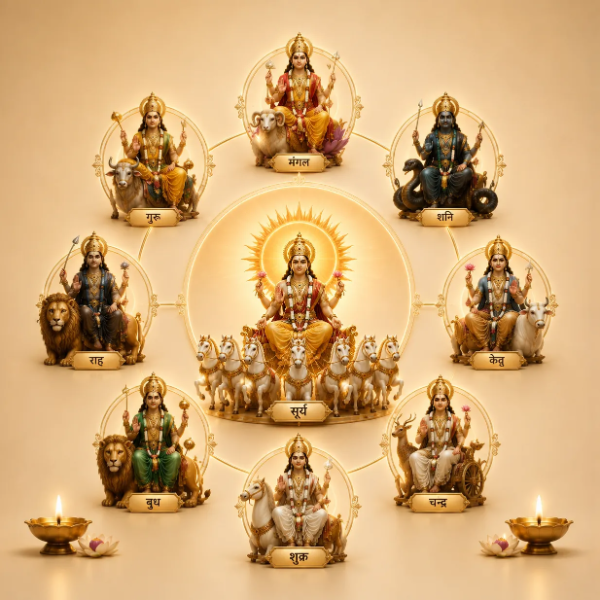
I bow down to Budha (Mercury), who is dark like the bud of the Priyangu flower, possesses an incomparable form, is gentle, and endowed with all auspicious qualities. This mantra is a reverent salutation to the planet Mercury, seeking its benevolent influence for intellectual clarity, effective communication, and overall well-being.
Benefits & Science
Benefits of Chanting:
Regular chanting of the Budha Dhyana Mantra is believed to cultivate a profound sense of mental clarity and focus. It can significantly enhance intellectual capacities, making the mind more receptive to new knowledge and fostering sharper memory retention. Practitioners often report improvements in communication skills, enabling more articulate and persuasive expression, which is invaluable in both personal and professional spheres. The mantra's vibrations are thought to soothe the nervous system, reducing mental agitation, stress, and anxiety. From an astrological perspective, it helps mitigate the adverse effects of an unfavorably placed Mercury in a birth chart, promoting success in education, business, and creative pursuits. It fosters a balanced and serene disposition, leading to greater overall well-being and a more harmonious life.
Scientific Perspective:
From a scientific viewpoint, the rhythmic chanting of mantras like the Budha Dhyana Mantra engages specific brain regions associated with language, memory, and emotion. This repetitive vocalization can induce a meditative state, characterized by alpha and theta brainwave activity, known to promote relaxation, creativity, and enhanced cognitive function. The controlled breathing involved in chanting stimulates the vagus nerve, which plays a crucial role in regulating the body's parasympathetic nervous system, leading to reduced heart rate, lowered blood pressure, and a decrease in stress hormones like cortisol. The precise phonetic vibrations are also theorized to create subtle internal resonance, potentially optimizing neural pathways and improving neuroplasticity, thereby contributing to enhanced intellectual and communication abilities over time. This practice is akin to mindfulness exercises that improve mental focus and emotional regulation.
Mythology & Origin
Mantra Origin Saga:
Budha, the deity of Mercury, has an intriguing origin story in Hindu mythology. He is the son of Chandra (the Moon god) and Tara, the wife of Brihaspati (Jupiter), the preceptor of the Devas. This unusual parentage makes Budha a unique figure among the Navagrahas. When Tara became pregnant by Chandra, a dispute arose between Chandra and Brihaspati, leading to a celestial war. Eventually, Brahma intervened, and Tara revealed Budha's paternity. Due to his mixed parentage, Budha embodies a blend of intuition (Chandra) and intellect (Brihaspati's influence through Tara), making him highly intelligent and adaptable.
Scriptures Mentions:
References to Budha and his characteristics can be found in various Vedic scriptures, Puranas, and astrological texts. The 'Brihat Parashara Hora Shastra', a foundational text of Vedic astrology, elaborately describes the nature, attributes, and astrological significance of Budha. The 'Vishnu Purana' and 'Bhagavata Purana' also narrate the story of Budha's birth and his lineage. Mantras dedicated to Budha, including Dhyana Mantras, are prescribed in various ancient astrological and Tantric traditions for planetary pacification and enhancement.
Associated Rishi & Deity:
The primary deity associated with this mantra is Budha (Mercury). He is often depicted with a green complexion, four arms holding a scimitar, a shield, a mace, and a varada mudra, riding a lion or a chariot drawn by eight horses. He is considered a son figure to Chandra (Moon) and a disciple of Brihaspati (Jupiter) in terms of knowledge. The Rishi associated with the general Navagraha mantras is often mentioned as Rishi Parashara or Rishi Kashyapa, who contributed significantly to Vedic astrology.
Historical Significance:
Historically, the worship of Navagrahas (nine planets) has been an integral part of Hindu astrological and religious practices for millennia. Budha, as one of these crucial celestial bodies, has always been revered for his influence on intellect, communication, education, and trade. Ancient Indian treatises on statecraft, such as Kautilya's 'Arthashastra,' indirectly highlight the importance of advisors and communication, which align with Budha's significations. Chanting Budha mantras has been a traditional method for scholars, merchants, and orators to enhance their respective skills and overcome challenges, symbolizing the continuous human endeavor to align with cosmic forces for success and well-being.
Frequently Asked Questions (FAQs)
Who can chant the Budha Dhyana Mantra?
What is the best time to chant this mantra?
Are there any dietary restrictions while chanting?
Can this mantra help with academic success?
What are the common astrological effects of a weak Mercury?
Is it necessary to use a mala for chanting?
How long should one chant this mantra to see results?
Can children chant this mantra?
Mantra Sadhana Guidelines
Best Time to Chant
- Mondays are especially auspicious and beneficial.
- Early morning Brahma Muhurta (4:00 - 6:00 AM) is best.
- Highly fruitful during Pradosh Kaal and Mahashivratri.
- Chant before commencing any auspicious task or ritual.
Other Popular Navgrah Mantras
Other Devotional Categories




Download App
पंचांग तिथि, त्यौहार, व्रत, उत्सव, एकादशी, आरती संग्रह, मंत्र, व्रत कथा