
Om Dasharathaye Vidmahe Sita Vallabhaya Dheemahi Tanno Ramah Prachodayat
Unlock the divine power of Rama Gayatri Mantra. Explore its deep spiritual meaning, profound benefits for inner peace, clarity, and righteousness. A complete chanting guide for spiritual growth.
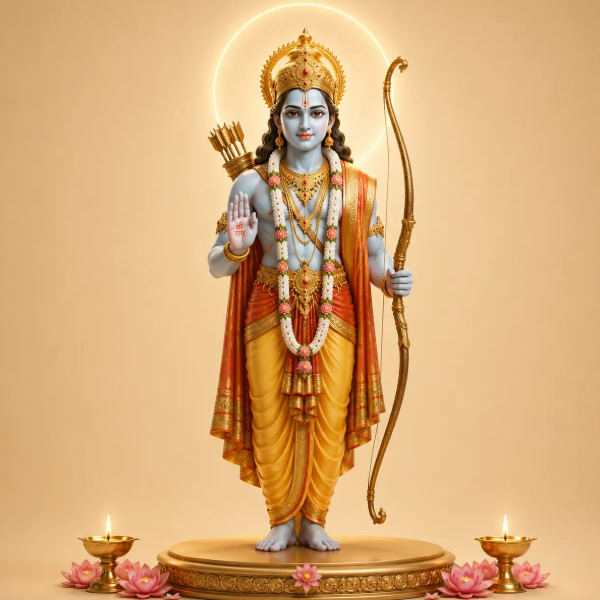
Meaning of Mantra
Om. We know and meditate upon the son of Dasharatha, and on the beloved of Sita. May that Lord Rama inspire and illuminate our intellect with divine wisdom and righteousness.
Benefits & Science
Benefits of Chanting:
Regular chanting of the Rama Gayatri Mantra has a profound impact on one's psychological and spiritual well-being. The rhythmic vibrations help in calming the mind, reducing mental chatter, and fostering a sense of inner peace. This cultivation of tranquility can lead to improved mental clarity, aiding in better decision-making and problem-solving. Spiritually, it acts as a conduit for connecting with the higher self, promoting ethical conduct, and strengthening one's resolve to live a life aligned with dharma. The mantra's resonance is believed to activate specific energy centers, potentially leading to emotional balance, reduced stress levels, and a subtle protective aura that naturally deflects negative influences by cultivating positive internal states.
Scientific Perspective:
From a scientific standpoint, chanting the Rama Gayatri Mantra involves rhythmic vocalization and repetition, which can induce a meditative state. This practice has been shown to slow down brainwave frequencies from beta to alpha or even theta states, associated with relaxation, heightened creativity, and improved focus. The vibrational sounds stimulate the vagus nerve, which plays a crucial role in the parasympathetic nervous system, leading to a 'rest and digest' response that reduces stress, lowers heart rate, and promotes a sense of calm. The coherent sound patterns can also create a resonance within the body's cellular structure, potentially optimizing physiological functions and fostering a sense of well-being through neurochemical releases like endorphins and oxytocin, known for mood enhancement and bonding.
Mythology & Origin
Mantra Origin Saga:
While the core Gayatri Mantra is attributed to Sage Vishwamitra, specific 'Gayatri' mantras dedicated to various deities, like the Rama Gayatri, emerged in later Puranic and Smriti traditions. These mantras retain the Gayatri meter and structure (24 syllables, three padas) but invoke the essence and form of a particular deity. The Rama Gayatri distills the divine attributes of Lord Rama, making his spiritual essence accessible for meditation and invocation.
Scriptures Mentions:
The principles and qualities of Lord Rama are extensively detailed in the Valmiki Ramayana, the Adhyatma Ramayana, and various Puranas (like Skanda Purana, Brahmanda Purana). The concept of Gayatri mantras for various deities, including Rama, is found in later Vedic texts and Smriti literature, solidifying their place in devotional practices.
Associated Rishi & Deity:
The primary deity is Lord Rama, the seventh incarnation of Vishnu, revered as Maryada Purushottam (the ideal man). Sita, his consort and the embodiment of purity and sacrifice, is also invoked as 'Sita Vallabhaya' (beloved of Sita), highlighting their divine union. While not directly linked to a specific sage's creation like the original Gayatri, its spirit aligns with the wisdom imparted by revered Vedic seers.
Historical Significance:
The Rama Gayatri Mantra is deeply significant in the Bhakti (devotional) tradition, particularly for followers of Lord Rama. It emerged as a powerful tool for personal devotion, enabling devotees to connect with Rama's virtues and seek his guidance. Historically, it reinforced the cultural and spiritual values of Dharma, righteous leadership, and familial duties that Rama epitomized, serving as an enduring source of moral and spiritual inspiration across generations in India.
Frequently Asked Questions (FAQs)
What is the Rama Gayatri Mantra?
Who is Lord Rama in Hindu mythology?
What are the primary benefits of chanting the Rama Gayatri Mantra?
Can anyone chant the Rama Gayatri Mantra, regardless of their religious background?
What is the significance of 'Sita Vallabhaya' in the mantra?
How often should I chant the Rama Gayatri Mantra for maximum benefit?
What does 'Prachodayat' signify in the mantra?
Are there any specific mudras or postures recommended for chanting this mantra?
Mantra Sadhana Guidelines
Best Time to Chant
- Mondays are especially auspicious and beneficial.
- Early morning Brahma Muhurta (4:00 - 6:00 AM) is best.
- Highly fruitful during Pradosh Kaal and Mahashivratri.
- Chant before commencing any auspicious task or ritual.
Other Popular Lord Shri Ram Mantras
Other Devotional Categories


Download App
पंचांग तिथि, त्यौहार, व्रत, उत्सव, एकादशी, आरती संग्रह, मंत्र, व्रत कथा